
Digital ID: Reasons to Reject The New Digital Domesday | Essential Guide
Everything You Need to Know About Digital ID – 14 Oct 2025 | HelioWave
The New Digital Domesday Book – 9 Aug 2025 | Sam William
RFK JR Speaks Out About Digital ID
Digital ID is a Complete Scam -29 Sept 2025 | Count Dankula
FINAL WARNING: Dr Mike Yeadon Interview – 3 Jul 2025 | Oracle Films
Digital ID Is The Hill To Die On – 7th Oct 2025 | Jerm Warfare
Jerm and Iain Davis chat about the implications of digital identity systems, especially the UK’s proposed BritCard.
US Is Quietly Rolling Out Digital ID | Miles Harris
Digital ID, sold as a revolution in convenience, one login for every government service, immediate bank verification, no need for multiple passwords. Digitisation, efficiency, progress and a means to combat crime and illegal working. Yet as many are aware, the real story is that the same system that promises frictionless access also holds the power to silently lock you out from your job, your bank account, travel and even healthcare. You see, with digital ID, one digital credential becomes the gatekeeper to daily life.
WELCOME TO BABYLON… – 11 Oct 2025 | The Truth is Stranger Than Fiction
Reasons to Reject
Digital ID: Psychological Control Through Data Domination
The New Digital Domesday Book masks total surveillance as progress, embedding fear and control into a centralised Digital ID system, enabling unprecedented surveillance and manipulation disguised as progress. The threat to human freedom is stronger than ever before.
In an age where technology promises convenience and efficiency, a darker reality lurks beneath these alluring veneers. The rollout of Digital ID systems worldwide signals not progress, but a looming digital panopticon—where every citizen’s identity, behaviour, and even beliefs can be monitored, controlled, and manipulated. What began as a trial in Somaliland is now poised to reshape governance in the United Kingdom, embedding unprecedented surveillance under the guise of security and modernisation.
The_Void unpacks the New Digital Domesday Book—an all-encompassing digital identity system cloaked in fear and propaganda—and exposes its role as a weapon of psychological warfare, social engineering, and total societal domination. At the same time, the expansion of Automatic Voter Registration marks yet another step toward a future where individual autonomy fades into a centralised, data-driven regime of control. Understanding this digital web is essential, for the story machine thrives on our forgetting. Will we remember and reject before it’s too late?

“Every right that you have is transformed into a privilege contingent upon your obedience to arbitrary government dictates. It will make you a slave. What do we do? We resist!”
– RFK JR
This article features a selection of videos in the tabs above that delve deeply into the risks and realities of digital identity systems. Scroll through videos to explore how digital IDs, far from being simple tools of convenience, serve as instruments of surveillance, data centralisation, and control.
Control Grid Forms
The Agenda: A Seamless System of Surveillance, Obedience, and Control
Cloaked in the warm and fluffy language of promoting just, peaceful, and inclusive societies, Digital ID is part of the Agenda 2030 Sustainable Development Goals. Specifically, Target 16.9 of the SDGs aims to provide legal identity for all, including birth registration, by 2030. National Digital Identification Systems are being developed all over the world to ensure that everyone has a legal and digital identity, which supports various authoritarian sustainable development objectives such as social inclusion, access to services, and economic participation. Digital ID is considered a crucial enabler for achieving multiple SDGs by ensuring individuals have recognised legal identity, facilitating access to rights and services. The result: total surveillance, obedience, and control.

The Somaliland Trial
A Digital Laboratory
Somaliland‘s trial acted as a testing ground for this ambitious digital ID, which began in early 2025 with support from the World Bank. Platforms such as Hubiye for real-time identity verification, e-Aqoonsi—a mobile digital ID app—and a Certificate Delivery System streamlined official documentation issuance.
By September 2025, the digital ID became mandatory for passport applications, expanding to domestic travel, banking, and transport licensing by January 2026. Mass registration pilots in districts like Shangani and Boondheer paved the way for city-wide expansion, with millions expected to enroll by 2029.
Crucially, this success hinges as much on social engineering as technology—conditioning citizens to accept pervasive surveillance as a gateway to opportunity. Many Somalis now see the digital ID as essential for accessing formal employment, banking, and public services—privileges previously beyond reach without recognised ID.
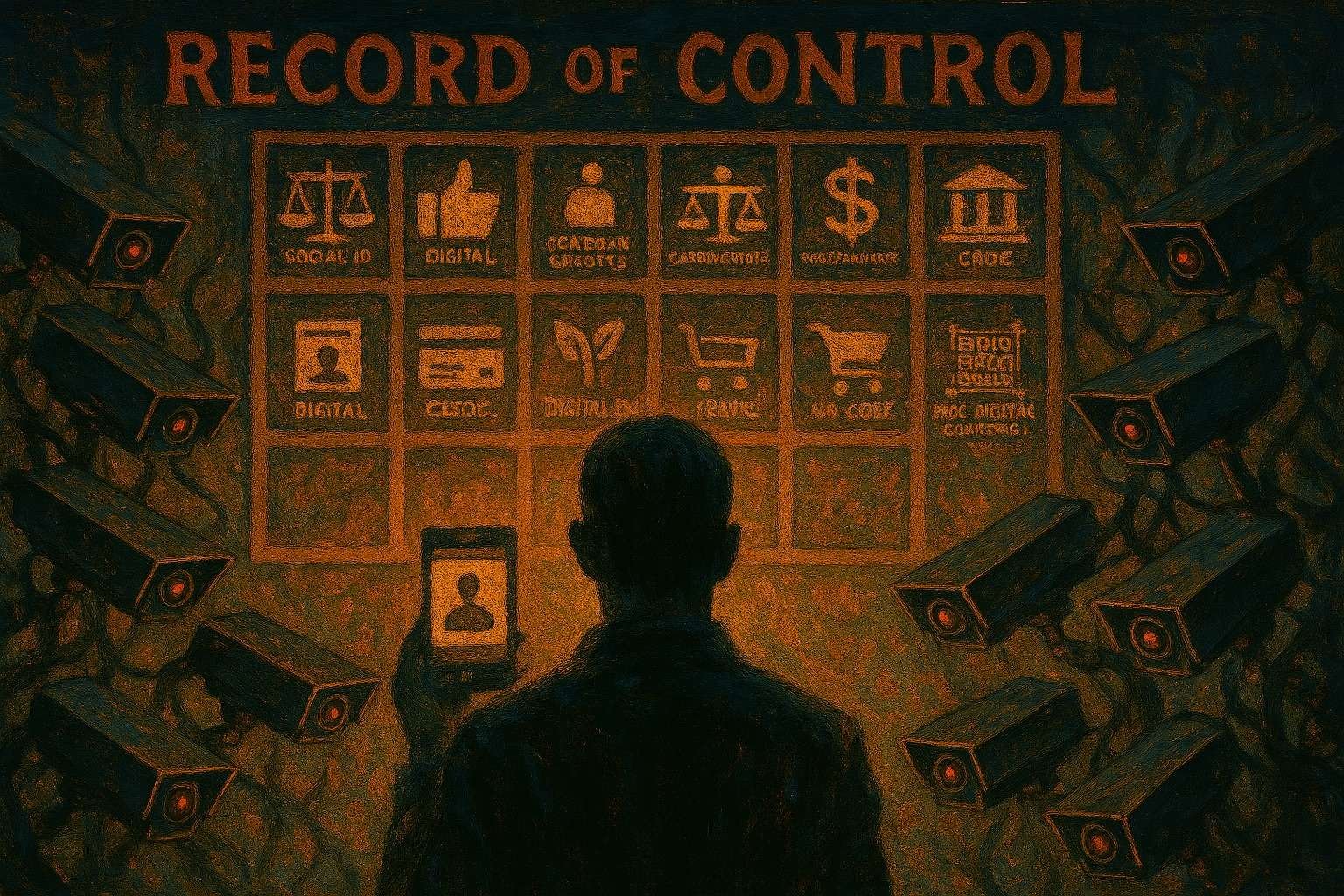
Record of Control
The Invisible Chains of Surveillance and Compliance
The original Domesday Book was an instrument of Norman England’s dominance—a detailed census to enforce control. This “New Digital Domesday” is its modern, far more intrusive incarnation. The regime’s ambition is a centralised database housing every citizen’s personal, financial, social, and behavioural data. This follows the classic Hegelian Dialectic—Problem, Reaction, Solution:
Problem: Manufactured crises and stoked fears of lawlessness and instability. The Somaliland trial was an experiment in normalising mass data capture among vulnerable populations, cloaked as development aid.
Reaction: Through propaganda and social engineering, public consent was secured for this surveillance under the guise of security and protection from foreign threats. The digital ID was spun as empowerment and good governance, masking its true function as a monitoring and control tool.
Solution: Total data domination enabling real-time surveillance, predictive policing of dissent, and finely honed propaganda to sustain social compliance. Feeling perpetually observed, resistance erodes, and the puppeteers remain unseen and unchallenged.
For readers, aware of the hidden forces steering world events, the greatest threat to their parasitic psychopathy is collective memory and awareness. The New Digital Domesday challenges the very notion of freedom, rewiring identity into a system of control.
“Most men and women will grow up to love their servitude and will never dream of revolution.”
— Aldous Huxley
Digital Resistance
The Crucial Battle Against Totalitarian Control
Digital IDs form the cornerstone of a creeping totalitarian regime. Disguised as progress, these systems enable unprecedented surveillance and behavioural control, linking individuals to data points within a digital panopticon.
Alongside social credit systems, carbon credits, and programmable Central Bank Digital Currencies (CBDCs), Digital IDs underpin a structure designed to enforce obedience. While the story machine promotes narratives of convenience and security, the reality is stark: these are instruments of psychological warfare shaping behaviour and trimming autonomy.
Digital ID in the UK
The Excuse for Enslavement
On 26 September 2025, UK Prime Minister Keir Starmer announced the rollout of mandatory Digital IDs to curb illegal immigration and fight climate change. Starmer portrayed the scheme as an “enormous opportunity” for national security and streamlined access to services like jobs, childcare, and welfare.
“You will not be able to work in the United Kingdom if you do not have Digital ID.”
– Keir Starmer – September 2025
Yet, beneath these justifications lies a darker truth. The crises invoked are exploited as smokescreens to justify digital control. This initiative fits neatly into the Problem-Reaction-Solution framework, masking invasive surveillance as modern governance.
The Digital ID will link each person to a constantly monitored digital profile, centralised under state control and stripped of privacy under the pretext of security. The language of protection cloaks the erosion of autonomy and sets the stage for an Orwellian reality demanding resistance.
Entrenchment Timeline
Step-by-Step Implementation of Total Control
The push for digital identity systems and automatic registration mechanisms has deep political and commercial roots extending over decades. Key figures like Tony Blair championed early moves toward state-led identity verification and data centralisation, advocating for digital “modernisation” as a path to social control framed as progress. Influential leaders such as Bill Gates and Klaus Schwab, alongside institutions like the United Nations and the World Economic Forum, have been instrumental in advancing this agenda. The WEF’s promotion of the Fourth Industrial Revolution and the Great Reset has positioned digital identity at the core of a transformative governance model, emphasising seamless integration of digital identity in world economic, social, and political systems under the guise of innovation and sustainability.
- 1992: Agenda 21 adopted at the UN Earth Summit, emphasising sustainable development and world governance frameworks, which laid groundwork for future digital identity initiatives.
- 1997–2000: Tony Blair promotes biometric IDs and national identity schemes in the UK.
- 2010: UK scraps physical ID cards amid privacy concerns.
- 2015: UN launches Agenda 2030 Sustainable Development Goals (SDGs), with Goal 16.9 specifically targeting universal legal identity for all by 2030, pushing states toward digital ID systems.
- 2016: WEF launches the “Fourth Industrial Revolution” concept, emphasising the fusion of physical, digital, and biological systems, with digital identity as a key pillar.
- 2018: WEF introduces the “Great Reset” framework, promoting a comprehensive restructuring of economies, institutions, and governance, with digital identity central to the transition.
- 2023: WEF publishes “Reimagining Digital ID,” promoting decentralised digital identity as foundational to trust, privacy, and the digital economy.
- Early 2020s: Digital identity systems grow quietly amid surveillance expansion.
- 2024: WEF launches the Connected Future Initiative under its Centre for the Fourth Industrial Revolution, aiming to establish global Digital Public Infrastructure including digital ID, biometric authentication, and secure data exchange.2024: Political pressure mounts on immigration and security fronts.
- Mid-2025: UK Labour government under Keir Starmer announces compulsory digital ID and AVR.
- September 2025: “Brit Card” proposal unveiled, sparking public backlash and explosive petition growth.
- Present: Government pushes to legislate despite overwhelming opposition, touting it as modern governance necessity.

“The regime wants to keep track of everyone. They also want you to have something needed to access certain institutions or services in society–this is your society card. You need this to take part in society. If you do not think right, or you do things the regime doesn’t like, they will switch off your card and ban you from using certain services–until you start acting right. IT’S ALL ABOUT CONTROL.”
Count Dankula – Digital ID is a Complete Scam
What Digital ID Looks Like in Practice
Enmeshed in the All-Seeing Grid of Surveillance and Obedience
The UK’s Digital ID system will primarily be a smartphone app, resembling the NHS app or mobile banking wallets, containing biometric-verified personal details like name, birth date, nationality or residency status, and a photograph.
Mandatory for employment verification, it replaces systems like the National Insurance number. Employers must verify the right to work through the app, controlling access to the labour market. This digital identity becomes the gatekeeper for employment, healthcare, welfare, driving licences, childcare, and government service access.
This digital ID interfaces with broader social control systems—social and carbon credits rate behaviour and enforce compliance, while programmable CBDCs will regulate how money is spent, controlling financial freedom.
Together, these systems form a digital leash: identity monitored, behaviour scored, economic agency regulated. This sophisticated regime enforces obedience through relentless surveillance and automated control.
The promised convenience obscures a dystopian reality where freedom is conditional, privacy surrendered, and identity becomes a tool for control rather than a right.
Expansion into the Corporate Sphere
Beyond government services, Digital ID is rapidly positioning itself as a mandatory gateway for corporate inclusion, epitomising modern fascism. With the scope, reach, and capabilities of Digital ID, it doesn’t take much to imagine a world where every move, transaction, and behaviour is monitored and controlled in real time. This digital gaze will follow individuals from government services into the corporate sphere, erasing boundaries between state and business oversight.
- Employment, banking, and even basic commercial transactions require real-time verification via a centralised digital ID system.
- Corporations link Digital ID profiles with social credit scores, deciding access to jobs, loans, housing, travel, food, clothing, and services based on compliance with behavioural norms.
- Programmable CBDCs restrict spending based on carbon credit allowances or social credit “ratings,” enforced automatically through digital wallets tied to one’s ID.
- Businesses refuse service or employment unless Digital ID-linked biometric authentication and compliance histories meet their corporate policies.
- Data sharing between government and private sector creates a fused surveillance state, where dissent or “non-compliance” results in economic and social exclusion orchestrated by corporate and state actors alike.
This wraps citizens in a suffocating digital chains where identity, behaviour, and economic survival are policed by a seamless state-corporate apparatus. This fusion of public authority and private power via Digital ID and accompanying systems represents the apex of a fascist surveillance and control regime—privacy is extinct, autonomy a distant memory, and freedom a privilege dolled out by the all-seeing data masters.
This is the digital panopticon—where identity is not just verified but weaponised to enforce submission under a seamless fascist regime of state-corporate domination.
“Digital ID is the key that unlocks the door for everything else that follows. It’s important to understand that the systems are already in place to go operational once that door is opened… We are looking at a very draconian behavioural control system that is going to control everything we do.”
– Iain Davis – Digital ID Is The Hill To Die On

Automatic Voter Registration (AVR):
Expanding the Digital Grip
Adding another layer to this digital control matrix, the UK Labour Party plans to introduce Automatic Voter Registration (AVR) ahead of the next general election. This system will automatically enrol eligible voters onto the electoral register without requiring application, using government databases such as those from the Department for Work and Pensions (DWP). Newly enfranchised voters, including those aged 16 and 17 (following the planned reduction in voting age), will also be registered automatically.
While presented as a measure to increase democratic participation and simplify registration, AVR clearly aligns with the broader strategy of data centralisation and social engineering. Automated registration reduces individual agency over voter inclusion and links seamlessly with the Digital ID system, strengthening government control over political engagement. This further interweaves identity, civic participation, and surveillance, tightening the digital chains binding citizens.
Similar to how digital ID integrates with social and carbon credit systems, AVR functions as a tool to streamline population monitoring and enforce compliance, normalising the surrender of personal data and autonomy in the name of governance efficiency. It extends the regime’s reach directly into the heart of democracy, consolidating power behind layers of data-driven control.
Beneath the Veneer
Exposing the Hidden Reality of Digital IDs
What many once dismissed as paranoia is now tangible reality. Digital ID implementation is a planned move in ongoing psychological warfare, embedding surveillance deeper under the facade of modernisation.
The story machine manipulates perception to lull the public into complacency, disguising digital ID as harmless innovation, while it transforms citizens into obedient data points whose lives can be tracked, predicted, and controlled.
This escalation of control demands vigilance. The agenda isn’t public service enhancement but fortifying a digital leash enabling predictive behavioural control and identity standardisation.
Mass Surveillance and Control
The mandatory digital ID is a linchpin in the totalitarian push threatening personal freedoms. Despite significant public rejection, the government presses ahead, linking identity verification to access to work and services. This move lays the groundwork for unprecedented mass surveillance and behavioural control.
Rejecting Totalitarianism
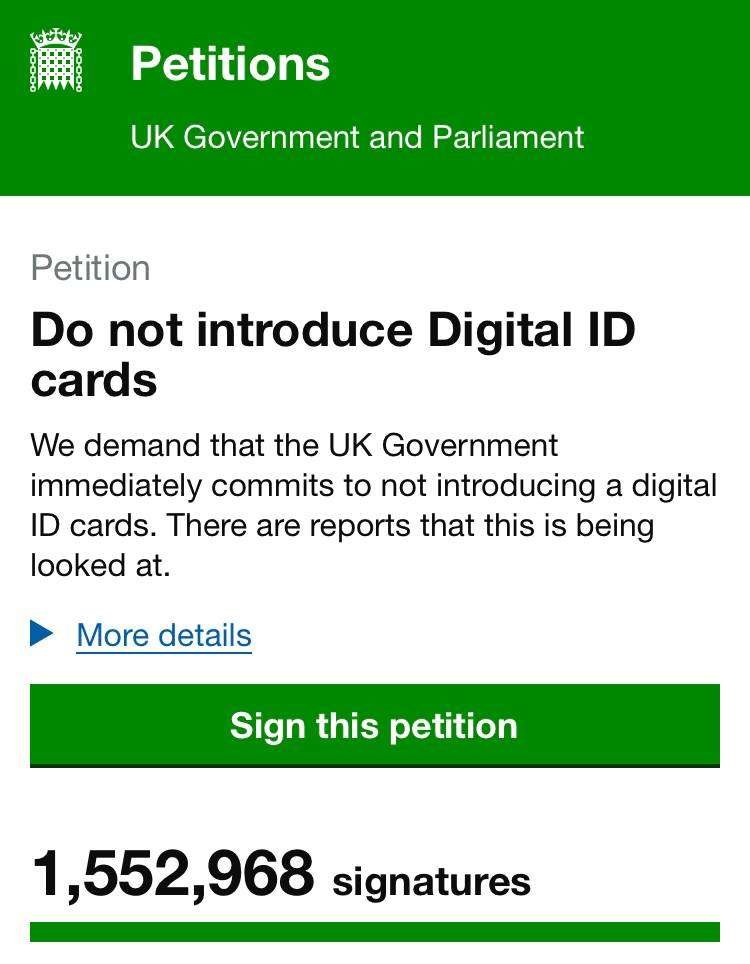
Public resistance is swelling. A UK petition titled “Do not introduce Digital ID cards” amassed over 1.5 million signatures in under 24 hours—growing faster than any petition in recent history, signalling deep public unease. This groundswell rejects the dystopian path digital ID represents. Sadly, petitions are just a way to get the government to tell you no a second time.
Digital ID is less a convenience than a tool of subjugation and surveillance, aimed at behavioural control under the guise of security and efficiency. Awareness and resistance are essential to preserving autonomy against this advancing digital panopticon. The fight to reject digital IDs is truly a frontline in rejecting creeping totalitarianism in the digital age.

Rejecting Technocratic Tyranny
Stand Firm Against Digital Domination
As the UK government moves forward with mandatory digital ID rollout, it is crucial for citizens to understand their rights and the broader implications of this technological shift. The most important safeguard currently enshrined in law is found in Section 74 of the Digital Economy Act 2017, which states:
“(1) A participating relying party must not, as a condition of providing a service or access to a service, require an individual to create or use a digital ID.”
Section 74 of the Digital Economy Act 2017
This means no individual should be forced to create or use a digital ID simply to access essential services. Yet, the growing dependence on digital identity systems for everyday activities risks normalising surveillance, data centralisation, and loss of autonomy.
The introduction of digital IDs under the guise of convenience and security masks a dangerous slide toward technocratic control. Citizens must reject this encroachment to protect fundamental freedoms, privacy, and democratic rights. Vigilance, public awareness, and collective action are essential to stopping the digital chains tightening around society.
Refuse to be reduced to a data point in a centralised system.
Stand up for freedom.
Reject digital domination.
Digital ID in The_Void:
They All Said the Same Thing… You Just Didn’t Notice | Video Advice
Davos 2026: Everything You Need to Know in Under 15 Minutes | HelioWave
Hindsight 2020 | Eric Dubay
CBDC: The End of Money | Big Picture
Everything You Need to Know About COP30 | HelioWave
Problem Reaction Solution: Mass Biometric Video Analytics | Sam William
Sources and links
Digital Economy Act 2017 – legislation.gov.uk
New Digital ID Scheme Announced in the UK
What is the plan for digital IDs and will they be mandatory?
Is 2025 the Year of Digital ID in the UK?
New digital ID scheme to be rolled out across UK
New digital ID will be mandatory to work in the UK
Britain to introduce compulsory digital ID for workers
UK Government Announces Mandatory Digital ID Scheme
Do not introduce Digital ID cards – Petitions
Somalia kicks off mass digital ID registration drive – Biometric Update
Federal Republic of Somalia launches mass registration drive for its Digital ID – World Bank Blog
Somalia expands national digital ID use cases to meet 15M issuance target by 2029 – Biometric Update
Somalia Launches Three Digital ID Systems to Modernize National Identity – IDTechWire
Source: Digital ID: The New Digital Domesday Book | Sam William

























Leave a Comment
Want to join the discussion?Feel free to contribute!