
STORM | GENER8ION
Storming the System
From Revolt to Unity
From schoolyard revolt to choreographed unity, GENER8ION and Yung Lean’s “STORM” and “STORM II” trace how defiance can become belonging.
Romain Gavras’s seven-minute film follows Yung Lean through a bleak British boys’ school, where intimidation, vandalism and adolescent disorder give way to a tightly choreographed collective movement. Bringing together the tracks “STORM I” and “STORM II,” it moves from a portrait of a school in turmoil to a vision of its students acting in unison.
Set in Leeds in 2034, the film’s world feels heightened but familiar. Uniforms, corridors and assembly spaces evoke institutions built around routine and rank; graffiti and broken furniture suggest that routine has stopped holding. Lean plays a disruptive, intimidating pupil who commands attention—and, for a time, the other boys.

The Language of Defiance
The first movement presents rebellion as spectacle. Fights and destruction fill the school, while a contest emerges over who gets to define disorder: the institution that sets the rules, or the pupil who breaks them.
The lyrics sharpen that sense of threat with jagged phrases such as “death wish”, “hit list” and “blacklist”. Repeated commands to “run” suggest pursuit and imminent danger, while the refrain about standing for something frames commitment as a test of courage. The effect is confrontational, but deliberately ambiguous.
From Disorder to Unity
“STORM II” shifts the emotional register. Menace gives way to promises of endurance and closeness: “We stay united through the storm” and “I never fall, I’m standing tall”. Repetition remains central, but now it works less like an alarm than a chant, binding voices into a shared rhythm.
That togetherness is not uncomplicated. Love is compared to a drug, the relationship is described as painful, and the reassurance that “it won’t last forever” sits alongside the insistence on staying together. The tension gives the anthem its psychological charge: attachment can sustain, but it can also be difficult to leave.
Choreography and Control
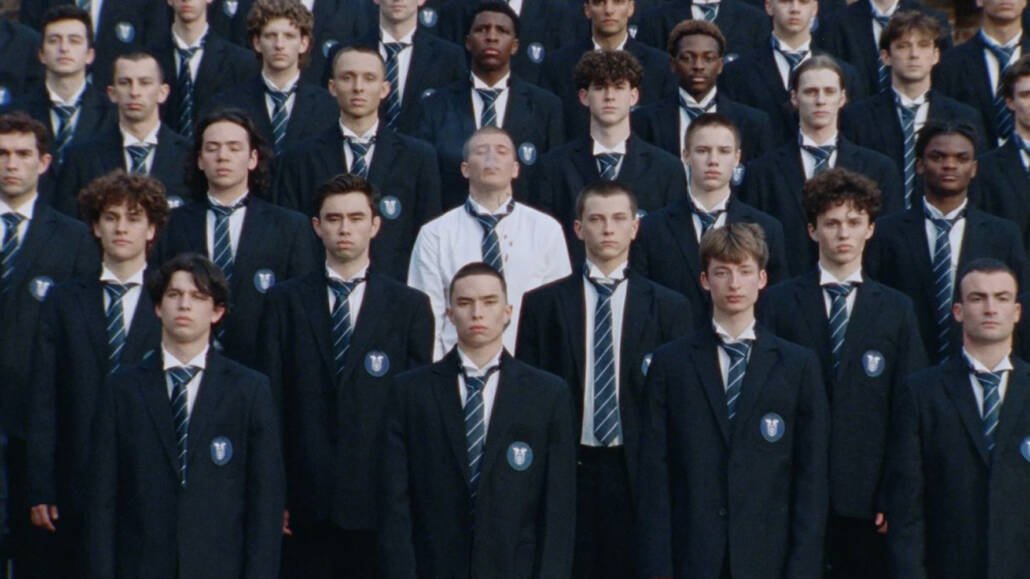
The visual language changes with the music. The students first assemble in a graduation-style group portrait, then break into a carefully coordinated dance around Lean. Choreographed by Damien Jalet, the sequence transforms a crowd of isolated figures into a synchronised body. Where movement once suggested friction and threat, it now becomes expressive and shared.
Yet the film does not resolve its tension by restoring order. It replaces one image of control with another: the bully’s command gives way to the choreography’s precision. The students are no longer simply resisting the institution, but neither do they appear entirely free of direction. Their collective movement is beautiful, disciplined and unsettling.
That is the film’s central provocation. It asks how images make power feel natural: the lone figure who dominates a room, the crowd that follows a rhythm, the institution that makes hierarchy seem inevitable. “STORM” shows how quickly disorder can be recast as solidarity.
Source: STORM starring Yung Lean | GENER8ION

Leave a Comment
Want to join the discussion?Feel free to contribute!