

The Committee of 300 | The Underclass
Silent Architecture
Engineered Narratives And Psychological Influence Systems
The Committee of 300 – 19 Aug 2023 | The Underclass
Narratives shape perception, guiding public attention through emotional distraction, curated conflict, and soft coercion, sustaining an illusion system where influence is internalised rather than openly imposed.
In discussions of modern power structures, it is increasingly difficult to ignore the role of narrative construction as a tool of control. Political theatre, media cycles, and cultural flashpoints often appear spontaneous, yet their consistency suggests a more deliberate architecture. The Underclass podcast approaches this landscape not as a series of isolated events, but as a coordinated system of influence—one that operates primarily through perception rather than overt force.
At the centre of this interpretation sits the idea of an enduring network of shadow coordination, frequently associated with names such as the Committee of 300, the Club of Rome, the Frankfurt School, the Tavistock Institute, and the Trilateral Commission. Whether viewed as formal institutions or symbolic representations of overlapping interests, these entities are custodians of long-term strategic direction across finance, governance, media, and defence. The precise boundaries between them are less important than the shared implication: that influence is consolidated, not dispersed.

The most effective control is not imposed—it is internalised. Rather than relying on overt coercion, influence is exerted through emotional priming, narrative framing, and the careful management of attention. Public discourse is saturated with emotionally charged issues that divide, distract, and exhaust. In this environment, the individual becomes less capable of identifying underlying structural shifts, as cognitive bandwidth is consumed by reactive engagement.
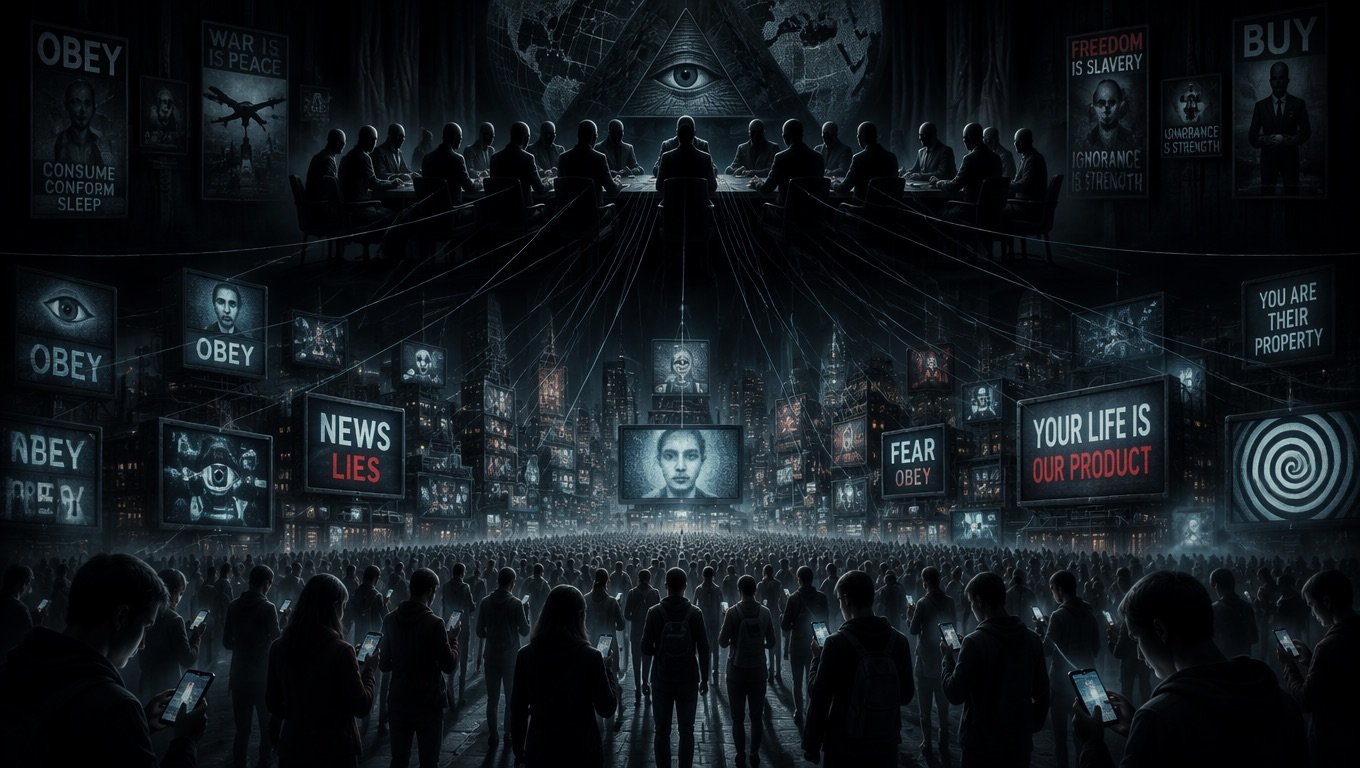
One illustrative example lies in the cyclical amplification of cultural conflict. Seemingly organic disputes—whether political, social, or ideological—are often elevated to a level of urgency that eclipses material concerns such as economic restructuring or institutional consolidation, their prominence is strategically curated. The result is a feedback loop: outrage generates engagement, engagement reinforces visibility, and visibility shapes perceived reality.
Another mechanism is the cultivation of authority through expertise. Institutions associated with behavioural science, particularly those linked to mid-20th-century research into group psychology and mass persuasion, have contributed frameworks that remain highly relevant. The Tavistock Institute, for instance, is frequently cited in discussions of applied social psychology, particularly in how environments and narratives are structured to guide collective behaviour without overt awareness, the principle is well established: people respond predictably to carefully designed stimuli.
The concept of “soft power through implicit coercion” is central here. Unlike traditional forms of domination, which rely on visible force, this model operates through incentives, norms, and perceived consensus. Individuals are nudged toward conformity not because they are compelled, but because deviation appears socially or psychologically costly. Over time, this creates a self-reinforcing system in which the boundaries of acceptable thought narrow without the need for explicit enforcement.
These dynamics are part of a larger story machine—a system whose primary function is to maintain the illusion of spontaneity and decentralisation. Within this framework, political actors are less autonomous agents and more intermediaries, translating broader strategic aims into palatable narratives. Their emotional appeals, while often perceived as genuine, serve a functional purpose: to anchor public attention at the surface level.
What emerges is a convergence of interests that benefits from opacity. The language of coordination may vary—whether one speaks of committees, think tanks, or informal networks—but the effect remains consistent: a managed environment in which perception shapes reality, and reality, in turn, reinforces perception.
For readers attuned to the mechanics of propaganda and social engineering, the challenge is not merely to identify these patterns, but to resist their most subtle effect—the erosion of independent interpretation. The question is no longer whether influence exists, but how deeply it is embedded in the narratives we accept as given.
Source: The Committee of 300 | The Underclass










Leave a Comment
Want to join the discussion?Feel free to contribute!