
We Are In A “FOURTH TURNING,” What Does That Mean? | Van Neistat
Crisis Cycle
We Are In A “FOURTH TURNING,”
What Does That Mean? – March 2025 | Van Neistat
A visual representation of our 80-year history cycles, as laid out in the 1997 book, THE FOURTH TURNING.
The “Fourth Turning” is a concept developed by historians William Strauss and Neil Howe in their 1997 book The Fourth Turning: An American Prophecy. It describes a recurring historical cycle divided into four generational “turnings,” each lasting approximately 20-25 years. These turnings reflect societal moods and behaviours shaped by generational dynamics, and the Fourth Turning represents a period of crisis and transformation.
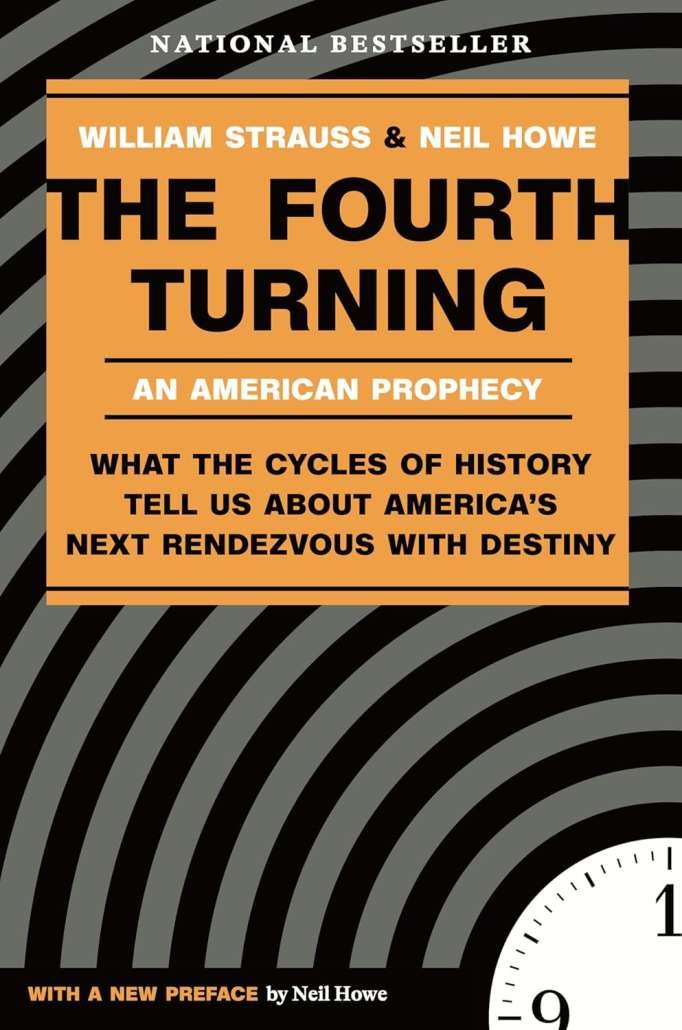
The Fourth Turning explains why and how the Boomers, Gen-X, Millennial, and Gen-Z generations experience and shape the world according to the eras in which they grew up.

Boomers = Prophet Generation
Gen X = Nomad Generation
Millennials = Hero Generation
Gen Z = Artist Generation
The Four Turnings
- High: A period of institutional strength and collective optimism, following the resolution of a previous crisis.
- Awakening: A time of cultural upheaval and spiritual exploration, challenging established norms.
- Unraveling: An era of individualism, institutional decline, and growing societal anxiety.
- Crisis (Fourth Turning): A decisive period marked by major upheaval, such as wars or economic collapses, where society undergoes profound change to rebuild its institutions and values.
Characteristics of the Fourth Turning
- Catalyst: The Fourth Turning begins with a significant event or series of events that disrupt societal stability (e.g., the Great Depression or the 2008 financial crisis).
- Regeneracy: During the crisis, society begins to unify around new values, institutions, and leadership to address the challenges.
- Outcome: The crisis resolves with the establishment of a new civic order, paving the way for the next cycle.
Current Context
Neil Howe argues that we are currently living through a Fourth Turning. This phase is characterised by economic uncertainty, political polarisation, social unrest, and worldwide challenges such as pandemics and geopolitical conflicts. These conditions align with the theory’s predictions that society will face significant upheaval before rebuilding.
The Fourth Turning
Crisis and Psychological Warfare in Social Engineering
In the context of psychological warfare, propaganda, and social engineering, the concept of the “Fourth Turning” offers a compelling lens through which societal upheavals can be understood. Rooted in the cyclical generational theory developed by historians William Strauss and Neil Howe, the Fourth Turning represents a period of crisis where old systems collapse, paving the way for transformative change. This phase is not only a historical phenomenon but also a fertile ground for psychological manipulation and propaganda efforts aimed at reshaping societal norms and behaviours.
What Is the Fourth Turning?
The Fourth Turning is the final stage in a recurring cycle of generational moods, marked by profound societal crises. These crises often involve economic collapse, political instability, or war—events that destabilise existing structures and demand collective action to rebuild. It is during this period that psychological warfare and propaganda emerge as powerful tools to influence public sentiment and engineer social cohesion or division.
While Strauss and Howe’s theory frames the Fourth Turning as a natural cycle, crises are often orchestrated or manipulated by controlling forces—political elites, corporate interests, or ideological factions—to accelerate systemic change.
Key characteristics of the Fourth Turning include:
- Catalyst Events: Triggering moments such as financial crises or geopolitical conflicts.
- Regeneracy: A phase where society unifies around new values and leadership.
- Outcome: The establishment of a new civic order.
Psychological Warfare in Times of Crisis
Psychological warfare thrives during periods of uncertainty and upheaval, such as those typified by the Fourth Turning. Historically, it has been used to destabilise opponents by exploiting their vulnerabilities—fear, doubt, loneliness, and humiliation—while reinforcing unity among allies.
- Targeting Vulnerabilities: Psychological warfare systematically exploits emotions considered weaknesses—fear, hate, deceit, pain, humiliation—to demoralise enemies.
- Propaganda as a Weapon: Messages tailored to undermine morale are disseminated through media channels, leaflets, or digital platforms. For example, during World War II, leaflets depicting marital infidelity were dropped to sow insecurity among soldiers.
- Strategic Goals: In wartime contexts like Ukraine today or historical examples like WWII, psychological operations aim to generate confusion and fear while emphasising the justice of one’s own cause.
Social Engineering Through Propaganda
Social engineering during a Fourth Turning leverages propaganda not only to destabilise adversaries but also to mobilise populations toward collective goals. Techniques include:
- Framing Narratives: Presenting one’s side as just while portraying opponents as unjust.
- Encouraging Dissension: Fostering anti-war sentiment or war-weariness within enemy ranks.
- Psychological Defences: Building resilience against enemy propaganda by instilling confidence in one’s cause.
In peacetime applications, psychological warfare techniques subtly alter public perceptions to make populations more susceptible to coercion or influence. This can involve shaping implicit views through strategic communications that isolate opponents or foster international sympathy for one’s policies.
The Role of Media in Modern Psychological Warfare
The modern Fourth Turning is uniquely shaped by digital media’s ability to amplify psychological operations across global audiences. Social media platforms act as battlegrounds where narratives are contested and manipulated:
- Disinformation Campaigns: Spread false information to create confusion.
- Echo Chambers: Reinforce ideological divides among populations.
- Cultural Manipulation: Use memes and viral content to subtly shift public opinion.
Time Loop
The Fourth Turning represents more than a cyclical historical phase; it is a crucible for psychological warfare and social engineering strategies that aim to reshape societies at their most vulnerable moments. Understanding this interplay between crisis cycles and manipulation tactics provides valuable insight into how power structures adapt—and how individuals can resist being pawns in larger sociopolitical games.
Source: We Are In A “FOURTH TURNING,” What Does That Mean? – YouTube









Leave a Comment
Want to join the discussion?Feel free to contribute!