
NEXT CRISIS: Surviving 2025 | Quick Guide
A Wild Start To 2025 – Jan 2025 | HelioWave
HelloWave explores the wild events at the start of 2025 and the agendas at play.
Something Strange is Happening in America:
The 2025 Awakening – Jan 2025 | Reallygraceful
Reallygraceful discusses various social and political phenomena occurring in the United States. The content explores themes of societal change, awakening, and potential shifts in public consciousness as the nation approaches significant events and transformations.
You were born into chaos magik… – 15 Jan 2025 | The Truth is Stranger Than Fiction
Crisis Manipulation
During crises, regimes often exploit fear, uncertainty, and confusion to manipulate public perception and behaviour through propaganda.
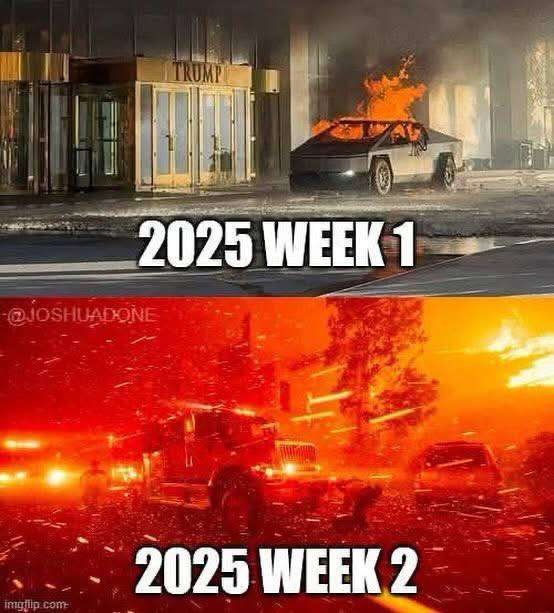
As we step into 2025, the media landscape is already rife with crises shaping public discourse and influencing societal perceptions. Among the most prominent stories capturing attention are the alleged cybertruck incident at Trump Tower and the devastating wildfires in Hollywood.
The Trump Tower cybertruck story has become a focal point for discussions surrounding cybersecurity and political implications, with claims of a significant breach raising questions about the safety of high-profile locations and the integrity of political figures. This narrative not only stirs public concern but also serves as a platform for broader discussions about technology, privacy, and governance in an increasingly digital world.

Simultaneously, the Hollywood wildfires have reignited debates on the “climate change” story and emergency preparedness. As images of destruction flood social media, they evoke emotional responses and prompt calls for action, while also highlighting the ongoing challenges and oddities faced by communities in these now all-too-common disaster areas. The juxtaposition of these crises highlights how media narratives are leveraged to shape public opinion and mobilise support for various agendas.
In this environment, where information spreads rapidly and narratives shift overnight, it is crucial to analyse how these stories are framed and the potential implications for society. The crises of early 2025 illustrate the power of media in not just reporting events but also in shaping perceptions and driving social engineering efforts.
The_Void explores how psychological manipulation, propaganda, and social engineering are employed by various entities to shape societal attitudes and responses during tumultuous times.
“Never let a good crisis go to waste.”
Rahm Emanuel
The strategic maxim “Never let a good crisis go to waste,” famously articulated by Rahm Emanuel, encapsulates a fundamental principle in psychological warfare and social engineering.
Understanding Psychological Warfare
Defining Psychological Warfare
Psychological warfare refers to the use of propaganda and psychological tactics to influence the attitudes and behaviours of target populations. It aims to create a climate of fear and confusion that can be exploited for political or social gain. This manipulation manifests through various means, including disinformation campaigns, media control, and targeted messaging.
Mechanisms of Manipulation
Propaganda Dissemination: Governments and organisations utilise propaganda to control narratives during crises. This includes exaggerating threats or downplaying dissent, thereby shaping public sentiment toward desired outcomes.
Scapegoating: Regimes often redirect public anger or fear towards specific groups, creating moral panics that distract from governmental agendas.
Cognitive Warfare: This form of warfare focuses on altering how individuals perceive issues through targeted messaging, exploiting social media platforms for rapid information dissemination.
Historical Contexts of Social Engineering
Throughout history, various regimes have capitalised on crises for social engineering purposes:
The Cold War: Both Western countries and the USSR engaged in extensive propaganda campaigns aimed at swaying public opinion and undermining each other’s credibility.
The War on Terror: Governments invoked existential threats to justify military actions and curtail civil liberties, framing dissenters as unpatriotic or dangerous.
Contemporary Examples
The “COVID-19” scare serves as a recent illustration of how crises are utilised for social engineering. Governments employed behavioural insights and fear to craft messages that shaped public compliance with draconian health measures, raising debates over transparency and trust in governmental actions. Additionally, misinformation campaigns and manipulation during elections have demonstrated the power of psychological operations in influencing democratic processes.
The Role of Media Manipulation
Exploiting Digital Vulnerabilities
In the digital age, the participatory culture of the internet has become a double-edged sword. While it offers platforms for expression, it also provides opportunities for manipulation. Regimes exploit social media to disseminate misinformation and manipulate narratives, targeting specific demographics to achieve their objectives; there’s a psyop for everyone.
Tactics Employed
Misinformation Campaigns: Entities engage in planting or amplifying false narratives using both human actors (e.g., troll armies/ system assts) and automated tools (e.g., bots).
Targeting Influencers: Public figures (system assets) are often targeted for social engineering efforts to sway public opinion through their influence.
Algorithm Manipulation: Coordinating actions across multiple accounts can force topics into public discourse, effectively shaping conversations around critical issues.
Exploitation
The intersection of crises with psychological warfare reveals a complex landscape where manipulation is not only employed but often executed with precision by those in power. By leveraging propaganda, scapegoating, and cognitive warfare techniques, regimes engineer societal responses that align with their objectives while undermining government integrity. Understanding these mechanisms is crucial for promoting resilience against such tactics in contemporary society.
As we navigate an increasingly complex information environment, recognising the signs of psychological manipulation becomes essential for safeguarding socieltal values and promoting informed citizenry. The historical lessons learned from past crises emphasises the importance of vigilance in the face of propaganda and social engineering efforts that seek to exploit human vulnerabilities for nefarious ends.
Sources and links
Psychological Manipulation and Prevention Methods
A Study on the Psychology of Social Engineering-Based Cyberattacks
Social Engineering and Media Manipulation
Something Strange is Happening in America: The 2025 Awakening
Source: A Wild Start To 2025…








Leave a Comment
Want to join the discussion?Feel free to contribute!