
The Dead Internet Theory | All Time
The Dead Internet Theory – Part 1 | All Time
The Dead Internet Theory – Part 2 | All Time
The Dead Internet Theory – Part 3 | All Time
The Dead Internet Theory – Part 4 | All Time
Synthetic Consensus
The Dead Internet Theory: Manufacturing Reality in the Age of Synthetic Consensus
For most people, the internet still feels like a sprawling, chaotic space driven by human voices. Opinions clash, trends emerge, and culture evolves in real time. Yet beneath this apparent disorder lies a more unsettling possibility: that much of what we experience online is no longer organic at all.
The so-called “Dead Internet Theory” suggests that a significant portion of online activity is generated not by people, but by automated systems — bots, artificial personas, and algorithmically amplified content. While the name may sound dramatic, the underlying concern is far less fantastical. Various studies and network analyses have indicated that less than 60 per cent of web traffic can be confidently attributed to human users. The remainder is made up of scripts, crawlers, and increasingly sophisticated artificial agents designed to simulate engagement.
This is not merely a technical curiosity. It is a structural shift with profound psychological implications.

“Studies suggest that less than 60% of web traffic is human.”
All Time
Feedback Loop.
At its core, the modern internet functions as a feedback loop. Content is created, measured, amplified, and reshaped based on engagement signals. The more something appears popular, the more visible it becomes. The more visible it becomes, the more people interact with it. This cycle, once driven primarily by genuine human interest, can now be seeded and steered artificially.
When non-human actors enter this loop at scale, they do more than inflate numbers. They manufacture consensus.
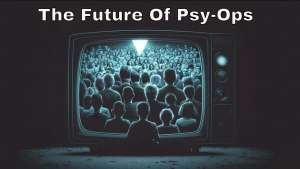
Imagine encountering a viewpoint online. It appears widely shared, heavily liked, and vigorously defended. In reality, a significant portion of that activity could originate from coordinated bot networks or algorithmic amplification systems. The psychological effect is subtle but powerful: individuals are far more likely to accept, internalise, or at least tolerate ideas that seem socially validated.
This is where the theory intersects with psychological warfare and social engineering.
The objective is not necessarily to convince outright, but to shape the boundaries of perceived normality. By flooding the information space with consistent signals — repetition, agreement, outrage, or ridicule — operators can nudge public perception without ever issuing a direct command. Over time, this creates an illusion of consensus that influences behaviour, voting patterns, and cultural attitudes.
In this context, the internet becomes less a marketplace of ideas and more a curated environment. Narratives are not simply shared; they are engineered, tested, and refined. The story machine does not need to control every voice. It only needs to dominate visibility and momentum.
Crucially, this system thrives on plausibility. Most interactions still involve real people. Genuine users continue to produce content, argue, and engage. This mixture of authentic and synthetic activity makes detection difficult and denial easy. The illusion holds because it is not entirely false — only carefully distorted.
It is also worth noting that automation is not inherently malicious. Search engines rely on crawlers. Platforms use algorithms to filter and recommend content. Businesses deploy bots for customer service and marketing. The line is crossed when these tools are used to simulate public opinion or manipulate perception at scale.
The feedback loop then becomes self-reinforcing. Artificial signals influence human behaviour, which in turn generates real engagement, further validating the original signal. Over time, the distinction between what was seeded and what emerged naturally becomes almost impossible to trace.
Whether one fully subscribes to the Dead Internet Theory or views it as an exaggeration, the underlying dynamics are difficult to ignore. The architecture of the modern web allows for influence operations that are subtle, scalable, and largely invisible to the average user.
The question is no longer whether manipulation exists, but how much of our perceived reality online is shaped before we ever encounter it.
In an environment where visibility can be engineered and consensus can be simulated, the most effective form of control is not censorship, but curation. The system does not need to silence dissent if it can simply ensure it is never seen.
And in that sense, the internet is not dead — it is curated to appear alive in very specific ways.
Sources and links
Source: The Dead Internet Theory 4
Source: The Dead Internet Theory 3
Source: The Dead Internet Theory 2
Source: The Dead Internet Theory 1










Leave a Comment
Want to join the discussion?Feel free to contribute!