
A British Guide to The End of The World | BBC
Manufactured Terror
A British Guide to The End of The World – 2019 | BBC
Training Britain to Live in Fear
The nuclear age was less a story of weapons than of fear: a carefully cultivated belief that made populations obedient, rulers indispensable and questioning itself seem dangerous.
BBC Four’s A British Guide to the End of the World is presented as a haunting retrospective of Britain’s nuclear age: bomb tests in the South Pacific, civil-defence planning, hidden archive footage and the testimony of those caught up in the machinery of Cold War preparedness. But viewed through the lens of psychological warfare, the programme invites a more unsettling question than the one it asks. It assumes the central premise — that nuclear weapons are real, usable and capable of ending civilisation — and then asks how ordinary people should have lived beneath that assumption.
The more considered question is: who benefited from teaching the public to believe it?

A Premise Never Questioned
The documentary begins with Operation Grapple, Britain’s thermonuclear test series at Christmas Island in 1957–58, and follows the state’s efforts to prepare the population for nuclear attack. Its archive includes government information films, news broadcasts and classified material, all deployed to recreate an atmosphere of “stockpiled paranoia”.
That phrase is more revealing than the programme perhaps intends. Paranoia does not simply arise. It is cultivated, repeated, institutionalised and made respectable. A population can be governed far more easily when it believes annihilation is one decision away, when it accepts that unseen enemies possess unimaginable power, and when it looks to the state for protection from a threat the state itself says cannot be fully defended against.
Whether the weapons existed exactly as advertised is almost secondary to the social effect. The story of the Bomb trained generations to accept fear as a permanent condition of political life.
The Theatre of Deterrence
The official rationale was “deterrence”: if everyone believed the other side could destroy them, no one would strike first. Yet deterrence is, by definition, a psychological operation. Its purpose is not merely to destroy an enemy; it is to shape an enemy’s — and a public’s — imagination.
The BBC describes Britain’s post-war ambition to join the United States and Soviet Union “at the nuclear table”, preserving its status as a great power. In other words, the bomb was not only a weapon. It was a badge of rank, a bargaining chip and a spectacle of state authority.
For the public, the message was blunt: your rulers possess forces beyond your comprehension; rival rulers possess them too; only the state stands between you and extinction. That is a highly convenient arrangement for any ruling class. Fear narrows debate. Fear makes obedience seem sensible. Fear turns questioning into irresponsibility.
Civil Defence: The Ritual of Helplessness
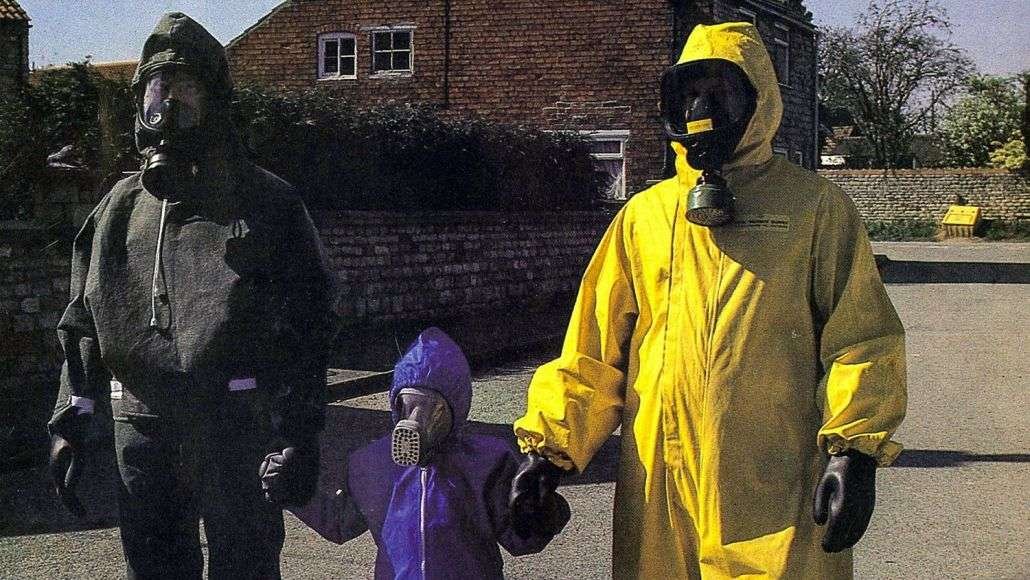
Much of the film’s material concerns Britain’s preparations for attack: bunkers, warning systems, survival advice and officials planning how society might continue after catastrophe. The programme treats these efforts as poignant, absurd and futile. From a propaganda perspective, their futility may have been the point.
A population told to stockpile tissues, makeup and morale-boosting supplies while facing “the end of the world” was being taught a peculiar lesson: the danger is absolute, but your role is to comply with instructions. The impossibility of genuine protection reinforces dependence. You cannot verify the threat, defeat the threat or escape the threat — but you may follow the state’s guidance.
This is a classic structure of social control. The threat need not be fully understood by the public. It need only be believed. Once believed, it justifies secrecy, expenditure, hierarchy and emergency powers.
The Human Cost of the Story
None of this requires dismissing the suffering of those involved. The testimonies of servicemen sent to witness British tests are disturbing: men positioned near detonations, reportedly without adequate protection, later describing blinding flashes, burned birds and long-term health consequences. Later BBC reporting has highlighted claims from veterans, their families and indigenous communities affected by testing in Australia and the Pacific.
That record should make us more sceptical, not less. Governments demonstrably concealed risks, restricted information and used conscripted and colonial populations as instruments of strategic theatre. If the authorities were willing to expose their own servicemen and local communities to danger while controlling the narrative, why should the public treat every official claim about nuclear power, capability and intent as beyond scrutiny?
The issue is not whether explosions occurred. It is whether the public was given truth — or a carefully managed story designed to produce awe, terror and compliance.
The Fear Economy
For those accustomed to examining the hidden hand behind public events, the nuclear age offers a masterclass in narrative management. The threat was remote, invisible and unverifiable to ordinary citizens. Its existence was confirmed by the same institutions that funded it, classified its evidence and benefited from its political consequences.
The result was a permanent emergency mentality. Vast sums could be justified. Foreign policy could be framed as survival. Dissent could be portrayed as naivety or treason. The public was not merely being informed; it was being conditioned.
A British Guide to the End of the World is valuable precisely because its archive exposes the machinery of that conditioning: the films, the drills, the official language, the solemn broadcasts and the quiet assumption that the citizen’s duty was to be afraid in the correct manner.
Necessary Scepticism
The programme asks how Britain prepared for nuclear catastrophe. A more searching account would ask how the public was prepared to accept nuclear catastrophe as credible, inevitable and beyond democratic control.
Real or exaggerated, primitive or advanced, the nuclear weapon functioned — and still functions — as a weapon of propaganda. Its greatest power may not lie in its physical effects, but in its ability to occupy the imagination: to make populations feel small, frightened and dependent; to make the dark magicians appear indispensable; and to transform political choices into matters of survival.
The story machine does not merely report catastrophe. Sometimes, it manufactures the conditions in which catastrophe becomes believable. And a population that accepts the premise without question has already surrendered the most important ground: the freedom to ask who wrote the script, and why.


























Leave a Comment
Want to join the discussion?Feel free to contribute!