
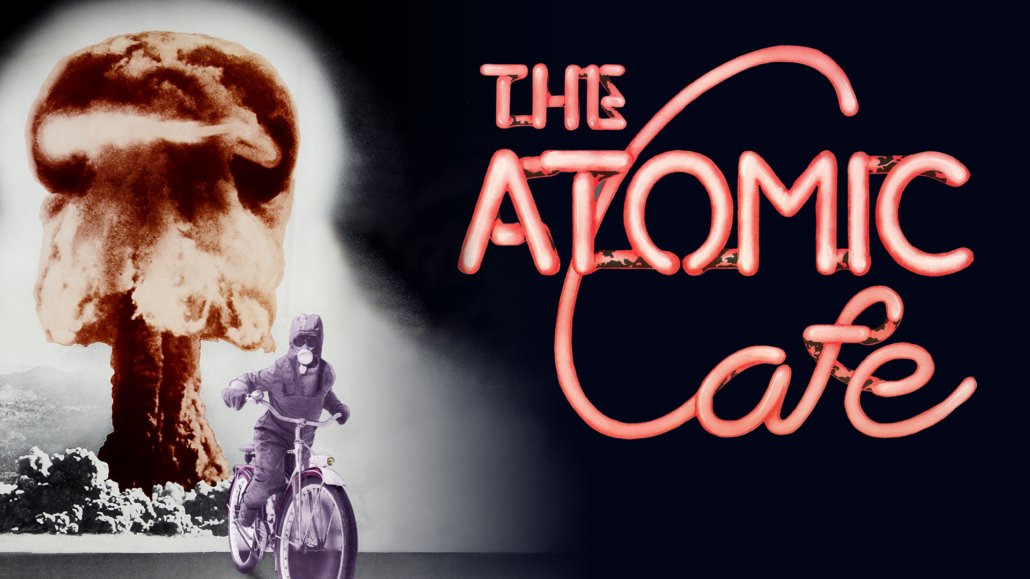
The Atomic Café
Dropping The Bomb
The Atomic Café – 1982
The Atomic Cafe exposes the choreography of consent: terror dressed as reassurance, survival recast as obedience, and mass destruction rendered a beautiful, patriotic spectacle.
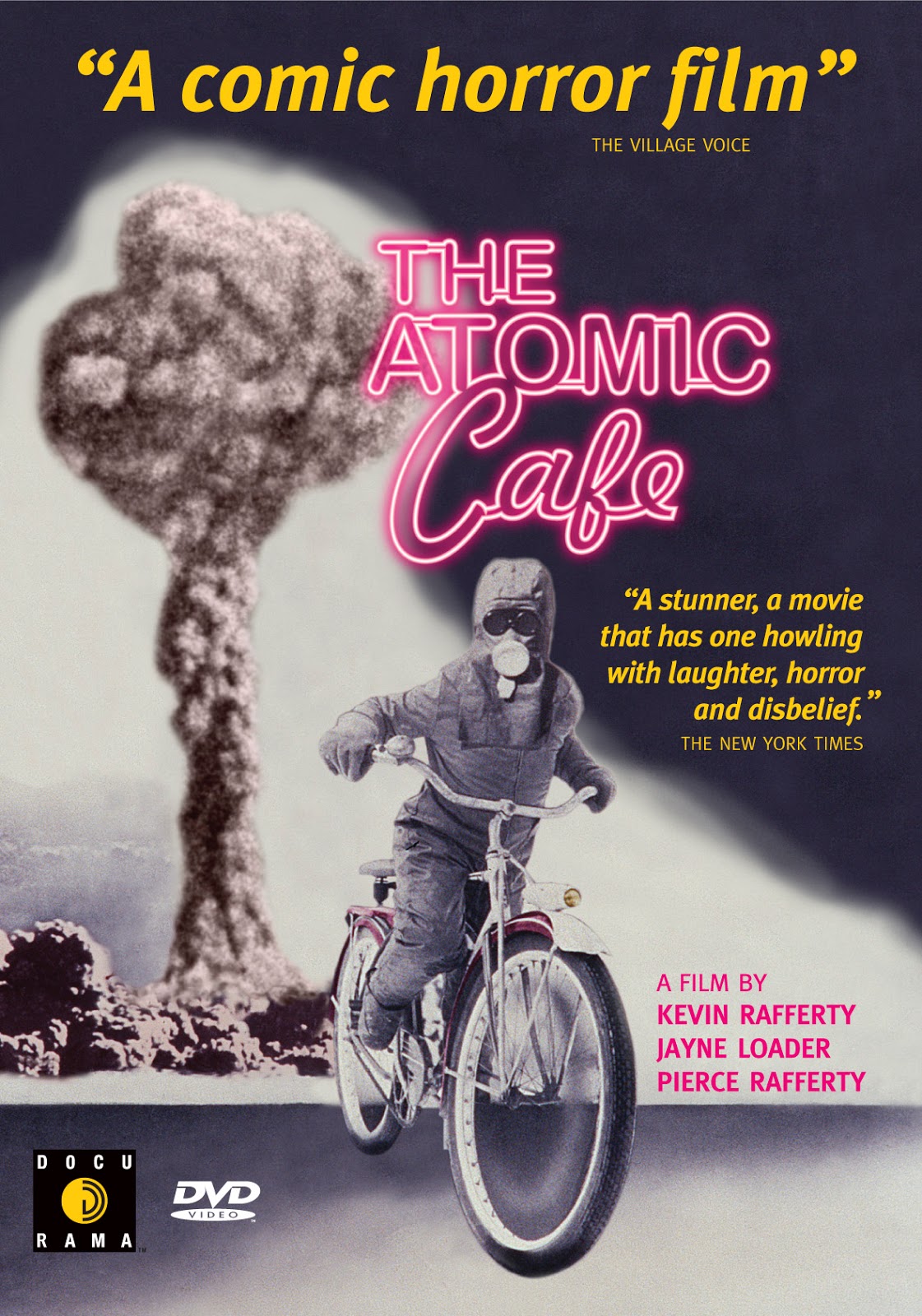
The Atomic Cafe is a 1982 American documentary film directed by Kevin Rafferty, Jayne Loader and Pierce Rafferty. It is a compilation of clips from newsreels, military training films, and other footage produced in the United States early in the Cold War on the subject of nuclear warfare.
The film covers the beginnings of the era of nuclear warfare, created from a broad range of archival material from the 1940s, 1950s and early 1960s including newsreel clips, television news footage, U.S. government-produced films (including military training films), advertisements, television and radio programs. News footage reflected the prevailing understanding of the media and public.



“A stunner, a movie that has one howling with laughter, horror and disbelief.’
The New York Times
Beautiful Annihilation
How The Atomic Cafe Exposed the Machinery of Fear
The Atomic Cafe reveals how fear was packaged as safety: nuclear annihilation reframed as spectacle, obedience as patriotism, and psychological control as ordinary civic duty.
The Atomic Cafe is not merely a documentary about nuclear weapons. It is an autopsy of a story machine: a state-media system that transformed existential terror into something manageable, patriotic, even beautiful. Released in 1982 and assembled by Kevin Rafferty, Jayne Loader and Pierce Rafferty, it uses no narrator—only the official voices of the early Cold War, left to condemn themselves through their own words.
The film’s power lies in its method. Its directors sifted through roughly 10,000 hours of archival material, drawing on newsreels, military training films, civil-defence broadcasts, adverts, radio and television programmes, then edited them into a narrative that “told itself”. What emerges is a portrait of psychological warfare conducted not only against an enemy, but against a domestic population taught how to feel about annihilation.
The Aesthetics of Annihilation
Few lines capture the technique better than the US Army training film’s declaration: “Viewed from a safe distance, the atomic bomb is one of the most beautiful sights ever seen by man.” This is propaganda at its most refined: it does not deny the bomb’s purported horror; it reframes it as spectacle, mastery and technological destiny.
The audience is positioned at a “safe distance”, both physically and emotionally. The blast becomes a sublime image rather than an apparent mass-death event. Beauty, in this context, is not incidental—it is an instrument of control. If destruction can be made visually magnificent, then the moral reflex to recoil can be weakened, redirected, or converted into awe.
Fear, Then Reassurance
The early nuclear state faced a communications problem: it needed the public to take the Soviet threat seriously, yet not become so frightened that daily life, political obedience or military spending became unstable. The solution was a dual message—be afraid, but be reassured; the danger is immense, but you can survive it with the correct behaviour.
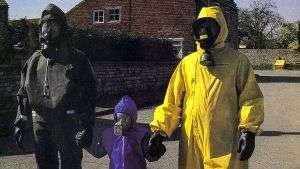
Hence “duck and cover” drills, fallout-shelter guidance, civil-defence broadcasts and cheerful instructional films. The Atomic Cafe shows how these materials presented nuclear attack as a problem of personal preparedness: hide beneath a desk, follow instructions, trust the authorities. The implication was subtle but profound: survival is framed as a civic duty, while questioning the system that had created the danger is not.
This is social engineering in its classic form. The public is not simply told a story; it is trained into a role in it. Citizens become participants in their own protection, and therefore less likely to ask why they have been placed in harm’s way.
The Story Machine at Work
The film reveals that propaganda rarely arrives wearing a mask marked “propaganda”. It comes as education, entertainment, news, public safety and patriotic duty. The Raffertys and Loader drew from a broad cultural ecosystem: government films, popular songs, television, adverts and press coverage, all of which helped normalise the atomic age.
By removing narration, the filmmakers prevent the viewer from being told what to think. The original materials are allowed to speak in their own idiom—confident, paternal, cheerful, bureaucratic—and the contrast between their tone and their subject becomes devastating. The result is not merely satire. It is a demonstration of how meaning is manufactured through repetition, framing, authority and emotional conditioning.
Soldiers as Test Subjects
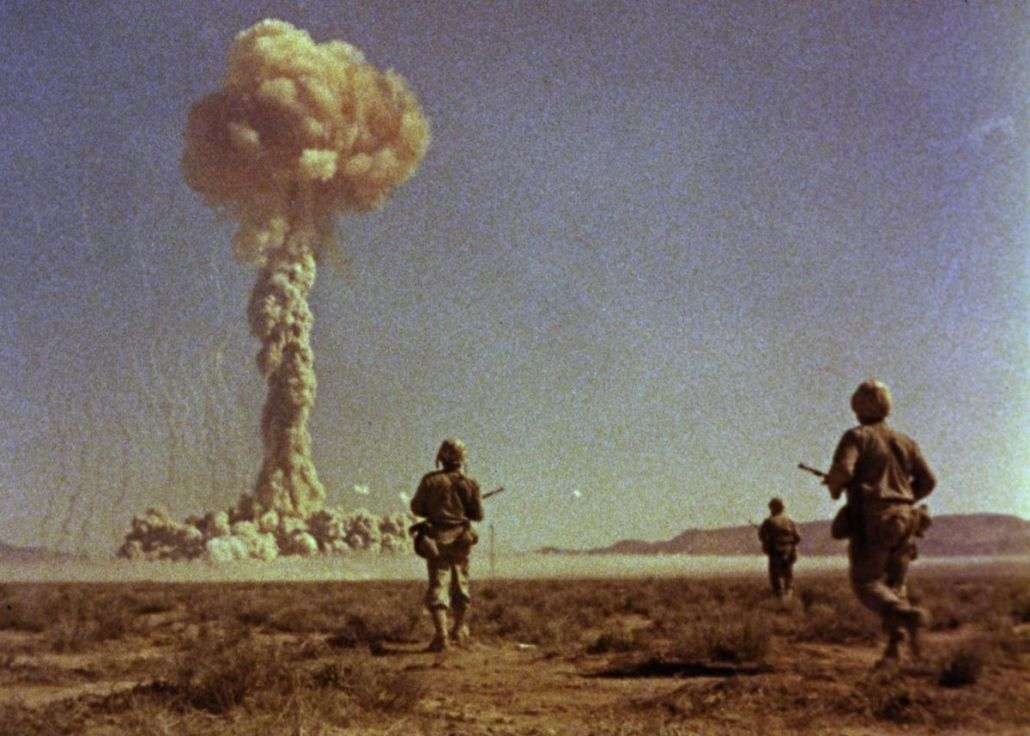
Perhaps the film’s darkest material concerns troops marched toward nuclear tests at the Nevada Test Site, including footage associated with the 1957 “Troop Test Smoky” exercise, in which we are told servicemen were exposed to radiation. The imagery is chilling precisely because it treats human beings as components in an experiment: soldiers observe the blast, then become evidence in the state’s claimed attempt to understand—and manage—the effects of nuclear warfare.
This is the hidden logic of the story machine made visible. The public sees patriotic preparedness; the institutional record reveals calculation, exposure and risk transferred downward to those with least power to refuse.
Why it Still Matters
The Atomic Cafe was released as the Reagan administration sought to expand the American nuclear arsenal, giving its archival critique immediate contemporary force. But its relevance is not confined to the Cold War. It remains a case study in how institutions manufacture consent: define the threat, supply the authorised emotional response, offer a ritual of compliance, and call the whole arrangement common sense.
The film was later selected for the US National Film Registry, recognised as culturally, historically and aesthetically significant. Its lasting importance is not that it “proves” every official claim false, but that it shows how official reality is staged—through language, imagery, repetition and the careful management of fear.
The story machine tells us that the bomb was dropped on cities, but its psychological afterlife was dropped on entire populations. The Atomic Cafe asks us to notice the second explosion: the one that occurs inside the mind, where terror is packaged as safety, obedience as patriotism, and annihilation as a beautiful sight.
















Leave a Comment
Want to join the discussion?Feel free to contribute!