
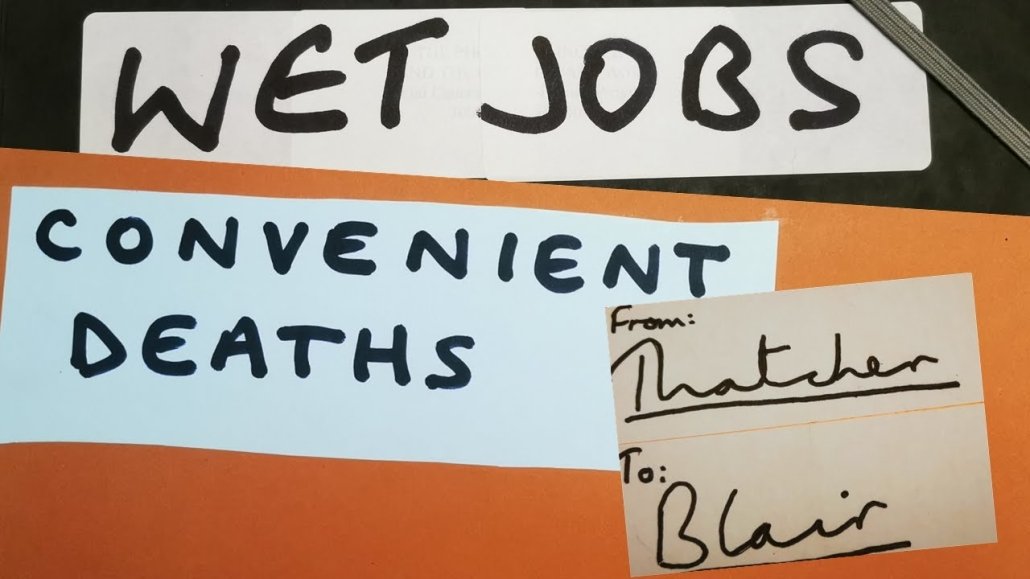
Wet Jobs: Convenient Deaths from Thatcher to Blair | Dark Age Theorist
Convenient Deaths
How Ambiguity and Narrative Shape Public Perception
Wet Jobs: Convenient Deaths from Thatcher to Blair – 2026 | Dark Age Theorist
Power operates through perception, where unresolved deaths, controlled narratives, and managed doubt sustain an illusion system that shapes belief while preventing certainty or collective action.
Wet Jobs: Convenient Deaths from Thatcher to Blair by Dark Age Theorist explores a sequence of controversial deaths in late 20th-century Britain, raising questions not only about the events themselves, but about how such events are framed, absorbed, and ultimately neutralised within public consciousness.
At its core, the film is less about proving a hidden hand and more about exposing the conditions under which suspicion either flourishes or is quietly contained.

The Function of “Wet Work” in Narrative Systems
The term “wet job” suggests state-sanctioned assassination—covert, deniable, and often messy. Whether or not any individual case fits that definition is secondary to a more interesting question: how do such operations work psychologically?
In a tightly managed information environment, ambiguity becomes a tool. A death ruled inconclusive, a chain of inconsistencies, or a rushed inquiry generates just enough doubt to fracture consensus, without ever forming into actionable belief.
This ambiguity serves two parallel functions:
- It prevents closure for those who question official accounts.
- It prevents mobilisation by keeping suspicion diffuse and unprovable.
The result is a population caught between unease and resignation.
Case Studies in Managed Uncertainty
The documentary walks through several high-profile deaths, each accompanied by unresolved elements or contested interpretations:
- Hilda Murrell: An anti-nuclear campaigner whose death raised questions about surveillance and state sensitivity to dissent.
- Willie McRae: A political figure whose fatal incident left behind ambiguities that were never fully settled.
- Princess Diana: Perhaps the most widely scrutinised case, where public grief collided with persistent alternative theories.
- Dr. David Kelly: A weapons expert whose death followed intense political pressure during the Iraq War controversy.
- Robin Cook MP: A prominent critic of government policy whose sudden death invited speculation in certain circles.
Individually, each case sits within its own context. Collectively, they form a pattern—not just of the possibility (in some cases probability) of coordinated action, but of recurring uncertainty.
The Psychology of Suspicion
In psychological warfare, the key mechanism is not secrecy alone, but narrative management.
When an event challenges public trust, the response often follows a familiar structure:
- Rapid establishment of an official account.
- Limited or tightly scoped investigations.
- Media framing that emphasises closure while acknowledging minor inconsistencies.
- Gradual fading of coverage over time.
This process does not need to eliminate doubt. It only needs to ensure that doubt remains socially and politically inert.
Over time, a subtle conditioning takes place. The public learns that certain questions lead nowhere. Curiosity becomes associated with futility, and scepticism becomes self-limiting.
Common Features and Structural Signals
The documentary highlights recurring features across these cases:
- Inconclusive or contested forensic details.
- Individuals connected to sensitive political or scientific domains.
- Timing that intersects with broader political tensions.
- Official responses that prioritise finality over transparency.
- Occurrences repeated too often to be mere coincidence.
These features contribute to a pattern of unease. Importantly, such patterns do not require a single orchestrating force to be effective. They emerge from institutional incentives to protect stability, reputation, and continuity.
The Illusion System
The illusion system is less about deception in a crude sense and more about coherence. Modern governance depends on maintaining a shared understanding of reality that is stable enough to prevent fragmentation.
Events that threaten that stability are not always suppressed; more often, they are absorbed, reframed, and rendered ambiguous.
In this sense, the story machine operates not by telling people what to think, but by shaping the limits of what can be meaningfully concluded.
Inconclusiveness as Strategy
One of the most striking observations from Wet Jobs is that none of the cases reach definitive resolution within the narrative presented. This is not a failure, but a feature.
Inconclusiveness:
- Protects institutions from definitive accusations.
- Prevents critics from achieving decisive proof.
- Sustains a low-level atmosphere of distrust without triggering systemic rupture.
It is a delicate equilibrium, one that keeps the system intact while allowing just enough friction to release pressure.
Beyond the Cases
Whether one accepts the implications suggested in the documentary or not, its real value lies in prompting a deeper examination of how information, authority, and belief interact.
The question is not simply whether any given death was suspicious. It is how societies process suspicion itself.
In that sense, Wet Jobs functions as a study in perception management. It invites viewers to consider not only what happened, but how they are encouraged to think about what happened—and, perhaps more importantly, how far that thinking is allowed to go.
Signals in the Noise
The Quiet Hand of Censorship
One of the more curious details surrounding Wet Jobs is not contained within the film itself, but in how it is treated. Its age restriction by YouTube stands as a quiet but noticeable intervention, one that inevitably shapes who encounters the material, and under what conditions.
Such measures are often justified in neutral terms: policy enforcement, content sensitivity, or “community guidelines”. Yet within the broader context of narrative control, they take on an additional dimension. Restriction does not erase information; it alters its accessibility, its legitimacy, and its perceived risk.
For some, this acts as a deterrent. For others, it functions as a signal.
In environments where information is abundant but attention is tightly mediated, even small acts of limitation carry disproportionate weight. They contribute to an atmosphere in which certain lines of inquiry feel marginal, discouraged, or socially costly to pursue.
The boundaries of acceptable curiosity are subtly reinforced.
In this light, the age restriction becomes part of the story itself—not as proof of any specific claim, but as an example of how modern systems manage exposure. The question it leaves is not simply what is being shown, but how, and to whom.
And perhaps more importantly: what remains just out of reach.
Source: Wet Jobs | Dark Age Theorist
























Leave a Comment
Want to join the discussion?Feel free to contribute!