

The Black Nobility – Frances Leader | Jerm Warfare
The Black Nobility:
A Legacy of Psychological Manipulation, Social Engineering, and Propaganda
The term “Black Nobility” evokes images of power, influence, and secrecy. Rooted in the oligarchic families of Venice and Genoa, these aristocratic dynasties have wielded immense control over world systems for centuries. Their history is marked by ruthless tactics, strategic alliances, and a mastery of psychological manipulation that shaped the socio-political landscape of Europe and beyond.
Historical Foundations
The origins of the Black Nobility trace back to the medieval period when Venetian oligarchs secured privileged trading rights and established monopolies that fuelled their economic dominance. By the 12th century, these families had solidified their position through strategic marriages with European royalty, creating an intricate web of alliances. This network not only ensured their survival but also allowed them to exert exceptional influence over political decisions.

Their methods are often unscrupulous—employing murder, blackmail, kidnapping, and deception to maintain their power. The term “Black” was attributed to their reputation for employing extreme measures to achieve their objectives. These families are instrumental in shaping the modern banking system, leveraging financial control to dominate governance and commerce around the world.
Psychological Manipulation and Social Engineering
The Black Nobility‘s influence extends far beyond wealth and politics; they have mastered psychological manipulation and social engineering to consolidate power. By intertwining their interests with religious authority—particularly through connections with the Vatican—they have positioned themselves as both protectors and manipulators of spiritual leadership. This dual role enables them to shape societal norms and maintain a conservative legacy amidst changing political landscapes.
Strategic marriages serve as tools for social engineering, ensuring loyalty and ambition within their ranks while influencing broader societal structures. Their ability to control narratives through propaganda further cement their dominance.
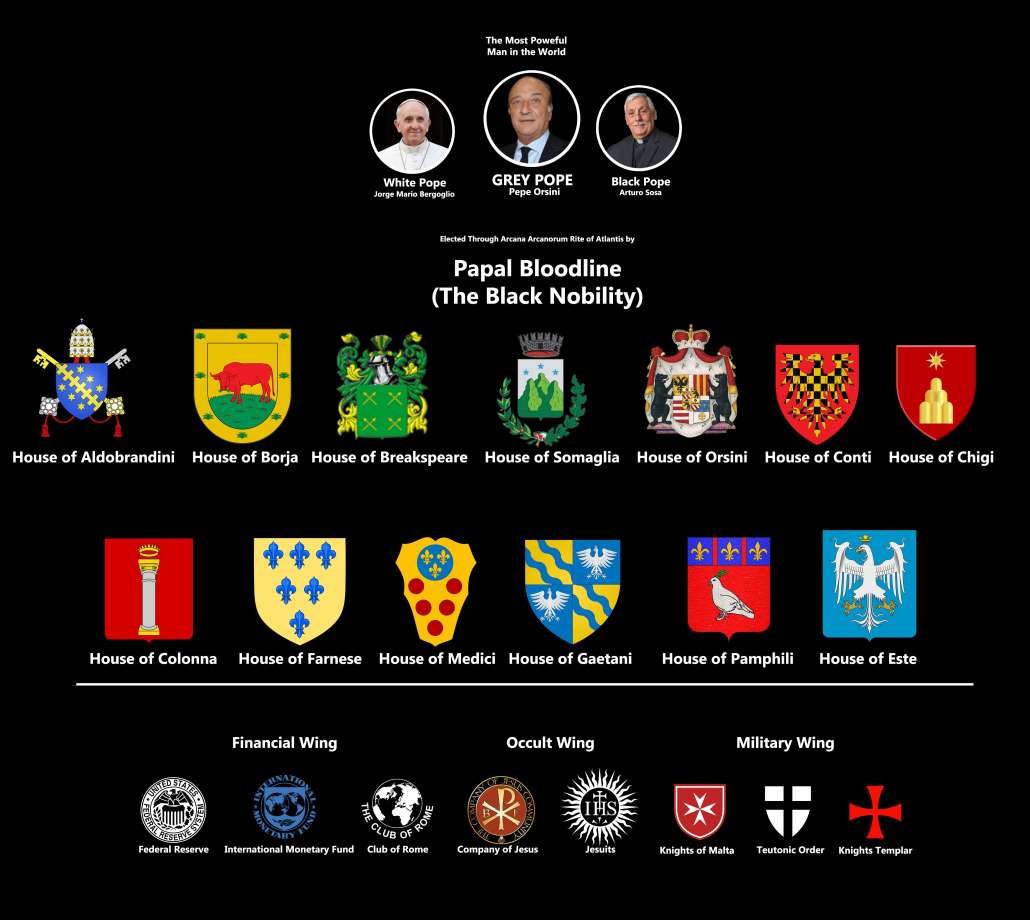
Here is a list of prominent Black Nobility families, many of whom have historical ties to the Papacy and continue to hold significant influence:
- House of Orsini – Known for their involvement in both secular and religious institutions, they have produced several cardinals and even Popes.
- House of Chigi – A prominent family with connections to the Vatican, currently led by Mario Chigi.
- House of Colonna – One of the most influential families, with ties to the Papacy and significant roles in Rome‘s governance.
- House of Medici – Although their main branch is extinct, cadet branches continue to exist, with Ottaviano de’ Medici being a notable figure.
- House of Gaetani – Led by Bonifacio Gaetani, this family has maintained its noble status.
- House of Pamphili – Jonathan Doria Pamphilj is a current representative of this family.
- House of Este – Lorenz Este leads this historical family.
- House of Aldobrandini – Giovanni Aldobrandini is a notable member, though the family’s main line is considered extinct.
- House of Pallavicini – Maria Camilla Pallavicini represents this family.
- House of Savoy – Emanuele Filiberto di Savoia is a prominent figure, though the Savoy family’s role in the Black Nobility is complex due to their historical opposition to the Papacy.
- House of Ruspoli – Francesco Ruspoli leads this family.
- House of Torlonia – Giovanni Torlonia is a notable member.
- House of Borghese – Scipione Borghese is a prominent figure in this family.
- House of Massimo – Fabrizio Massimo is a current representative.
- House of Sacchetti – Urbano Sacchetti leads this family.
- House of Farnese – Prince Carlo, Duke of Castro, represents this family.
- House of Borromeo – Vitaliano Borromeo is a notable member.
- House of Barberini – Urbano Barberini is a current figure in this family.
- House of Fugger – Hubertus Fugger-Babenhausen is a prominent member.
- House of Giustiniani – Girolamo de Massa leads this family.
- House of Foscari – Lorenzo de Medici-Tornaquinci-Foscari is a notable figure.
- House of Odescalchi – Carlo Odescalchi is a current representative.
- House of Corsini – Filippo Corsini leads this family.
- House of Crescenzi – Domenico Crescenzi is a notable member.
- House of Borja – Francisco de Borja Soto is a current figure in this family.
- House of Breakspeare – Filippo Massimo-Lancellotti II represents this family.
- House of Sforza – Ascanio Sforza is a notable member.
These families have played significant roles in shaping European history, particularly through their connections with the Vatican and their influence on political and social structures.

Propaganda and Legacy
Propaganda has been a cornerstone of the Black Nobility‘s strategy. By controlling information flows and crafting narratives that align with their interests, they have manipulated public perception for centuries. Their legacy is evident in modern political systems where their strategies persist. From influencing economic policies to steering military decisions, their impact remains woven into contemporary governance.
The Black Nobility exemplifies how psychological manipulation, social engineering, and propaganda is used as tools for maintaining power across generations. Their legacy serves as a reminder of the enduring influence of elite networks on globalist systems. As we unravel their history, we gain insights into the mechanisms of control that continue to shape our world.
Understanding the tactics employed by the Black Nobility offers valuable lessons on recognising and resisting manipulation in modern society. Whether through historical analysis or contemporary reflection, exploring their impact challenges us to question the narratives that define power and control today.
Roman Empire 2.0
Frances Leader‘s Uncensored Substack delves into Black Nobility, exploring its influence on globalist systems and societal structures with meticulous research and analysis.
She has gained recognition for her detailed investigations, particularly on the concept of Black Nobility, which she describes as atheistic and nihilistic elites originating from Roman Senator families displaced in 476 AD. Leader argues that these groups exert influence over globalist systems, including surveillance and health policies.
Very few people know anything about the Black Nobility.
In fact, before speaking to Frances, Jerm also didn’t know anything about the Black Nobility.
Who or what are the Black Nobility?
Grammatically, both ‘is’ and ‘are’ can be used with the term ‘Black Nobility‘, depending on context.
The Black Nobility are the richest and most powerful families in the world who work in tandem with the Vatican, the Jesuits, and the Illuminati to achieve their goal of world domination.
John Coleman, author
In short, the Black Nobility is a cabal of ruthless, power-hungry aristocrats who have spent centuries manipulating European (and international) politics and finance to further their own interests.
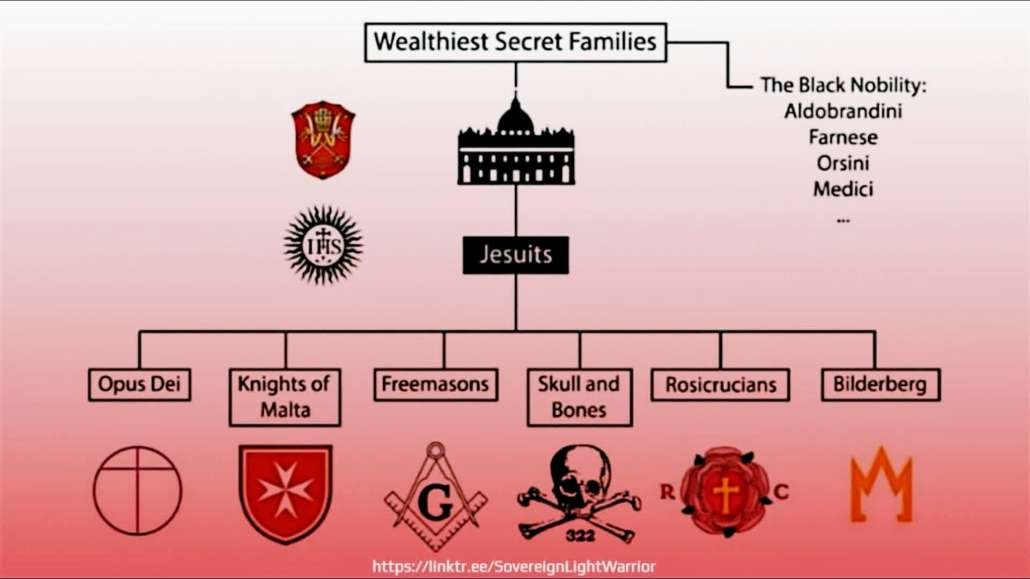
They are likely the most powerful families in the world.
These Black Nobility families are satanic—they pull every string, from the Jesuits to the Rothschilds, and their power is pure evil.
Fritz Springmeier, author
Frances explains in far greater depth, but, basically, the Black Nobility‘s roots can be traced back to the Roman Empire, where they emerged as a powerful and wealthy elite.
They were (and still are) the descendants of Roman senators, consuls, and generals who had amassed vast fortunes through conquest and exploitation.

As the Roman Empire declined, they adapted and evolved, forming alliances with the rising powers of Europe, including the Roman Catholic Church and Church of England.
They used their wealth and influence to secure positions of power within the Churches, often marrying into noble families and securing bishoprics and cardinalates for their sons. This strategic maneuvering allowed them to maintain their grip on power, even as the Roman Empire ‘crumbled’.
Jerm uses quotation marks because, as Frances points out, the Roman Empire didn’t really come to an end. It simply took on a more subversive form, with centres of power in Rome, London, and Washington.
She calls it the Roman Empire 2.0.
The European Black Nobility, by virtue of their vast financial holdings, have dictated the policies of nations for centuries, always working toward the establishment of a one-world government.
Eustace Mullins, author
Frances gives a brilliantly substantial, yet concise, breakdown of the Black Nobility, including their history, politics, and relevance today.
As an aside, a fashionable trend is to blame ‘the Jews‘ for all that’s wrong with the world, but, while true to some degree, it’s a bit myopic and she explains why.
Source: Who are the Black Nobility and why do they matter?



























Leave a Comment
Want to join the discussion?Feel free to contribute!