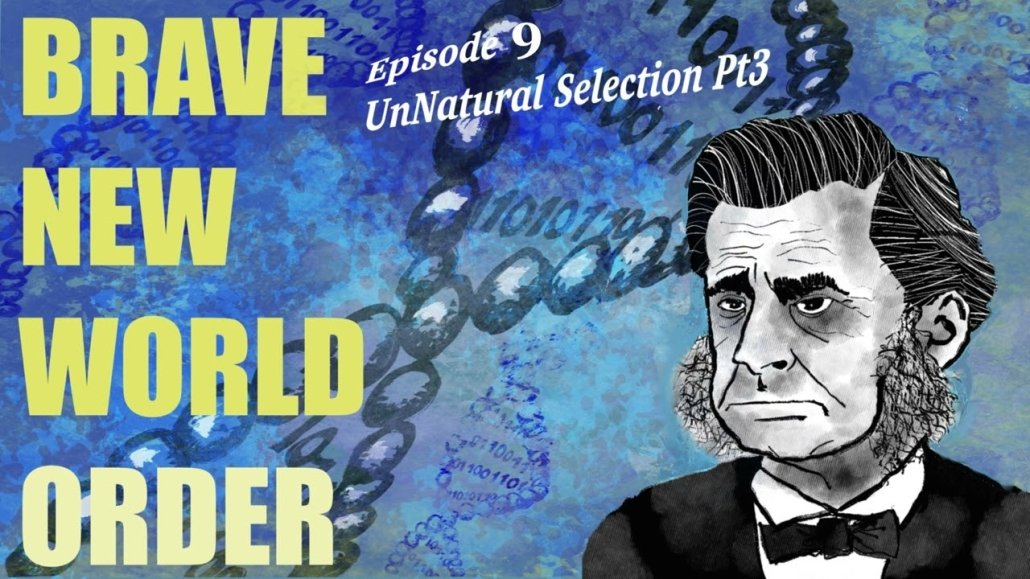
Huxley’s Brave New World Order – Ep9: UnNatural Selection Part 3 | Sheep Sharm
Hidden Frameworks
[SF201] Huxley’s Brave New World Order Ep9 UnNatural Selection Pt3 | Sheep Sharm
The Huxleys and the Architecture of Engineered Thought
In an age where perception is curated as carefully as policy, the true battleground is no longer physical territory, but the human mind. To understand how modern narratives are shaped, one must look beyond surface events and examine the intellectual frameworks that underpin them.
Step back far enough, and a pattern begins to take form. Around the mid-19th century, the foundations of accepted knowledge appear to have undergone a quiet but profound restructuring. What is now presented as settled science may not have emerged purely from open inquiry, but from ideas that were cultivated, reinforced, and ultimately embedded within institutions.

At the centre of this shift stood an interconnected network of influential families — most notably the Huxleys, the Darwins, and the Galtons. These were not isolated thinkers, but dynasties operating across science, education, and policy, shaping not only what was studied, but how it was interpreted.
Thomas Henry Huxley, remembered as “Darwin’s Bulldog,” played a decisive role in driving evolutionary theory into the academic mainstream. His efforts extended well beyond scientific advocacy. They marked the beginning of a broader ideological transition — one that reframed humanity not as a being of purpose, but as a product of process, governed by chance and competition.
This shift carried significant psychological implications. Once human identity is reduced to biology, it becomes something that can be analysed, categorised, and ultimately managed. From this foundation, the leap to social engineering becomes not only possible, but logical.
Francis Galton, Darwin’s cousin, advanced this thinking into the realm of application. Through the development of eugenics, he proposed that human populations could be “improved” through controlled selection. What began as theory soon found traction within policy circles, influencing governance and shaping social attitudes in ways that still echo today.
The Huxley lineage extended this influence into the twentieth century with remarkable continuity. Julian Huxley, as the first Director-General of UNESCO, advocated for a scientific humanism that blurred the boundary between knowledge and governance. His vision positioned institutions not merely as centres of learning, but as instruments for guiding societal evolution.
Meanwhile, Aldous Huxley approached the same themes through fiction — though his work reads less like imagination and more like disclosure. Brave New World presents a society where control is achieved not through force, but through conditioning, pleasure, and psychological management. Consent is engineered. Dissent is neutralised before it can fully form.
This is the essence of modern psychological warfare: influence without visibility.
Across generations, members of this network occupied key positions within academia, media, and policy-making bodies. This continuity raises an unavoidable question. Were these developments the natural unfolding of intellectual progress, or the result of a more coordinated alignment of influence?
The concept of academic inheritance becomes difficult to ignore. Authority is not only earned; it is preserved and passed along. Networks reinforce themselves, ensuring that certain perspectives remain dominant while others are quietly excluded. Over time, this creates a closed loop in which ideas are no longer tested, but maintained.
Within such a system, even scientific interpretation can become directional. Fields like palaeontology, for instance, often present evolving theories as settled refinements, despite reliance on speculative reconstruction. The issue is not that inquiry is false, but that its boundaries may be subtly constrained.
This is how the illusion system sustains itself.
The story machine does not impose belief outright. It cultivates it through repetition, institutional authority, and cultural saturation. Narratives are introduced, reinforced, and normalised until they become indistinguishable from reality itself. Once embedded, they form invisible frameworks through which all subsequent thought is filtered.
Dissent, within this structure, is not openly crushed. It is reframed as irrational, marginal, or unworthy of serious consideration. In this way, control is maintained without the appearance of control.
From a social engineering perspective, this represents a highly refined model. It does not rely on coercion, but on alignment — shaping perception so that individuals willingly operate within predefined boundaries.
The legacy of the Huxleys and their contemporaries, viewed through this lens, is not confined to scientific contribution. It reflects the construction of an enduring framework — one that defines not only what is known, but what is considered knowable.
For those examining propaganda and psychological influence, the implications are clear. Power does not always announce itself. More often, it is embedded within systems of thought, quietly guiding direction while remaining just out of view.
Understanding these hidden frameworks is not about rejecting knowledge, but about questioning how it is formed — and who benefits from its acceptance.
Source: [SF201] Huxley’s Brave New World Order Ep9 UnNatural Selection Pt3