
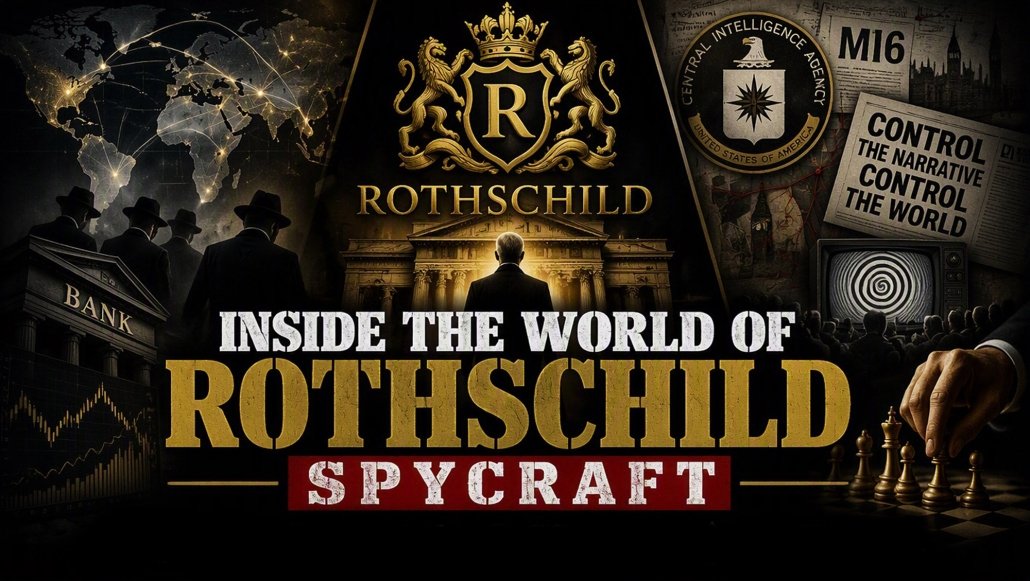
Inside the World of Rothschild Spycraft with Jay Dyer | Tin Foil Hat
Inside the World of Rothschild Spycraft with Jay Dyer
Episode 1007 – July 2026 | Tin Foil Hat
Inside the World of Rothschild Spycraft with Jay Dyer
Episode 1007 – July 2026 | Tin Foil Hat
#1007: Inside the World of Rothschild Spycraft with Jay Dyer | Tin Foil Hat
The Machinery of Influence
Banking Power, Intelligence Networks, and the Engineering of Perception
Jay Dyer reveals how financial networks, intelligence agencies, and engineered narratives converge to shape perception, manage instability, and quietly maintain enduring structures of power.
In this episode of Tin Foil Hat, Sam Tripoli is joined by Jay Dyer for a conversation that moves beyond surface-level geopolitics into the underlying structure of power. Referring to Frederic Morton’s authorised biography The Rothschilds, the discussion opens a wider examination of how finance, intelligence, and narrative operate as a single, reinforcing system—the Illusion System.
“Let me issue and control a nation’s money, and I care not who makes its laws.”
Mayer Amschel Rothschild
Hidden Architecture
The polite version of history suggests that powerful financial dynasties merely navigated the upheavals of the nineteenth and twentieth centuries. That claim does not hold.

Morton’s account makes clear that these were not passive observers. They were embedded within the systems that produced those upheavals. Governments relied on their capital, wars required their financing, and political outcomes were closely tied to the financial frameworks behind them. Influence was not incidental—it was structural.
What stands out most in the Rothschild family story is not just wealth, but method. Secrecy, discipline, and control of information defined the operation. The family’s strength lay in its ability to gather intelligence, transmit it rapidly, and act on it before competitors—or even governments—could respond. Through tightly controlled internal communication, trusted couriers, and coordinated strategy, they built a network that functioned in many respects like a private intelligence system operating across Europe.
This was deliberate and long-term. Power was approached as a multigenerational project, structured for continuity rather than short-term gain. Each generation inherited not only wealth, but a system—refined, protected, and expanded over time.
By the early nineteenth century, this model was already in place: capital moving across borders with ease, information arriving ahead of public knowledge, and political developments anticipated rather than reacted to. The fusion of finance and intelligence was not a later innovation—it was foundational.
The emergence of formal intelligence agencies such as the CIA and Mossad did not introduce a new paradigm. They institutionalised an existing one. Information, influence, and capital became increasingly linked, with intelligence organisations operating within environments shaped by financial and strategic interests.
Intelligence agencies are not simply neutral bodies concerned with security. They function as instruments that manage risk, protect established interests, and shape conditions favourable to existing power structures. Covert operations, regime interventions, and influence campaigns are not exceptions—they are mechanisms built into the system.
At the centre of these mechanisms lies psychological warfare.
Not crude propaganda, but the management of perception itself. The objective is to shape how reality is interpreted—what is considered credible, what is dismissed, and what never enters serious discussion. Once perception is guided, control becomes largely invisible.

Mind Control
Programmes such as MK-Ultra, now partially declassified, emphasise how seriously institutions have approached the question of influencing human cognition. The importance lies not in exaggeration, but in documented intent: understanding how belief and behaviour can be shaped. Within that context, psychological operations are not peripheral—they are central.
The notion that powerful institutions exist in pure competition also begins to break down under scrutiny. Rivalries are real, but so are shared interests—financial continuity, system stability, and the preservation of influence. Cooperation does not need to be declared; it emerges through alignment.
This is where networks such as Fabian circles and Milner-associated groups come into view. Gradualist political change, technocratic governance, and long-term social restructuring developed within overlapping spheres of finance, policy, and academia. The method is not sudden upheaval, but incremental transformation—slow, cumulative, and largely unnoticed until firmly established.
What emerges from all of this is not disorder, but design.
A system in which finance, intelligence, ideology, and narrative reinforce one another. The story machine is not metaphorical—it is functional. It filters reality, defines the limits of acceptable discourse, and ensures that even opposition rarely escapes its framework.
The result is a managed perception of the world, where events are not only shaped but interpreted in ways that sustain the structure beneath them.
Power, in this context, does not need to hide.
It operates through systems, through continuity, and above all, through belief.
Source: Inside the World of Rothschild Spycraft with Jay Dyer l Episode 1007









Leave a Comment
Want to join the discussion?Feel free to contribute!