
An Expose of America’s Illuminati | Millennium 2000
Oligarchy of Evil
An Expose of Americas Illuminati – 1993 | Millennium 2000
War has been declared against you. There isn’t anything you have or hoped to have that they are not planning on taking away. They want it all.
A grave warning from 1993, Anthony J. Hilder in conversation with Jordan Maxwell, Terry Cook and Ray Yunger: “We are being led like sheep to the slaughter.”

“The American dream is over, the American nightmare is here.”
Anthony J. Hilder

“There isn’t anything you ever had, there isn’t anything you own, there isn’t any right that you possess that they’re not planning on taking away. They want it all!”
Anthony J. Hilder
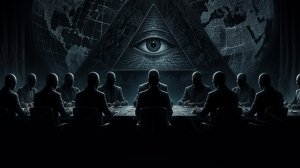
The occult design of the US capital, set in stone was laid out by Master Masons in the shape of the Illuminati Pyramid. Early on, these Warlocks of Washington plotted to place their Luciferian symbols into the foundations of society and gain control over America’s banking system. The American public knows next to nothing about “those” shadowy Faustian figures who run and ruin this now captured Nation from the corporate boardrooms of the Major Banking Institutions.
America today has essentially a one party system run by and for the benefit and pleasure of the International Banksters, who are sucking away the very sustenance of this once great nation. Their goal is to establish a one-world government upon the ashes of American sovereignty.
Millennium 2000
Symbols, Power and Manufactured Reality
Millennium 2000 exposed the hidden language of power: symbols, finance and manufactured consent shaping a public trained to accept control as inevitable.
Filmed in 1993, Millennium 2000 brought together Anthony J. Hilder, Jordan Maxwell and Terry Cook for a discussion that now feels less like a relic of the VHS era than a blueprint for the psychological battlefield of the present. The programme framed the emerging “New World Order” not merely as a political programme, but as an integrated system of finance, institutional symbolism, language, media and mass conditioning.
For those already alert to narrative management, the interview remains valuable less as a set of claims to accept uncritically than as a study in how populations are prepared to accept profound changes in sovereignty, culture and perception. Its central premise is that the visible political stage is often a distraction from the deeper machinery that shapes what people believe is possible.
The Conversation
Millennium 2000 was a 109-minute VHS production, hosted by Anthony J. Hilder and featuring Jordan Maxwell, Terry L. Cook and Ray Yungen. Its stated subject was the influence of banking institutions, secret societies and occult symbolism over American political life, with the programme presenting its case as an exposé of the “Illuminati”.
The title itself was carefully chosen. “Millennium 2000” projected the audience forward into a new century, encouraging viewers to imagine that the political, economic and spiritual arrangements of the late twentieth century were not permanent but transitional.
Hilder’s role was that of the provocative host, framing the discussion around an “oligarchy of evil” and the end of the American dream. Maxwell supplied the symbolic and religious framework, while Cook addressed the political and institutional dimensions of the argument. Together, they present a worldview in which elected office, corporate power and cultural messaging are not isolated phenomena, but parts of one coordinated system.
Anthony J. Hilder
Anthony J. Hilder was an American author, broadcaster, filmmaker and talk-show host whose work sought to challenge the official political narrative and expose what he viewed as the hidden forces behind public affairs. In Millennium 2000, he acted as the programme’s driving host, framing Maxwell’s symbolic research and Cook’s institutional analysis within a wider warning about concentrated power.
Hilder’s broader work can be understood as an effort at lifting the veil: encouraging audiences to look beyond party politics, celebrity leadership and official explanations towards the financial, ideological and psychological structures that shape public life. His contribution was not merely to name alleged conspirators, but to train viewers to ask who benefits when political choices appear limited, crises recur on cue and dissent is routinely recast as dangerous or illegitimate.
In that sense, Hilder’s legacy belongs to the tradition of independent political broadcasting: imperfect, combative and often controversial, yet insistent that the public should not mistake the visible spectacle of government for the full architecture of power.
Maxwell’s Method
Jordan Maxwell, born Russell Pine in 1940 and died in March 2022, spent more than five decades researching religion, symbolism, secret societies, language and hidden history.nHe became especially associated with “astro-theology”: the argument that many religious narratives, symbols and rituals have roots in observations of the sun, moon, stars and constellations.
His distinctive contribution was not simply to ask who holds power, but to ask how power makes itself appear natural. Maxwell examined corporate logos, state seals, currency, architecture, legal terminology and religious iconography as a visual and verbal language—one capable of conditioning the public long before any policy is announced.
That approach is directly relevant to psychological warfare. A population does not need to be persuaded by a single argument if its symbolic environment already teaches it what to fear, whom to trust, what authority looks like and what dissent means. Symbols work precisely because they bypass debate: they are felt before they are examined.
Symbols as Social Engineering
Maxwell’s work treats symbols not as decoration but as instruments of orientation. A flag, an emblem, a building, a corporate mark or a legal phrase establish an emotional relationship with authority before the public has consciously considered the issue at hand.
This is the mechanics of social engineering in miniature. When a population repeatedly encounters the same imagery in schools, courts, banks, media and public ceremonies, it gradually learns to associate certain institutions with legitimacy, protection and moral order. The result is not necessarily conscious agreement; it is habituation.
The danger arises when symbols are used to make an unpopular arrangement appear inevitable. If people are taught that a particular economic or political order is simply “how the world works”, they are less likely to question who benefits from it, who administers it and who pays the price when it fails.
The Story Machine
The story machine does not need to control every thought. It needs to control the boundaries of respectable discussion: which questions may be asked, which explanations are dismissed as extremism, and which realities may be named without social penalty.
In the 1993 interview, the participants argued that political parties, banking institutions and corporate power formed a single system rather than genuinely competing forces. Whether or not one accepts that thesis in its strongest form, the underlying observation remains important: when rival political factions share the same financial patrons, media dependencies and institutional incentives, the public may be offered a choice of personalities rather than a choice of direction.
That is the essence of managed politics. The audience is kept emotionally engaged by conflict, scandal and spectacle, while the structural questions—money creation, ownership, sovereignty, surveillance, war and the concentration of institutional power—remain outside the permitted conversation.
Why This Still Matters
The programme was made before the internet became the dominant public square, before smartphones made every pocket a portal for the infinite scroll, and before algorithmic feeds could tailor fear, outrage and conformity to the individual. Yet its concerns anticipate the present with striking clarity.
They discussed the “New World Order” as a long-term project of consolidation: political authority moving upward, economic power concentrating in financial institutions, national identity weakened, and populations managed through crisis, dependency and manufactured consent. Those themes have since become familiar features of contemporary political life, whatever one concludes about their origins or coordination.
The lesson is not that every claim made in 1993 should be treated as proven fact. It is that the techniques described—symbolic conditioning, linguistic framing, crisis management, institutional capture and the narrowing of public imagination—are real instruments of influence. A society that cannot recognise them is far easier to steer.
Maxwell’s Legacy
Jordan Maxwell‘s enduring significance lies in his insistence that power is not only exercised through laws, armies and elections, but through the stories a civilisation tells about itself. His research into religion, occult symbolism, legal language and secret societies made him a foundational figure for later alternative researchers and documentarians.
He died on 23 March 2022, aged 81, leaving behind an extensive archive and a body of work that continues to circulate through lectures, interviews, books and posthumous compilations. Whatever one makes of his conclusions, his central question remains urgent: what are we not being told, and why?
Millennium 2000 endures because it understood something that mainstream commentary still often avoids: the most effective control is not always visible coercion. Sometimes it is the quiet manufacture of a reality in which people no longer believe that another way of living, governing or thinking is possible.
Source: Millennium 2000: An Expose of Americas Illuminati




















Leave a Comment
Want to join the discussion?Feel free to contribute!