
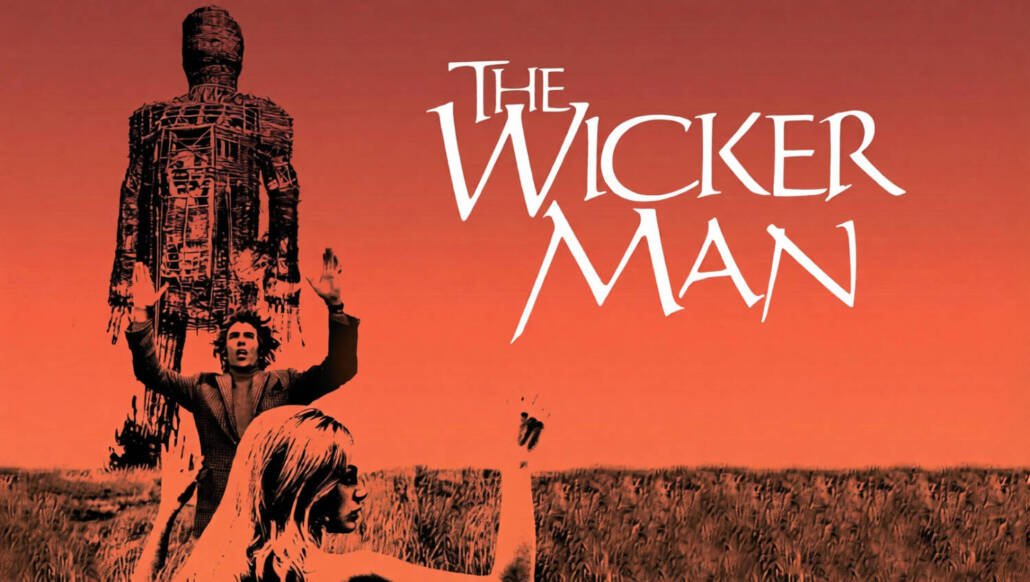
The Wicker Man
Ritualised Reality Control
The Wicker Man – 1973
Police Sergeant Neil Howie journeys by seaplane to the remote Hebridean island Summerisle to investigate the disappearance of a young girl.
The Wicker Man is a 1973 British folk horror film directed by Robin Hardy and starring Edward Woodward, Britt Ekland, Diane Cilento, Ingrid Pitt, and Christopher Lee. The screenplay by Anthony Shaffer, inspired by David Pinner’s 1967 novel Ritual, centres on the visit of Police Sergeant Neil Howie to the isolated Scottish island of Summerisle in search of a missing girl. Howie, a devout Christian, is appalled to find that the inhabitants of the island have abandoned Christianity and now practice a form of Celtic paganism.
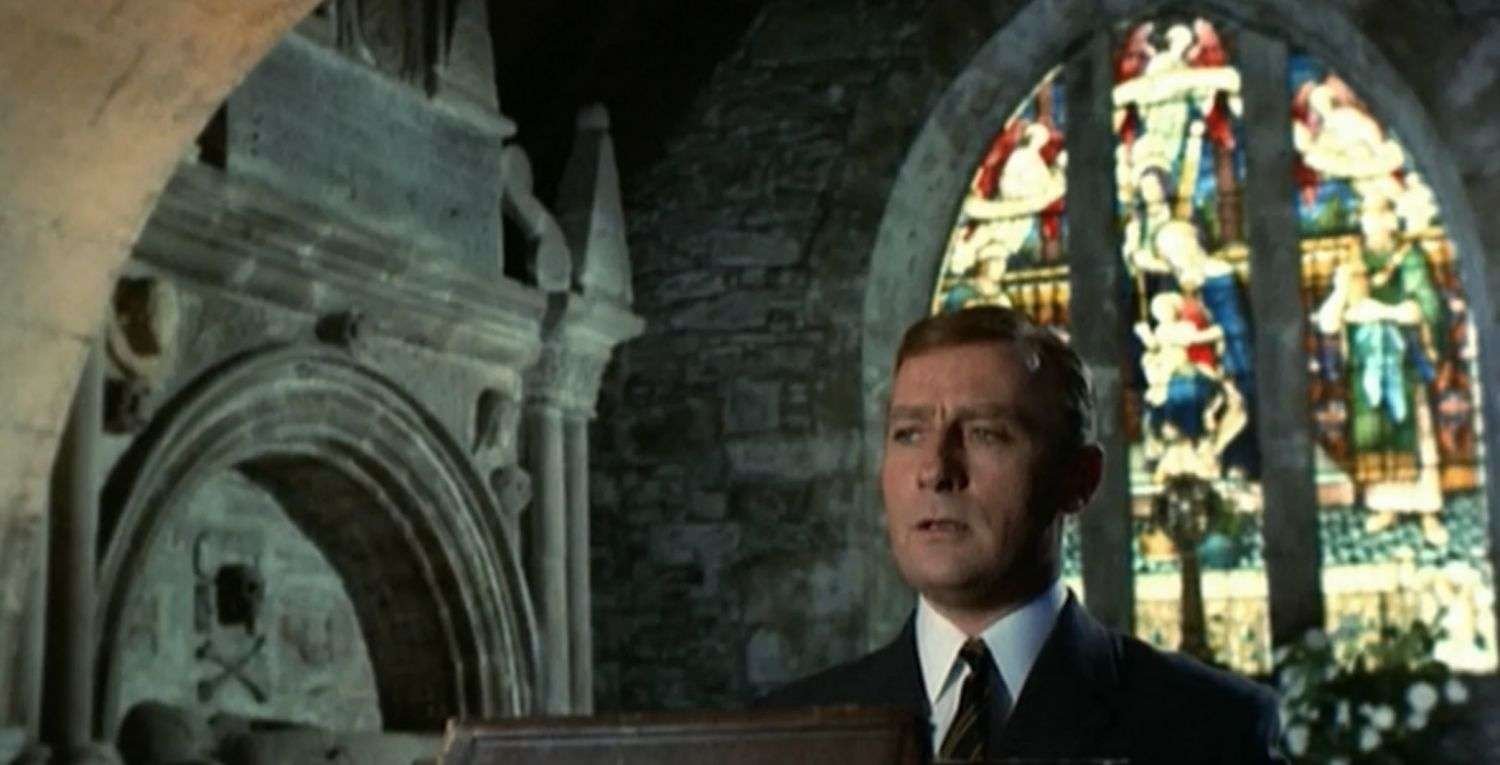
Police Sergeant Neil Howie journeys by seaplane to the remote Hebridean island Summerisle to investigate the disappearance of a young girl, Rowan Morrison, about whom he has received an anonymous letter. Howie, a devout Christian, is disturbed to find the Islanders paying homage to the pagan Celtic gods of their ancestors. They copulate openly in the fields, include children as part of the May Day celebrations, teach children of the phallic association of the maypole, and place toads in their mouths to cure sore throats. The islanders appear to be trying to thwart his investigation by claiming that Rowan never existed.

Paul Giovanni composed the film score.
The Wicker Man is well-regarded by critics. Film magazine Cinefantastique described it as “The Citizen Kane of horror movies”, and in 2004, Total Film magazine named The Wicker Man the sixth greatest British film of all time. It also won the 1978 Saturn Award for Best Horror Film.

The Wicker Man
A Masterclass in Manufactured Reality
Robin Hardy’s The Wicker Man is frequently celebrated as a genre landmark, but for those attuned to the mechanics of influence, it reads as something far more instructive: a precise case study in psychological warfare, narrative engineering, and the construction of a closed belief system. On the surface, it is the story of a devout Christian policeman, Sergeant Neil Howie (Edward Woodward), lured to the isolated Hebridean island of Summerisle to investigate the disappearance of a young girl. In truth, it is an examination of how an entire community can be steered—through ritual, song, secrecy, and staged events—towards a preordained conclusion, all while believing they are acting of their own free will.
The Architecture of Deception
From the moment Howie’s seaplane touches down, every element of his investigation is choreographed. The anonymous letter that summons him, the missing school register, the contradictory testimonies, the overtly sexualised May Day celebrations—all are components of a carefully scripted operation designed to disorient, isolate, and ultimately deliver him to the wicker effigy. The islanders do not merely lie; they construct an alternative reality in which Rowan Morrison never existed, forcing Howie to question his own sanity as much as their motives.
This is social engineering in its purest form: the manipulation of perception through controlled information, environmental cues, and collective reinforcement. Howie is not kidnapped; he is guided. He is not imprisoned; he is surrounded by a consensus reality that excludes the possibility of his success. His every attempt to assert logic or authority is met with a wall of cheerful incomprehension, a tactic familiar to anyone who has observed how institutions neutralise dissent not through force, but through the sheer weight of agreed-upon fiction.
Lord Summerisle
The Architect Behind the Curtain
At the centre of this operation stands Lord Summerisle (Christopher Lee), the island’s charismatic landowner and spiritual figurehead. He is the only character who does not truly believe in the pagan theology he espouses; for him, it is a tool of governance, a means of maintaining control over a dependent population. As one analysis notes, Summerisle’s propagation of pagan belief is “a handy tool for the control of his island serfs”.
This is the hidden hand in plain sight: the elite who understands that belief systems—whether religious, political, or ideological—are less about truth and more about utility. Summerisle’s ancestors reintroduced paganism to Summerisle not out of devotion, but to mollify and manipulate the populace, ensuring a compliant labour force and a stable social order. When the apple crop fails, the system demands a sacrifice to restore balance; Howie is selected not at random, but because he fits the ritual’s four requirements: he came willingly, he represents the law (“the power of a king”), he is a virgin, and he is a “fool” for falling for the deception.
The Illusion System in Action
What makes The Wicker Man so unsettling for the discerning viewer is not the horror of the sacrifice itself, but the ease with which the illusion is maintained. The islanders sing, dance, and celebrate as they prepare to burn a man alive, convinced of the righteousness of their cause. Their faith is not genuine; it is performative, reinforced through repetition, communal participation, and the suppression of alternative narratives.
This mirrors the broader mechanisms by which populations are steered towards acceptance of policies, conflicts, or social transformations that serve interests other than their own. The story machine does not require universal belief; it requires only sufficient participation and the exclusion of dissenting voices. Howie’s fate is sealed not because he is overpowered, but because he is rendered irrelevant—his truth dismissed as the ravings of an outsider who “doesn’t understand”.
Lessons for the Modern Observer
For readers familiar with the hidden architectures of power, The Wicker Man offers several salient lessons:
Narrative control is absolute: Whoever defines the terms of the discussion controls the outcome. Howie is trapped not by walls, but by a story in which he has no role except as the sacrificial fool.
Ritual reinforces compliance: The islanders’ songs, dances, and sexualised festivities are not mere eccentricities; they are tools of social cohesion and behavioural conditioning.
The elite cult do not believe their own propaganda: Summerisle is the only true atheist on the island, yet he is the most effective preacher.
Dissent is neutralised through gaslighting: Howie’s investigation is thwarted not by denial, but by the systematic erasure of evidence and the collective insistence that his premises are false.
A Film Ahead of Its Time
It is little wonder that Cinefantastique described The Wicker Man as “The Citizen Kane of horror movies”, or that Total Film named it the sixth greatest British film of all time. Its genius lies not in its scares, but in its clarity: it shows, without flinching, how a community can be led to commit atrocity in the name of tradition, faith, or necessity. In an age where narrative warfare is waged across every medium, where populations are steered by invisible hands through curated information and manufactured consensus, Hardy’s film remains a chillingly relevant text.
The wicker man itself is the ultimate symbol of this control: a prison disguised as a ritual structure, its burning framed as a joyous necessity rather than an act of cruelty. As Howie burns, chanting his prayers into the smoke, the islanders dance below, singing “Summer is Icumen In”. The illusion holds. The system endures. And the fool, having served his purpose, is consumed by the very story he sought to unravel.












Leave a Comment
Want to join the discussion?Feel free to contribute!