

Huxley’s Brave New World Order – Ep4: Mockingbird Part 1 | Sheep Farm
Shadow Scripts
[SF128] ‘Huxley’s Brave New World Order‘ Ep4 Mockingbird [Pt1] – June 2023 | Sheep Farm
Mockingbird Minds: Orwell, Huxley, and the Architecture of Control
Orwell and Huxley did not just imagine control; they mapped its psychology, revealing how narratives, media, and perception quietly shape reality and manufacture consent across society
The modern information landscape did not emerge by accident. It was engineered—layer by layer—through a careful fusion of psychological warfare, narrative management, and social conditioning. Episode 4 of Huxley’s Brave New World Order raises a provocative question: was George Orwell merely a writer, or something more embedded within the machinery he appeared to critique?
Eric Blair, known to the public as George Orwell, occupies a near-mythical place in cultural consciousness. His novel 1984 is routinely framed as a warning—a stark vision of a totalitarian future driven by surveillance, censorship, and fear. Yet the deeper question is not whether Orwell predicted such a world, but whether he was documenting an existing trajectory already understood by those shaping it.

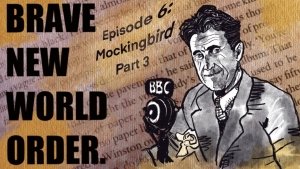
Orwell’s background invites scrutiny. He served in the Imperial Police in Burma, an early exposure to systems of control, hierarchy, and behavioural enforcement. Later, during the Second World War, he worked within the BBC‘s Eastern Service—a branch intimately tied to information dissemination and influence operations. This was not merely broadcasting; it was psychological positioning aimed at shaping perceptions abroad.
This raises an uncomfortable possibility. Was Orwell an independent observer who stumbled upon uncomfortable truths, or was he positioned—consciously or otherwise—within a network that required controlled disclosures? In other words, was 1984 a warning, or a conditioning tool?
The concept of “predictive programming” is often dismissed, yet its mechanics are straightforward. Introduce a future scenario through fiction. Normalise its imagery. Embed its language into public discourse. When elements of that scenario later emerge in reality, they are met not with shock, but with recognition. Acceptance follows more easily than resistance.
Alongside Orwell stands Aldous Huxley, whose Brave New World presents a different method of control—not through fear, but through pleasure, distraction, and engineered consent. Where Orwell’s world is enforced through oppression, Huxley’s is sustained through sedation. Together, these frameworks form a dual strategy: coercion when necessary, indulgence when effective.
Episode 4 draws attention to synchronicities surrounding the Huxley family and wider historical developments tied to population shifts and societal restructuring. Whether coincidence or design, these connections point towards a recurring pattern—elite networks deeply involved in shaping both the intellectual and biological contours of society.
Operation Mockingbird, often referenced in discussions of media manipulation, illustrates how narratives are not merely reported but constructed. Journalists, editors, and cultural figures have historically been leveraged to guide public understanding. The story machine does not simply inform—it filters, frames, and reinforces.
In such an environment, the role of literature becomes more complex. Books like 1984 and Brave New World may function less as isolated works of imagination and more as components within a broader signalling system. They outline boundaries, test reactions, and subtly define what is considered plausible.
The key mechanism at play is not overt control, but perception management. If reality can be interpreted in multiple ways, then guiding interpretation becomes more powerful than controlling events themselves. Language is shaped, dissent is reframed, and alternative viewpoints are either absorbed or marginalised.
For readers already aware of the unseen influences behind political theatre, the question is not whether manipulation exists, but how deeply it penetrates everyday thought. The illusion system depends on participation—on individuals accepting constructed narratives as organic truth.
Orwell famously wrote,
“Who controls the past controls the future: who controls the present controls the past.”
George Orwell
The enduring relevance of this statement lies not in its warning, but in its ongoing application. Control is not static; it evolves, adapts, and refines itself through culture, media, and belief systems.
Whether Orwell was a conscious participant or an unwitting conduit may ultimately be less important than the function his work serves today. The frameworks he described are no longer hypothetical—they are reference points embedded in collective awareness.
The question, then, is not simply who wrote the script—but who continues to edit it.
Source: [SF128] ‘Huxley’s Brave New World Order’ Ep4 Mockingbird [Pt1]





Leave a Comment
Want to join the discussion?Feel free to contribute!