
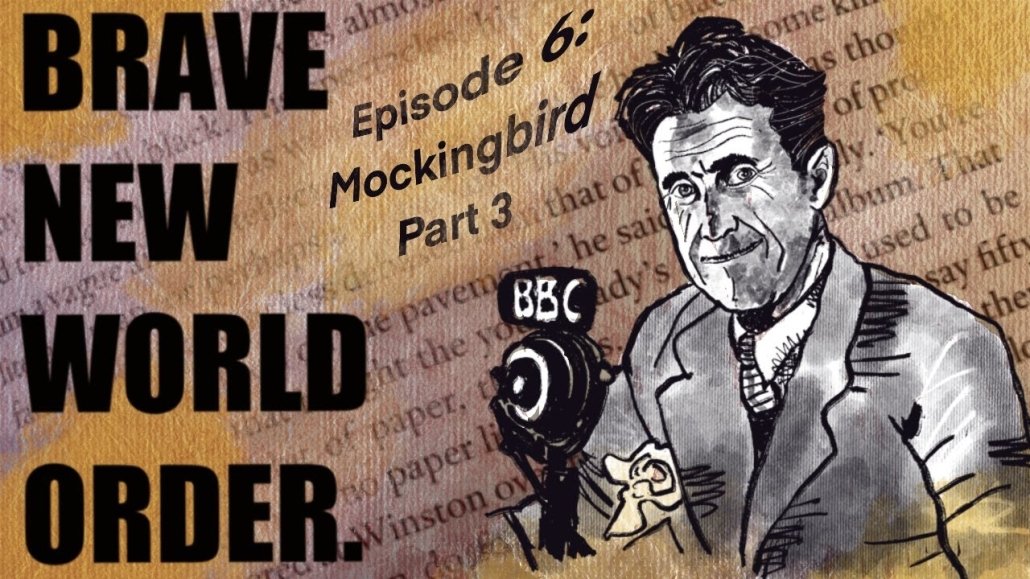
Huxley’s Brave New World Order – Ep6: Mockingbird Part 3 – Sheep Farm
Narrative Engineering
The Manufacture of Narrative: Orwell, Mockingbirds, and the Machinery of Perception
[SF149] “Huxley’s Brave New World Order” Ep6. George Orwell Mockingbird Pt3 – 2023 | Sheep Farm
An examination of Orwell’s legacy through the lens of psychological warfare, exploring narratives, lineage, and cultural icons may function within systems designed to shape perception.
In the sixth instalment of Huxley’s Brave New World Order, the “Mockingbird” series reaches its conclusion with an ambitious and controversial exploration of George Orwell—born Eric Blair—not simply as a writer, but as a constructed figure within a wider ecosystem of influence, messaging, and narrative control.
At its core, this episode invites viewers to reconsider a familiar literary icon through the lens of psychological warfare. Rather than treating Orwell as a lone truth-teller standing against authoritarianism, the programme suggests he may instead represent something more complex: a node within a broader network of ideological shaping.
Narrative as a Tool of Control
Modern psychological operations rarely rely on overt coercion. Instead, they function through story—carefully crafted, emotionally resonant, and widely disseminated. Literature, journalism, and cultural icons become vehicles for embedding ideas that feel organic but may serve strategic purposes.
Orwell’s works, particularly 1984 and Animal Farm, are often interpreted as warnings against surveillance and totalitarianism. Yet the episode raises an alternative angle: what if such narratives also serve to define the boundaries of dissent? By framing tyranny in specific, recognisable forms, they subtly guide audiences away from identifying less obvious systems of control.
This is not to diminish Orwell’s literary impact, but to question how influential figures are positioned within the cultural landscape. In information warfare, even genuine critique can be repurposed to reinforce the system it appears to challenge.
Genealogy and the Power of Lineage
A significant portion of the episode focuses on Orwell’s ancestry and social connections, suggesting links to establishment networks and institutional power structures. Whether or not every claim withstands scrutiny, the underlying theme is familiar within propaganda studies: pedigree matters.
Lineage, education, and social circles often determine access to platforms and credibility. In this sense, the construction of authority is rarely accidental. Figures who shape public consciousness are frequently those already positioned within influential networks.
From a psychological warfare perspective, this raises an important question: are cultural icons discovered, or are they elevated?
The “Mockingbird” Motif
The title “Mockingbird” is itself telling. Historically associated with narratives around media influence and intelligence-linked messaging, the term evokes the idea of voices that echo prescribed lines while appearing independent.
Within this framework, writers, journalists, and broadcasters are not necessarily conscious agents, but participants in a system that rewards certain viewpoints while marginalising others. The result is a feedback loop where approved narratives gain legitimacy through repetition.
In this context, Orwell’s prominence could be interpreted not as accidental brilliance alone, but as alignment—intentional or otherwise—with narratives that serve enduring institutional interests.
The Illusion System
The episode ultimately circles back to a central thesis: that the primary function of the story machine is to maintain an illusion of reality that feels coherent, contestable, yet ultimately contained.
This does not require absolute deception. In fact, it often relies on partial truths—enough authenticity to anchor belief, combined with selective framing that guides interpretation. Competing narratives may exist, but only within boundaries that prevent deeper structural questioning.
From this perspective, even dissent becomes part of the system’s architecture. Controlled opposition, cultural critique, and intellectual rebellion can all be absorbed into a wider framework that stabilises rather than disrupts.
Narrative Construction
While the episode presents provocative claims—including speculation about Orwell’s very existence, they serve a symbolic function: prompting viewers to question how much of what we accept as historical or cultural fact is mediated through layers of narrative construction.
It is widely considered that Orwell was a real individual whose experiences—colonial service, war, political disillusionment—shaped his writing. Yet at the same time, his elevation into a cultural touchstone reflects broader dynamics of influence, publishing power, and ideological resonance.
Why It Matters
The value of this discussion lies not in proving or disproving extreme claims, but in sharpening awareness of how narratives operate.
Psychological warfare today is less about hiding information and more about structuring it—deciding which stories are amplified, which are ignored, and how they are framed. In that sense, examining figures like Orwell is not about dismantling them, but about understanding the systems that make them significant.
For readers attuned to propaganda and social engineering, the key takeaway is simple: question not only the message, but the machinery behind it.
Source: [SF149] “Huxley’s Brave New World Order” Ep6. George Orwell Mockingbird Pt3






Leave a Comment
Want to join the discussion?Feel free to contribute!