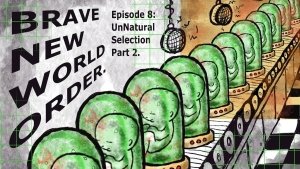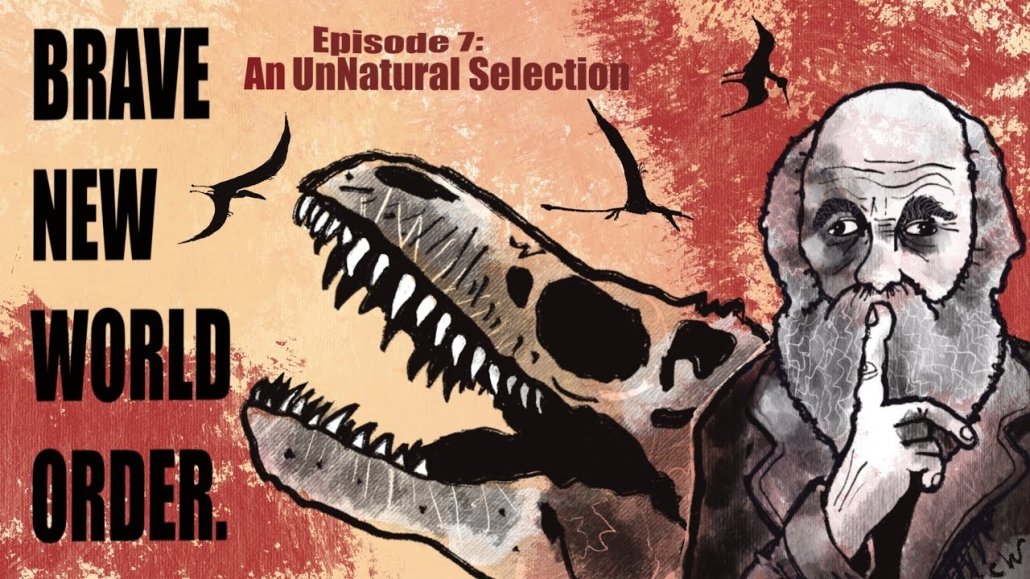
The Huxley’s Brave New World Order – Ep7: An UnNatural Selection Part 1 | Sheep Farm
Hidden Frameworks
[SF170] The Huxley’s Brave New World-Order Ep7
“An UnNatural Selection” [30/03/24] | Sheep Farm
The Academic Reset: Huxley, Darwin, and the Architecture of Engineered Thought
An influential network of 19th-century thinkers reshaped science, embedding narratives that continue to guide institutions, public perception, and the subtle mechanics of modern social control.
If one steps back and surveys the past two and a half centuries with a critical eye, a striking pattern begins to emerge. Somewhere in the mid-19th century, the foundations of knowledge itself appear to have been quietly restructured. What is now presented as settled science and unquestionable truth may, in fact, have originated as carefully seeded theory—cultivated, protected, and ultimately institutionalised.
At the centre of this intellectual pivot stood a network of influential families: the Huxleys, the Darwins, the Galtons. Their names are now synonymous with scientific authority, yet their true legacy may lie less in discovery and more in direction. These were not isolated thinkers operating in a vacuum, but interconnected dynasties whose reach extended across academia, policy, and culture.

Thomas Henry Huxley, often referred to as “Darwin’s Bulldog,” was instrumental in embedding evolutionary theory into the academic bloodstream. His advocacy went far beyond scientific debate; it marked the beginning of a broader ideological shift. Evolution, framed as an unquestionable mechanism of progress, subtly redefined humanity’s place in the natural order—not as a creation of purpose, but as a product of chance and competition.
This reframing carried profound psychological consequences. By reducing human identity to biological processes, it opened the door to new forms of social engineering. If humanity is merely the outcome of natural selection, then why not guide that selection? Enter Francis Galton, Darwin’s cousin and the architect of eugenics—a doctrine that sought to “improve” the human population through controlled breeding. What began as theory soon found its way into policy, influencing governments and shaping societal norms.
The Huxley lineage did not stop with Thomas. His descendants would go on to occupy key positions within cultural and scientific institutions throughout the 20th century. Julian Huxley became the first Director-General of UNESCO, advocating for a scientific humanism that blurred the line between governance and ideology. Aldous Huxley, through works such as Brave New World, offered a vision of a society conditioned from birth—where control is not imposed through force, but through psychological manipulation and engineered consent.
These developments raise an uncomfortable question: were these ideas simply the natural progression of scientific inquiry, or were they part of a coordinated shift in how populations are understood and managed?
The concept of “academic nepotism” becomes difficult to ignore when one traces how influence was passed down through generations. Positions of authority were not merely earned; they were inherited, reinforced by networks that ensured continuity of thought. Dissenting perspectives, meanwhile, were marginalised or dismissed outright, labelled as unscientific or regressive.
Within this framework, even the boundaries of science itself appear flexible. Consider the evolution of palaeontology and the popularisation of concepts such as feathered or flying dinosaurs. While presented as evidence-based refinement, many researchers argue that such theories often rely on interpretative leaps—constructed narratives that serve to reinforce existing paradigms rather than challenge them.
This is not to suggest that all scientific advancement is fabricated, but rather that the direction of inquiry—and the interpretation of findings—can be subtly guided. When institutions, funding bodies, and educational systems are aligned under a shared ideological umbrella, the result is a self-reinforcing cycle: theory becomes doctrine, doctrine becomes curriculum, and curriculum becomes accepted reality.
From a psychological warfare perspective, the implications are profound. Control no longer requires overt coercion; it is achieved through the shaping of perception. If individuals are taught from an early age to view certain ideas as unquestionable, then those ideas effectively become invisible structures—frameworks within which all thought must operate.
The story machine does not demand belief; it cultivates it. Through repetition, authority, and cultural reinforcement, it maintains an illusion of consensus. Those who question it are not debated—they are dismissed.
In this light, the legacy of the Huxleys and their contemporaries may be less about the pursuit of truth and more about the construction of a system—one that defines what truth is allowed to be.
Understanding this history is not merely an academic exercise. It is an invitation to re-examine the narratives we have inherited, and to ask whether they serve the pursuit of knowledge—or the preservation of control.
Source: [SF170] The Huxley’s Brave New World Order Ep7 “An UnNatural Selection” [30/03/24]