
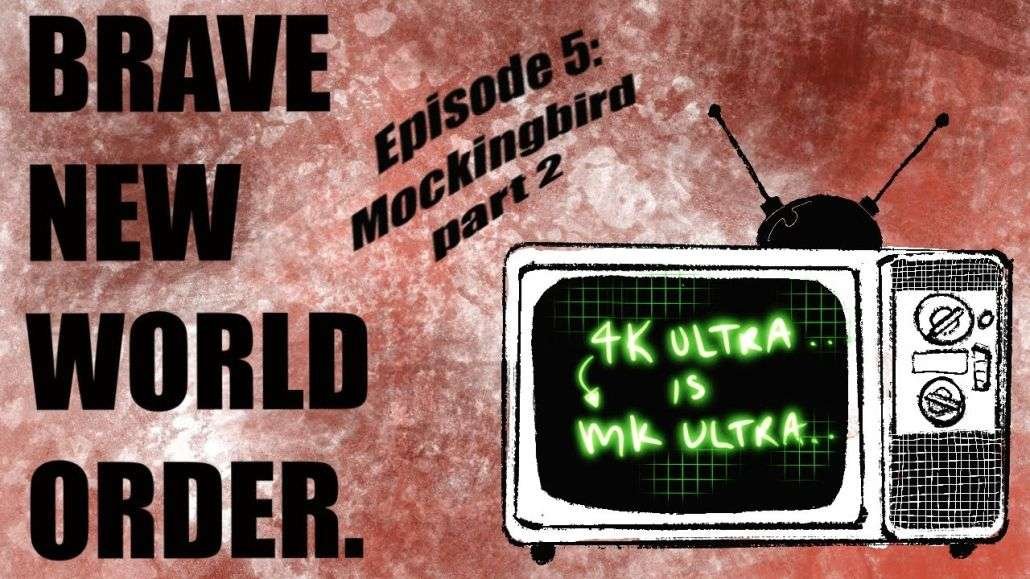
Huxley’s Brave New World Order – Ep5: Mockingbird Part 2 | Sheep Farm
Silent Narratives
[SF131] ‘Huxley’s Brave New World Order’ Ep5 Mockingbird [Pt2] – June 2023 | Sheep Farm
Orwell, Intelligence Networks, and the Architecture of Influence
Orwell’s legacy reveals a deeper network of influence, where literature, intelligence, and propaganda converge to shape perception, guiding societies through carefully constructed narratives and controlled dissent.
Within the architecture of modern psychological warfare, few cultural artefacts hold as much enduring power as George Orwell’s Animal Farm and 1984. These texts are presented as warnings—cautionary tales about authoritarianism and control—but a closer inspection raises a more unsettling possibility: what if they are also instruments of that very control?
Episode 5 of Huxley’s Brave New World Order continues to peel back the layers, shifting focus from Orwell himself to the network surrounding him—particularly his two wives—and their proximity to the machinery of state influence.
The Intelligence Web Around Orwell
The narrative begins with a premise established in the previous episode: that Orwell was not merely an independent writer, but someone deeply embedded within British intelligence circles. His documented cooperation with the Information Research Department (IRD)—a covert propaganda wing of the Foreign Office—places him within a wider ecosystem designed to shape opinion both domestically and abroad.
The IRD specialised in narrative management. Its purpose was not simply to counter rival ideologies, but to subtly steer perception, embedding approved viewpoints through trusted cultural channels. Literature, journalism, and academia became delivery systems.
Orwell, willingly or otherwise, sat at the intersection of these forces.
Eileen O’Shaughnessy: The Ministry Connection
Orwell’s first wife, Eileen O’Shaughnessy, worked within the Censorship Department of the Ministry of Information during the Second World War. This department was tasked with controlling the flow of information—deciding what could be seen, what must be hidden, and how narratives were framed.
This is not a trivial detail.
The Ministry of Information functioned as a central node in Britain’s wartime propaganda apparatus. It coordinated messaging, managed morale, and ensured that the public consumed a curated version of reality. The parallels with 1984‘s “Ministry of Truth” are difficult to ignore.
Was this coincidence, or something more deliberate?
The overlap between Orwell’s fictional constructs and his immediate environment suggests a feedback loop: lived experience informing narrative, and narrative reinforcing the structures of control.
Sonia Brownell: Gatekeeper of the Legacy
After Eileen’s death, Orwell married Sonia Brownell—a figure whose connections lead even deeper into the world of intelligence and influence operations.
Brownell’s association with the IRD, and her role in managing Orwell’s literary estate, positioned her as a gatekeeper of his legacy. Crucially, she was instrumental in the handling and distribution of 1984‘s rights at a time when Western intelligence agencies were actively seeking cultural tools to deploy in the ideological battles of the Cold War.
There is substantial evidence that Animal Farm and 1984 were promoted, funded, and disseminated by intelligence-linked organisations, including the CIA, as part of broader psychological operations. Animated adaptations, translations, and strategic placement within educational systems ensured maximum reach.
These works became more than novels—they became ideological anchors.
Operation Mockingbird and Cultural Engineering
The episode’s title, Mockingbird, alludes to the well-documented CIA programme aimed at influencing media narratives by embedding operatives within journalism, publishing, and broadcasting.
Within this framework, literature is not exempt. Stories shape perception more effectively than overt messaging because they bypass resistance. They embed assumptions, define boundaries of thought, and establish what is considered “normal” or “dangerous”.
Orwell’s works, widely taught and rarely questioned in terms of origin or sponsorship, function as a kind of controlled opposition. They present a version of tyranny that is overt, brutal, and easily identifiable—thereby obscuring more subtle, systemic forms of control operating in plain sight.
The Illusion System
At its core, the episode suggests that the “story machine” serves a singular purpose: maintaining the illusion.
By presenting curated dissent, it creates the impression of awareness while quietly guiding interpretation. Readers believe they are being warned, even as their understanding is being shaped within carefully defined limits.
This is the essence of sophisticated psychological warfare—not suppression, but direction.
If a population can be led to believe it recognises control, it is far less likely to detect the mechanisms actually in play.
Closing Observations
Episode 5 does not claim to provide definitive answers. Instead, it maps connections—between individuals, institutions, and narratives—that invite deeper scrutiny.
Orwell’s life, his relationships, and the afterlife of his work suggest a convergence between art and influence operations that is difficult to dismiss outright.
Whether one views these links as coincidence or coordination, the implications are the same: the stories that shape our understanding of power may themselves be products of it.
And in a landscape where perception is carefully managed, the most effective form of control is not force—but authorship.






















Leave a Comment
Want to join the discussion?Feel free to contribute!