
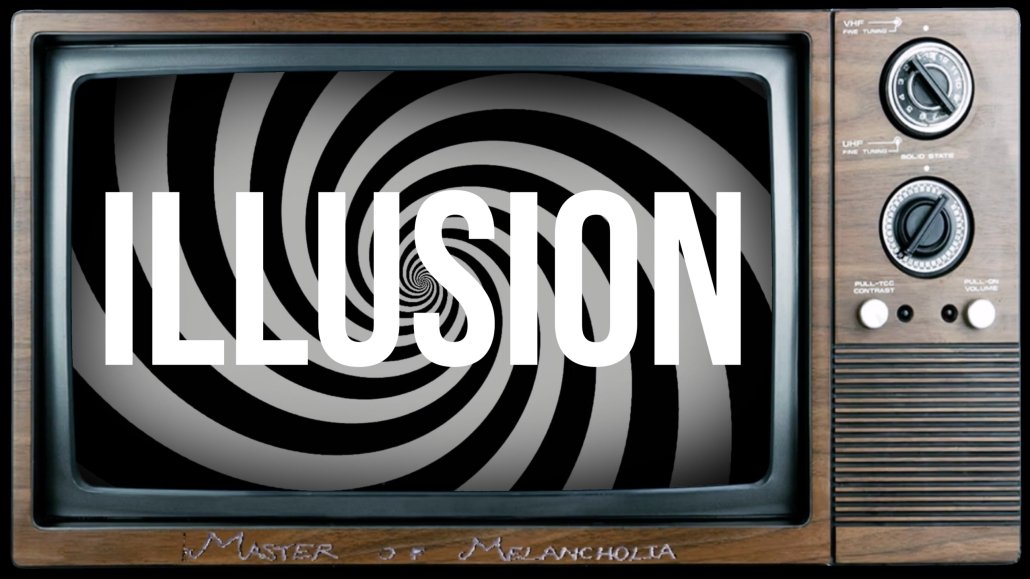
The Illusion System | Essential Guide
An Illusion – June 2026 | Master of Melancholia
Happy 4th of July!! – 4 Jul 2026 | Robot Polisher
Steven Jacobson – Mind Control In America | Jeff Rense
The Hidden Script
Psychological Warfare in the Age of the Story Machine
The news and the entertainment industry as a whole functions as a narrative weapon, shaping perception through fear, repetition, and imagery, sustaining an illusion system designed to influence belief and behaviour.
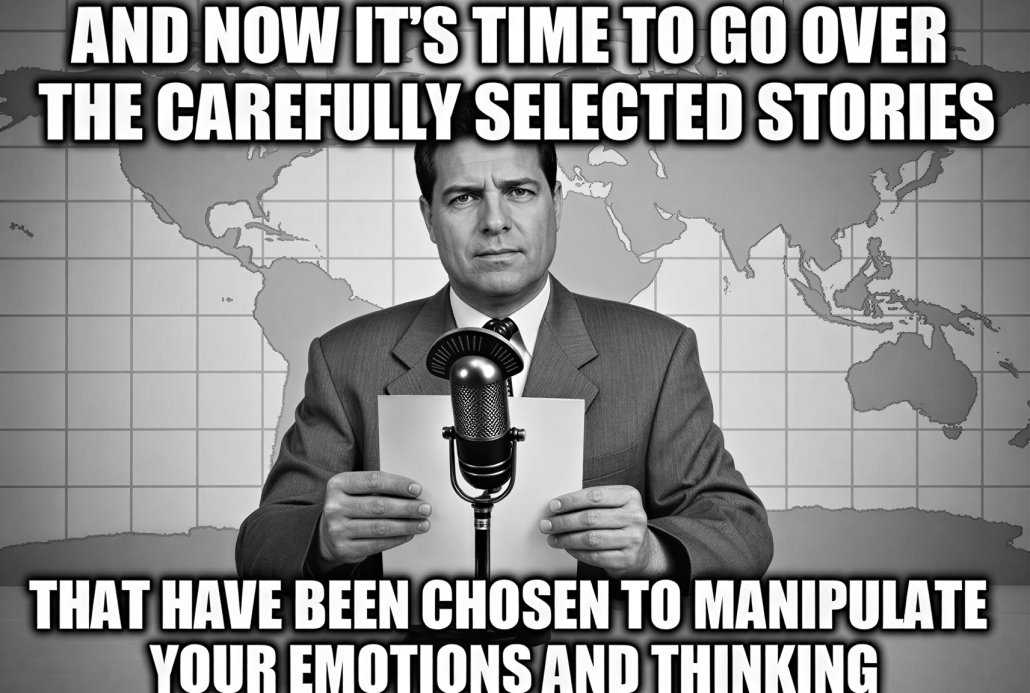
What we commonly refer to as “the news” operates less as a neutral conveyor of facts and more as a carefully engineered instrument of persuasion. It presents itself as information, yet functions with the same underlying intent as advertising: to shape perception, guide behaviour, and ultimately influence belief.
The distinction between journalism, entertainment and promotion has become increasingly blurred. Where companies use advertising to sell products, modern media ecosystems are deployed to sell interpretations of reality. Narratives are constructed, packaged, and distributed in ways that subtly steer public consciousness towards pre-approved conclusions. These are not merely stories; they are frameworks through which society is encouraged to interpret the world.

Fine Tuning Control
This is not a recent development. The machinery of influence has been refined over generations, evolving alongside advances in communication technology. Today, its reach is unprecedented. Screens dominate daily life — televisions, computers, smartphones — and through them flows a constant stream of curated imagery and narrative. These are not passive tools; they are among the most powerful psychological instruments ever created, capable of shaping not only what people think, but how they think.
Central to this system is the manipulation of perception. Visual media carries an inherent authority; people are conditioned to trust what they can see. Yet footage, no matter how compelling, is not proof in itself. It is a representation—framed, edited, and contextualised, possibly totally fake. What is omitted is often as significant as what is shown. In this sense, images become tools of persuasion rather than windows into objective reality.
The mechanics of control rely heavily on emotional engagement, particularly fear. A population kept in a state of low-level anxiety is more receptive to guidance and less likely to question authority. This principle has long underpinned practical politics: present a series of threats (real, exaggerated, or entirely fabricated) and position established institutions as the only source of safety.
“The whole aim of practical politics is to keep the populace alarmed, (and hence clamorous to be led to safety), by menacing it with an endless series of hobgoblins, all of them imaginary.”
H. L. Mencken – Prejudices 1925
These “hobgoblins” need not be tangible to be effective. Through repetition and narrative reinforcement, abstract dangers are made to feel immediate and personal. Over time, these ideas become embedded within the public psyche, forming a mental framework through which new information is interpreted. Entertainment media plays a crucial role here, blending fiction and reality in ways that normalise fear and condition responses.
This continuous cycle of narrative construction and emotional manipulation is what we describe as the story machine. Its primary objective is not simply to inform or entertain, but to maintain the illusion system—a consensus reality that feels organic yet is carefully managed.
Within this system, trust becomes the ultimate casualty. When every image, headline, and broadcast may serve a secondary purpose, certainty begins to erode. The viewer is left navigating a landscape where appearances are curated and meaning is mediated.
Yet awareness of these mechanisms is the first step towards disengagement from them. Recognising the techniques of psychological warfare—framing, repetition, emotional triggering, and selective presentation—allows discerning individuals to question rather than absorb, to observe rather than react.
The screens will continue to broadcast. The narratives will continue to evolve. But the extent of their influence depends, ultimately, on the willingness of the audience to accept them at face value.
The illusion system does not demand belief. It relies on it.
“The conscious and intelligent manipulation of the organised habits and opinions of the masses is an important element in democratic society. Those who manipulate this unseen mechanism of society constitute an invisible government which is the true ruling power of our country.
We are governed, our minds are molded, our tastes formed, our ideas suggested, largely by men we have never heard of. […] We are dominated by the relatively small number of persons who understand the mental processes and social patterns of the masses. It is they who pull the wires which control the public mind, who harness social forces and contrive new ways to bind and guide the world.”
Edward Bernays – Propaganda (1928)

The Mind Machine
The Illusion System relies on the Story Machine, and the Story Machine relies on the fear factory to keep the dark hyperstition magick running. It is an all-pervasive conveyor belt of predictive programming, coercion, and mind control, shaping reality by shaping perception. The result is a manufactured majority worldview, delivered largely through the images we absorb from screens.
The media we collectively love so much is used against us. With a screen now in every hand, the scale of influence has become intimate and constant. These are the black scrying mirrors of perception, control, and divination: we gaze into them in low light and absorb images, symbols, and visions that are interpreted intuitively before we have even consciously examined them. This is the visual-illusion effect in action.
The illusion system does not begin and end with the news. It reaches into politics, sport, entertainment, corporate culture, scientism, symbolism, and even language itself. It is not one programme or one institution, but a total environment of conditioning designed to shape what people notice, what they value, what they fear, and what they accept as normal.
The modern mind is not captured through one dramatic act, but through constant immersion. Messages are repeated across multiple channels until they feel self-evident. News confirms the political mood, politics borrows the language of entertainment, sport becomes tribal theatre, entertainment normalises values, corporations present themselves as moral authorities, and scientism is used to lend an air of unchallengeable certainty to preferred narratives. The result is not simply persuasion, but a managed reality.
“If you tell a lie big enough and keep repeating it, people will eventually come to believe it.
The lie can be maintained only for such time as the State can shield the people from the political, economic and/or military consequences of the lie.
It thus becomes vitally important for the State to use all of its powers to repress dissent, for the truth is the mortal enemy of the lie, and thus by extension, the truth is the greatest enemy of the State.”
Adolf Hitler – Mein Kampf (1925)
Mainstream Media Manipulation | Eric Dubay
Eric Dubay asks how large-scale conspiracies controlling humanity could occur without detection by the mainstream media.
Consolidating Control
Total Mind Capture and the Illusion of “Choice”
The illusion of choice is one of the most effective tools of the media-industrial complex. Although audiences are told they have endless options, the underlying ownership structure tells a different story. A small number of conglomerates dominate much of the news, entertainment, publishing, advertising, and digital distribution landscape, allowing narratives to be synchronised across supposedly independent outlets.
The scale of that consolidation is extraordinary. A relatively small number of media entities dominate the production and distribution of stories, images, and themes that shape public consciousness. The big players in the English-speaking media landscape include Comcast, Disney, Warner Bros. Discovery, Paramount Skydance, Sony, and Amazon, alongside major technology platforms that now shape what people see, share, and believe. Around this structure sits the wider news ecosystem, where major wire services such as Reuters, Associated Press, and PA Media supply the raw material that countless outlets recycle, reframe, and rebroadcast. The result is an information environment that feels vast, yet is built on a narrow foundation.
This concentration matters because it allows messaging to be repeated across multiple channels until it feels organic, consensus-driven, and unquestionable. Almost all US media is controlled by six major corporations:
- Comcast (owns NBCUniversal)
- Walt Disney (owns ABC, ESPN, major film studios)
- Warner Bros. Discovery (owns CNN, HBO, WarnerMedia)
- Paramount Skydance (owns CBS, Paramount Pictures)
- Sony (owns Sony Pictures, music, entertainment)
- Amazon (acquired major media properties)
The Source Layer
The Three Agencies Controlling Worldwide News
Beyond the six mega media conglomerates, there exists a second layer of consolidation at the content level. The majority of worldwide news originates from just three news agencies:
- Reuters (Thomson Reuters) — Founded 1851, the world’s largest international multimedia news provider with 2,600 journalists across 165 countries
- Associated Press (AP) — US-based non-profit, founded 1843
- PA Media — UK-based, founded 1868
Most news outlets—local newspapers, TV stations, online platforms—do not have their own international reporting capacity. They republish or adapt content from these three agencies. A single story from Reuters, AP, or PA can appear simultaneously across hundreds or thousands of outlets worldwide, creating the appearance of independent reporting while originating from the same source.
This means the six conglomerates control distribution, while Reuters, AP, and PA control the raw news content flowing through them. An outlet can be independent in ownership but still dependent on these three agencies for international coverage.
This creates a dual consolidation system: conglomerates control the channels, agencies control the content. Both layers work together to maintain the illusion system.
“We were born into a system of lies and deception.”
Steven Jacobson
Fine Tuned Ancient Order
The mechanisms of control are ancient, but they have been refined to an astonishing degree. Divide and rule keeps people separated into tribes. Bread and circuses keeps them entertained, distracted, and emotionally invested in spectacle. The Hegelian dialectic creates a managed conflict in which two apparent opposites are offered to the public, only for a preselected outcome to emerge as the “solution.” These are not new ideas, but they remain effective because they operate through human trust, fatigue, and repetition.
People are often reluctant to believe that deception of this scale is possible. It would never enter their heads that colossal untruths could be fabricated and maintained with such confidence. Even when confronted with contradictions, they may continue to search for an alternative explanation rather than accept that the narrative itself is engineered. That hesitation is part of the mechanism.
In the contemporary era, the challenge is compounded by CGI, synthetic media, and the rapid rise of AI-generated content. The line between authentic and fabricated has become far easier to blur. At the same time, the media’s grip on attention is stronger than ever. When images can be manufactured, voices cloned, footage edited seamlessly, and narratives amplified instantly, the question is no longer simply whether something is biased. It is whether it happened at all.
We are flooded with content so relentlessly that most people never stop to ask who is shaping the message, why it is being repeated, and what emotional response it is designed to produce. The result is a managed perception of reality, where people believe they are choosing freely while moving within a tightly controlled range of opinions, identities, and acceptable beliefs.
Shaping Malleable Minds
This is the deeper purpose of the mind machine: not merely to tell people what to think, but to shape the conditions under which thinking takes place. Once the frame is set, the audience may believe it has freely chosen its conclusions, when in fact the range of thought was carefully narrowed long before the conversation began.
The illusion is most powerful when it feels like common sense. That is why total capture matters. It is not just about media ownership, but about the colonisation of perception itself. In this environment, the central question is no longer just “What is true?” but “Who benefits from what is being shown?”
Stay calm, stay observant, and do not hand your mind over to the noise. Emotional detachment, clear thinking, and disciplined discernment are your strongest protections in a world built to confuse, provoke, and manipulate.
Refuse the bait. Question the frame. Watch the pattern. The less you react, the more you see. The more clearly you see, the harder you are to control.
Hold your centre, keep your standards high, and do not confuse urgency with truth.
Source: “An Illusion” [Full Version] – music video/social commentary
Source: Happy 4th of July!! – 4 Jul 2026 | Robot Polisher
Source: An Illusion by Macaria · Fakeotube


















Leave a Comment
Want to join the discussion?Feel free to contribute!