
The Greatest Deception – Zetetic Warrior | John Thor
Manufactured Reality
The Greatest Deception – Zetetic Warrior – 2023 | John Thor
How Narratives Shape Belief
Zetetic Warrior examines power, propaganda and social engineering through independent thought—questioning official narratives, hidden interests and the stories that shape public perception.
Cosmology is often presented as settled fact, yet the way people come to accept any model of reality deserves scrutiny. The flat-Earth debate is frequently dismissed as absurd, but it raises broader questions about authority, evidence, social pressure and the mechanisms by which public belief is formed.
The purpose of inquiry is not to replace one orthodoxy with another. It is to examine claims carefully, ask what evidence supports them and refuse to accept an assertion merely because it is repeated by institutions, media or popular culture.

The Burden of Proof
A central argument made by those sceptical of a spinning space ball is that the heliocentric model is a claim, and therefore carries the burden of proof. People are expected to accept a rotating planet, orbiting the Sun, within a vast universe, despite having no direct personal experience of such motion.
This position rests on a basic principle of reasoned debate: the person making a claim is responsible for supporting it. It is not the responsibility of a sceptic to produce a complete alternative explanation before challenging an assertion.
Demanding that a critic first provide another model is a logical diversion. A claim can be examined, questioned or found unsupported without the challenger offering a replacement. In a court of law, for example, the prosecution must establish its case; the accused is not required to prove an alternative account of events.
An established model should be assessed on the strength of its own evidence, rather than accepted because no rival explanation has been fully articulated.
Evidence Before Conclusion
The demand for evidence is not a rejection of science. It is a defence of science. Claims should be observable, measurable, testable and repeatable. Where a claim depends on authority, complexity or social consensus alone, it should be treated with greater caution.
A useful discipline is to separate three questions:
What exactly is being claimed?
What evidence has been presented in support of that claim?
Can that evidence be independently examined and repeated?
Applying those questions consistently protects against both blind trust and reflexive distrust. It also prevents debate from collapsing into a contest between competing authorities.
The Power of Intuition
Geocentric arguments often begin with familiar experience: water finds its level, the ground is still, the Sun moves across the sky and distant objects can be seen farther than expected.
These observations deserve consideration. Everyday perception is real, and people should not be ridiculed for noticing it. The relevant issue is whether large-scale surveying, navigation, engineering and systems are consistent with the claims made about the Earth’s shape.
Maps and Representation
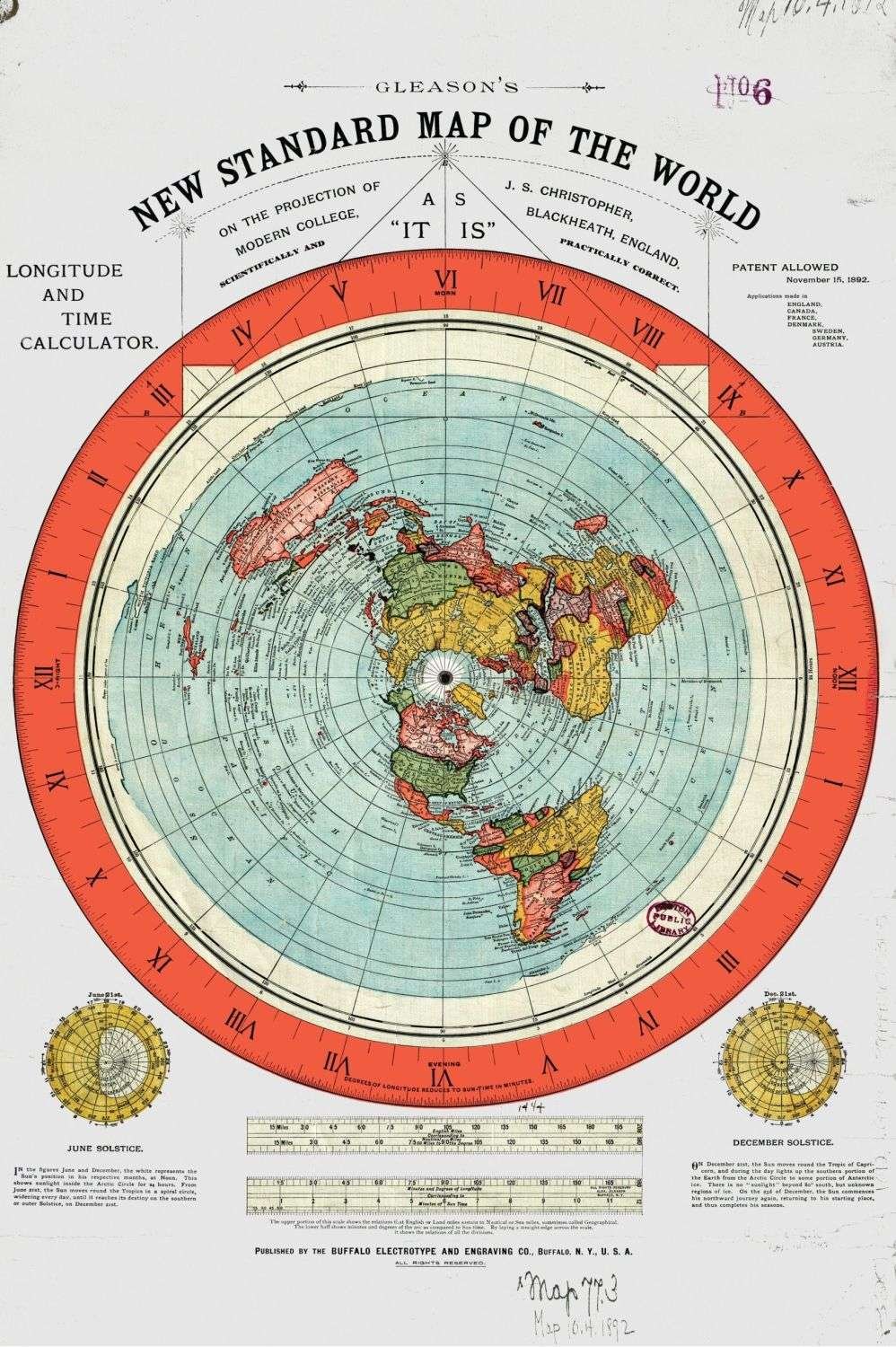
The Gleason map is often presented as evidence for a level world because it depicts the Earth as a circular plane, with the North Pole at its centre and Antarctica surrounding the outer edge.
The important question is not whether a map appears flat—every printed map does—but what it is designed to represent, what distortions it contains and whether it can be used consistently for navigation across the entire planet. Readers should examine the map’s stated purpose, mathematical basis and independent tests of accuracy.
Antarctica and Restricted Access
Antarctica is frequently cited in alternative narratives because public access is limited and military activity in the region has a long history. Restricted travel, permit systems, environmental controls and international treaties appear suspicious to those already distrustful of official institutions.
There are legitimate reasons for caution. States do restrict access to sensitive areas, classify military information and conduct operations without full disclosure. Antarctic governance is also unusual, involving territorial claims, scientific coordination, “environmental protection” and geopolitical interests.
Military History and Hidden Programmes
References to Operation Highjump, Operation Deep Freeze and Operation Fishbowl often appear in discussions of Antarctica, high-altitude testing and alleged concealment.
These are not trivial subjects. Governments have conducted secret programmes, misled the public and abused power throughout history. Healthy scepticism is warranted, particularly where military interests, classified research and political secrecy are involved.
The Atmosphere and Gravity
Another common argument holds that a pressurised atmosphere cannot exist beside the vacuum of space without a physical container. Critics compare the atmosphere to gas inside a tank and argue that gravity is presented as an unproven explanation rather than a demonstrated fact.
This raises a fair philosophical point: people should be able to explain why they accept scientific claims, rather than repeating terminology without understanding. The issue is not whether an authority asserts an explanation, but whether that explanation can be independently examined, tested and repeated.
Space, Institutions and Trust
Scepticism towards space agencies is often linked to documented fakery, institutional failures, political influence, military involvement and historical scandals. These concerns are not without foundation.
Public institutions have concealed information, made errors and served political interests. The recruitment of former Nazi scientists after the Second World War, for example, remains a legitimate subject of historical criticism.
Belief, Identity and Control
The deeper appeal of alternative cosmology lies beyond technical argument. It offers an explanation for alienation, distrust and the sense that public life is managed by forces beyond ordinary visibility.
If people believe they have been deceived about something as fundamental as the nature of the world, it becomes easier to view science, education, media, religion and politics as parts of a single system of control. That narrative can be empowering. It offers belonging, purpose and the feeling of possessing knowledge denied to others.
The Psychology of Certainty
People often defend familiar beliefs because those beliefs are connected to identity, community, education, family, career and worldview. This is not unique to any one group. It affects institutional science, political movements, religious communities and alternative communities alike.
Independent thinking therefore requires humility. It means asking whether one’s preferred explanation is being protected from challenge. It means noticing when a position becomes unfalsifiable—when every contrary fact is reinterpreted as further evidence of the conspiracy.
A healthy inquiry welcomes evidence that could prove it wrong.
Thinking for Ourselves
The most valuable lesson is not to accept a worldview merely because it is repeated by authority, nor to reject one merely because it is unpopular. Claims should be judged by the evidence offered in their support.
The greatest danger is being deceived by others.
True independence of mind requires the courage to challenge power—and the discipline to apply the same standard of proof to every claim, including one’s own.
Source: The Greatest Deception – Zetetic Warrior | John Thor


















Leave a Comment
Want to join the discussion?Feel free to contribute!