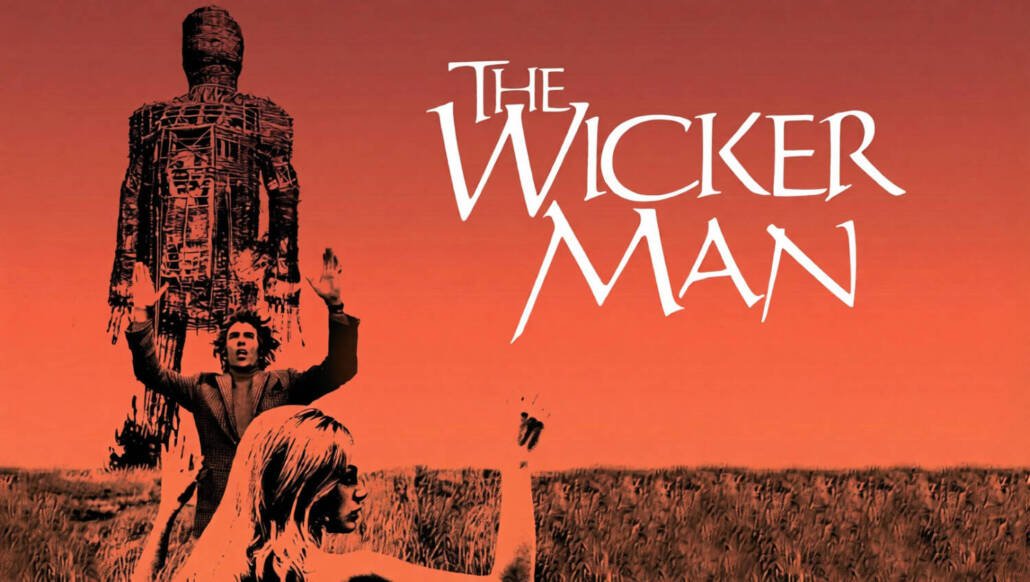
The Wicker Man
Helloween Nightmare Theater:
The Wicker Man with Austin Picard of the Underclass Podcast – October 2026 | William Ramsey
Was The Wicker Man just a horror film, or a pagan ritual the audience was made to take part in? William Ramsey is joined again by Austin Wade Picard of The Underclass for a deep dive into the 1973 cult classic: From Dennis Wheatley and Aleister Crowley to the Son of Sam letters and “Wicked King Wicker” moniker, Christopher Lee‘s 12,000-book occult library and his warning about black magic, the Green Man, the Maypole, and the mystery of the original negative, allegedly buried under a British motorway.
Director Robin Hardy said burning “the occasional policeman” sounded like a fair price. Screenwriter Anthony Shaffer said he looked forward to the day “when we are pagans again.” Join us, as we go through the film scene by scene and ask what was really being put in front of the audience.
The Wicker Man – 2025 | Jay Dyer & Tristan Haggard
Neopagan Revival, Burning Man, & The New Myth of the Old Gods
Wicker Man Analysis | Isaac Weishaupt
Join Isaac Weishaupt as he reviews the “Citizen Kane” of horror films: 1973’s “Wicker Man”. Discussing some occult and Luciferian ideas that were in the book “The Ritual” and reveal ALL of the occult ideas in the film with clips to support the ideas.
Ritualised Reality Control
The Wicker Man – 1973
Police Sergeant Neil Howie journeys by seaplane to the remote Hebridean island Summerisle to investigate the disappearance of a young girl.
The Wicker Man is a 1973 British folk horror film directed by Robin Hardy and starring Edward Woodward, Britt Ekland, Diane Cilento, Ingrid Pitt, and Christopher Lee. The screenplay by Anthony Shaffer, inspired by David Pinner’s 1967 novel Ritual, centres on the visit of Police Sergeant Neil Howie to the isolated Scottish island of Summerisle in search of a missing girl. Howie, a devout Christian, is appalled to find that the inhabitants of the island have abandoned Christianity and now practice a form of Celtic paganism.
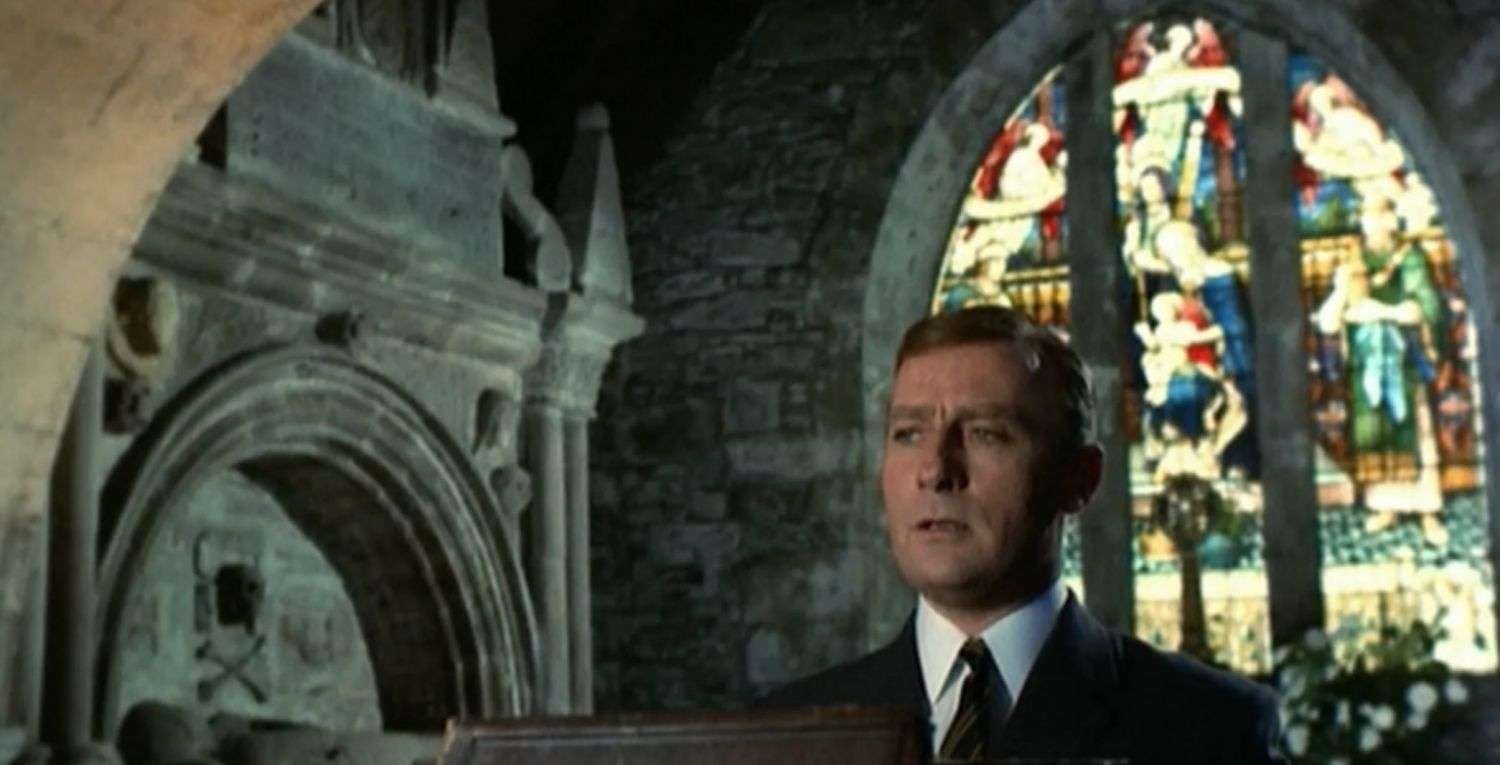
Police Sergeant Neil Howie journeys by seaplane to the remote Hebridean island Summerisle to investigate the disappearance of a young girl, Rowan Morrison, about whom he has received an anonymous letter. Howie, a devout Christian, is disturbed to find the Islanders paying homage to the pagan Celtic gods of their ancestors. They copulate openly in the fields, include children as part of the May Day celebrations, teach children of the phallic association of the maypole, and place toads in their mouths to cure sore throats. The islanders appear to be trying to thwart his investigation by claiming that Rowan never existed.
Paul Giovanni composed the film score.
The Wicker Man is well-regarded by critics. Film magazine Cinefantastique described it as “The Citizen Kane of horror movies”, and in 2004, Total Film magazine named The Wicker Man the sixth greatest British film of all time. It also won the 1978 Saturn Award for Best Horror Film.
The Sound of Summerisle
Songs of Sacrifice: The Soundtrack’s Pagan Spell
The music of The Wicker Man is the film’s principal instruments of enchantment. Composed, arranged, and partly written by American musician Paul Giovanni, and performed with the ad hoc British folk ensemble Magnet, the soundtrack turns pagan ritual into something seductive, communal, and very real.
Rather than deploying the shrieking strings or dissonant cues of conventional horror, the film uses folk songs, nursery rhymes, tavern tunes, and pastoral melodies. Their apparent innocence is the point: as Sergeant Howie’s Christian certainties collide with Summerisle’s fertility rites, the music makes the island’s worldview feel warm, ancient, and almost reasonable.
Folk Revival, Manufactured Antiquity
Giovanni’s score blends original songs with adaptations and arrangements rooted in British and Scottish folk traditions. Anthony Shaffer and director Robin Hardy drew on the folk-revival scholarship associated with Cecil Sharp, selecting material appropriate to spring, fertility, and harvest customs.
Songs as Ritual
The songs function almost like dialogue: they explain the islanders’ beliefs, normalise their sensuality, and draw Howie—and the audience—into their logic. Robin Hardy described the music as moving seamlessly in and out of speech, with lyrics carrying ideas that conventional exposition could not.
The Occult Effect
The soundtrack’s occult power lies in its moral ambiguity. The same pastoral modes that evoke innocence also sanction violence: the islanders’ singing does not merely accompany the sacrifice, it gives it communal meaning and ritual legitimacy. The music helps make the final killing feel, within the film’s internal logic, both monstrous and necessary.
That tension is clearest in the finale. Howie recites Psalm 23 while Lord Summerisle and the villagers sing “Sumer Is Icumen In”; Christian prayer and pagan song occupy the same burning frame. The result is not simply scary music, but a sonic enactment of competing cosmologies.
A Lost Score Made Canonical
For decades, the soundtrack was difficult to hear outside the film, adding to its cult mystique. In the early 2000s, Trunk Records located original reel-to-reel tapes at Pinewood, allowing the music to circulate as an album in its own right.
Its afterlife has been considerable: “Willow’s Song” was later covered by Sneaker Pimps, while the soundtrack’s fusion of folk revival, psych-folk, and uncanny pastoralism has influenced musicians and horror filmmakers seeking to make old songs feel dangerous again.
Giovanni and Magnet’s music is the spell itself: beautiful enough to invite belief, familiar enough to disarm suspicion, and festive enough to make the final fire feel like a rite of renewal rather than murder.

Cult Control
The Wicker Man
A Masterclass in Manufactured Reality
Robin Hardy’s The Wicker Man is frequently celebrated as a genre landmark, but for those attuned to the mechanics of influence, it reads as something far more instructive: a precise case study in psychological warfare, narrative engineering, and the construction of a closed belief system. On the surface, it is the story of a devout Christian policeman, Sergeant Neil Howie (Edward Woodward), lured to the isolated Hebridean island of Summerisle to investigate the disappearance of a young girl. In truth, it is an examination of how an entire community can be steered—through ritual, song, secrecy, and staged events—towards a preordained conclusion, all while believing they are acting of their own free will.
The Architecture of Deception
From the moment Howie’s seaplane touches down, every element of his investigation is choreographed. The anonymous letter that summons him, the missing school register, the contradictory testimonies, the overtly sexualised May Day celebrations—all are components of a carefully scripted operation designed to disorient, isolate, and ultimately deliver him to the wicker effigy. The islanders do not merely lie; they construct an alternative reality in which Rowan Morrison never existed, forcing Howie to question his own sanity as much as their motives.
This is social engineering in its purest form: the manipulation of perception through controlled information, environmental cues, and collective reinforcement. Howie is not kidnapped; he is guided. He is not imprisoned; he is surrounded by a consensus reality that excludes the possibility of his success. His every attempt to assert logic or authority is met with a wall of cheerful incomprehension, a tactic familiar to anyone who has observed how institutions neutralise dissent not through force, but through the sheer weight of agreed-upon fiction.
Lord Summerisle
The Architect Behind the Curtain
At the centre of this operation stands Lord Summerisle (Christopher Lee), the island’s charismatic landowner and spiritual figurehead. He is the only character who does not truly believe in the pagan theology he espouses; for him, it is a tool of governance, a means of maintaining control over a dependent population. As one analysis notes, Summerisle’s propagation of pagan belief is “a handy tool for the control of his island serfs”.
This is the hidden hand in plain sight: the elite who understands that belief systems—whether religious, political, or ideological—are less about truth and more about utility. Summerisle’s ancestors reintroduced paganism to Summerisle not out of devotion, but to mollify and manipulate the populace, ensuring a compliant labour force and a stable social order. When the apple crop fails, the system demands a sacrifice to restore balance; Howie is selected not at random, but because he fits the ritual’s four requirements: he came willingly, he represents the law (“the power of a king”), he is a virgin, and he is a “fool” for falling for the deception.
The Illusion System in Action
What makes The Wicker Man so unsettling for the discerning viewer is not the horror of the sacrifice itself, but the ease with which the illusion is maintained. The islanders sing, dance, and celebrate as they prepare to burn a man alive, convinced of the righteousness of their cause. Their faith is not genuine; it is performative, reinforced through repetition, communal participation, and the suppression of alternative narratives.
This mirrors the broader mechanisms by which populations are steered towards acceptance of policies, conflicts, or social transformations that serve interests other than their own. The story machine does not require universal belief; it requires only sufficient participation and the exclusion of dissenting voices. Howie’s fate is sealed not because he is overpowered, but because he is rendered irrelevant—his truth dismissed as the ravings of an outsider who “doesn’t understand”.
Lessons for the Modern Observer
For readers familiar with the hidden architectures of power, The Wicker Man offers several salient lessons:
Narrative control is absolute: Whoever defines the terms of the discussion controls the outcome. Howie is trapped not by walls, but by a story in which he has no role except as the sacrificial fool.
Ritual reinforces compliance: The islanders’ songs, dances, and sexualised festivities are not mere eccentricities; they are tools of social cohesion and behavioural conditioning.
The elite cult do not believe their own propaganda: Summerisle is the only true atheist on the island, yet he is the most effective preacher.
Dissent is neutralised through gaslighting: Howie’s investigation is thwarted not by denial, but by the systematic erasure of evidence and the collective insistence that his premises are false.
A Film Ahead of Its Time
It is little wonder that Cinefantastique described The Wicker Man as “The Citizen Kane of horror movies”, or that Total Film named it the sixth greatest British film of all time. Its genius lies not in its scares, but in its clarity: it shows, without flinching, how a community can be led to commit atrocity in the name of tradition, faith, or necessity. In an age where narrative warfare is waged across every medium, where populations are steered by invisible hands through curated information and manufactured consensus, Hardy’s film remains a chillingly relevant text.
The wicker man itself is the ultimate symbol of this control: a prison disguised as a ritual structure, its burning framed as a joyous necessity rather than an act of cruelty. As Howie burns, chanting his prayers into the smoke, the islanders dance below, singing “Summer is Icumen In”. The illusion holds. The system endures. And the fool, having served his purpose, is consumed by the very story he sought to unravel.
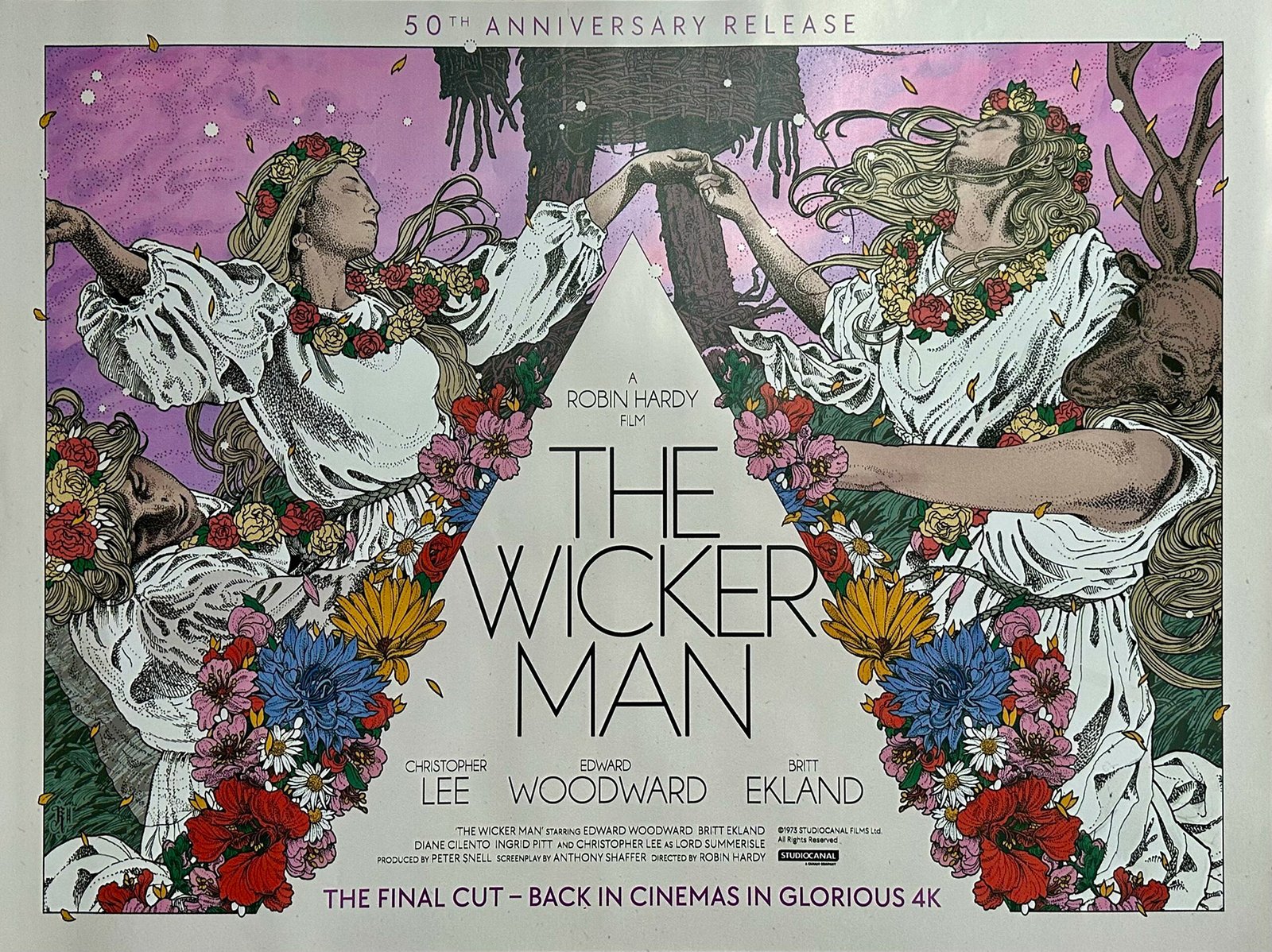
Occult Theatre
Ritual, Seduction and Sacrifice
Folk Horror as a Pagan Initiation
The Wicker Man is usually filed among British folk-horror classics, but its deeper significance lies in what it asks the viewer to do: sympathise with a pagan community, distrust Christian moral authority, and accept ritual sacrifice as tragic necessity. On one level it is a 1973 thriller; on another, it is a carefully staged initiation into an older symbolic order.
For an audience trained to regard religion as repression and “nature” as liberation, Summerisle is not merely a fictional island. It is a moral laboratory.
A Film About Sacrifice
Director Robin Hardy and screenwriter Anthony Shaffer did not stumble into the subject. Hardy later explained that he wanted to make a film about “the nature of sacrifice,” sending Shaffer to research pagan and Celtic society before the screenplay took shape.
That intention matters. The story of Sergeant Neil Howie is constructed as a descent: a Christian policeman enters a closed community, is mocked, seduced, deceived and finally offered to the old gods. The audience is positioned not simply to watch this happen, but to feel the island’s logic becoming increasingly plausible.
Christopher Lee described the film as a confrontation between “organised religion” and “the old belief that we must revere nature and appease it if necessary.” That formulation is revealing: the conflict is not presented as good against evil, but as two competing systems of belief.
Christopher Lee Warning About the Occult and Dark Forces
Christopher Lee is famous for playing dark characters in the movies. But did you know he is a descendent of Charlemagne? He was connected to the royal families of Europe and was Knighted under Queen Elizabeth. In his older years here he warns the audience not to dabble in the occult. In the older footage from 1975, he more gleefully describes Satanism.
Christopher Lee on Black Magick (1975)
Filmed at EMI Elstree Studios, Christopher Lee delivers a blunt, unflinching monologue on the reality of black magic. He insists it is “100 percent true” and “nothing fictitious,” naming Satanism, necromancy, alchemy, and witchcraft as its forms — “the worship of the force of evil.” He claims Satanic ceremonies “will be happening in Britain tonight” and that rituals must be deliberately blasphemous to work. His final warning is absolute: “never, never, never. You will not only lose your mind, you’ll lose your soul.”
Delivered by a man who has spent decades in horror — and believes it.
The Green Man and the Rhythm of the Ritual
The occult texture of The Wicker Man is not confined to its climax. It begins in the imagery: the Green Man, the maypole, fertility songs, phallic rites, nakedness in the graveyard and the constant suggestion that sexuality, agriculture and death are parts of one sacred cycle.
These are not incidental folkloric decorations. They establish a worldview in which the individual is subordinate to the land, the harvest and the community. Howie sees sin where the islanders see sacrament; he sees disorder where they see renewal.
The film’s music performs much of the persuasion. Its folk songs are cheerful, sensual and communal, drawing the viewer into Summerisle’s atmosphere before its brutality is revealed. By the time Lord Summerisle explains the necessity of sacrifice, the audience has already been softened by the film’s aesthetic charm.
Lord Summerisle: The Benevolent Tyrant
Christopher Lee‘s Lord Summerisle is one of cinema’s most effective depictions of the smiling manipulator. He does not present himself as a dark priest or tyrant. He presents himself as a rational, tolerant, enlightened ruler presiding over a happy, fruitful people.
His power lies in reframing. Christianity is portrayed as guilt, repression and failure; paganism as vitality, honesty and ecological harmony. Yet beneath this language lies a society built on deception, sexual manipulation and, ultimately, human sacrifice.
This is the classic structure of social engineering: first dissolve the old moral framework, then offer a new one that appears more natural, freer and more “authentic.” The individual is not told to obey; he is encouraged to feel his way into compliance.
Lee, Wheatley and the Occult Reputation
Christopher Lee‘s association with the occult is relatively well known. Stories of a vast library of 12,000 or even 20,000 occult volumes circulated widely, but Lee himself rejected the claim, saying he owned only a handful of such books.
Yet the legend is not without meaning. Lee’s interest in occult literature was encouraged by Dennis Wheatley, whose novels helped popularise black-magic imagery in post-war Britain. Lee later warned audiences emphatically against involvement with Satanism or black magic, saying it would cause them to “lose your mind” and “lose your soul.”
That warning gives his performance an additional charge. The actor most associated with Dracula and the occult becomes the high priest of a pagan community, while insisting, outside the film, that such forces are spiritually dangerous.
Crowley, Wheatley and the Cultural Current
The William Ramsey podcast discussion (in the tabs above) places the film within a wider cultural current: Dennis Wheatley, Aleister Crowley and the post-war fascination with secret rites, hidden orders and alternative spiritualities. Wheatley’s fiction familiarised a mass audience with the vocabulary of black magic; Crowley’s reputation made occult rebellion seem intellectually daring rather than merely deviant.
The Wicker Man arrives at the point where those currents could be made respectable through art. It does not present occultism as grotesque Gothic evil. It presents it as folk wisdom, sexuality, seasonal renewal and communal belonging.
That is a more effective form of propaganda. Fear repels; beauty persuades.
“When We Are Pagans Again”
Anthony Shaffer’s reported remark that he looked forward to the day “when we are pagans again” could be dismissed as a throwaway joke. Yet it captures the film’s underlying aspiration: not merely to depict paganism, but to rehabilitate it as a lost, suppressed and perhaps necessary form of social order.
Hardy similarly suggested that the film explored how much Christianity owes to paganism, and how much paganism owes to Christianity. In practice, however, the film’s emotional architecture favours the pagan side: Summerisle is warm, fertile and seductive; Howie is rigid, repressed and increasingly isolated.
The viewer is not asked to approve of murder. He is asked to understand it.
The Burning Policeman
Robin Hardy’s remark that burning “the occasional policeman” sounded like a fair price is often treated as gallows humour. In the context of the film’s logic, it is something more unsettling: a statement that individual life may be sacrificed for communal renewal.
Howie’s death is framed as tragic, but also as ritually necessary. The islanders do not see themselves as criminals. They see themselves as custodians of an ancient covenant. The film invites the audience to weigh their certainty against his, and leaves many viewers uncertain where moral authority truly lies.
That uncertainty is the point.
The Missing Negative
The strange afterlife of The Wicker Man has become part of its myth. The original negative disappeared from storage, and accounts have repeatedly claimed that it was used as landfill or ended up in the pylons supporting the M4 motorway. Other accounts place it beneath the M3. The details vary, but the central fact remains: much of the original material was lost, and the film survived only through later prints and restorations
Whether accident, negligence or something stranger, the disappearance fits the film’s themes with almost literary precision. A story about buried gods, hidden rites and sacrificial destruction became a film whose own body was buried beneath British infrastructure.
Not a Ritual — But a Rehearsal
The Wicker Man functions as a symbolic rehearsal in which Christian certainty is dismantled, pagan sensuality is made attractive, and sacrifice is reframed as communal necessity.
Its enduring power comes from that design. It does not lecture. It sings, dances, seduces and laughs. Then it asks whether the policeman on the wicker man was really the innocent one.
For those attentive to propaganda and social engineering, the film is a masterclass in moral inversion. The dark priest magicians do not always demand obedience through fear. Sometimes they offers a sunlit island, a maypole, a song — and waits to see who will call the sacrifice sacred.














Leave a Comment
Want to join the discussion?Feel free to contribute!