
Animal Farm
Illusion Control
Animal Farm – 1954 | Halas and Batchelor
Animal Farm is a 1954 British-American animated drama film produced by Halas and Batchelor, based on the novel of the same name by George Orwell.
George Orwell‘s Animal Farm stands as a masterful allegory dissecting the mechanisms of power, propaganda, and social control—the very pillars of psychological warfare that continue to shape our world. First published in 1945 and immortalised on screen in the 1954 British-American animated film by Halas and Batchelor, Animal Farm uncovers the grim artifice underpinning political puppetry and the construction of collective belief.
At its surface, Animal Farm narrates the tale of farm animals overthrowing their human farmer, seeking a utopia founded on equality, freedom, and happiness. Yet beneath this straightforward revolt lies a ruthless examination of how revolutionary idealism is methodically co-opted and corrupted by those who wield propaganda as a weapon. Orwell exposes how language becomes a tool for deception, rewriting truth to shape perception and consolidate power.
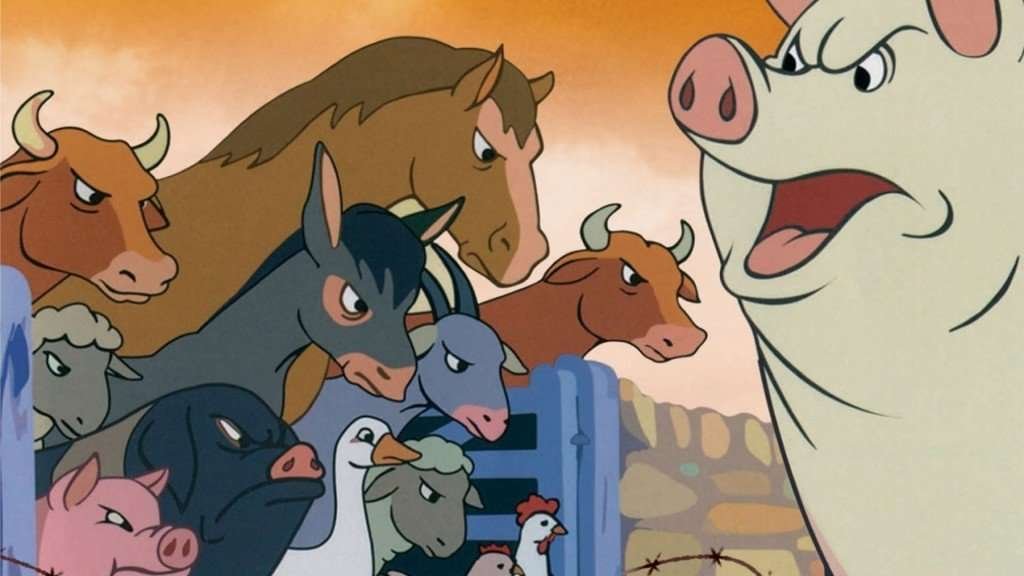
The animal leaders—mirroring historical totalitarian regimes—deploy myths, slogans, and carefully staged spectacles to manipulate their comrades. The immortal lines and commandments that once promised liberation slowly mutate, restraining freedom through enforced ignorance and fear of dissent. This transformation reflects the psychological warfare tactics elites employ to manufacture consent, directing behaviour and thought without overt coercion.
For readers attuned to the hidden forces steering global currents, Animal Farm is more than just a cautionary tale. It is a mirror held up to the ongoing theatre of the illusion system—a spectacle designed to stabilise the status quo by controlling narratives. The novella’s layered symbolism reveals social engineering’s blueprint: control the story, and you control reality itself.

The 1954 film adaptation, by conveying these themes through animation, extends Orwell’s reach into the realm of visual propaganda, underscoring how media itself becomes a battleground for psychological influence. In an era where information is weaponized and narrative dominance equates to power, Animal Farm remains an essential study of how societies are engineered to follow the scripts written by unseen hands. It challenges us to question the stories we are fed and to uncover the subtle, often invisible, chains that bind collective consciousness.
In understanding Animal Farm, one gains insight into the architecture of control—how revolutions are hijacked to serve new tyrannies, how propaganda reshapes truth, and how social engineering perpetuates the illusion of choice. It is not merely a fable but a study in the ongoing war for minds and souls beneath the surface of world events.
Animal Farm and the CIA
Animal Farm was significantly influenced by the CIA, specifically through its covert funding and intervention in the film’s production. The Office of Policy Coordination (OPC), a CIA branch tasked with fighting communism in popular culture, initiated contact with George Orwell‘s widow, Sonia Orwell, to secure the film rights and fund the adaptation. The CIA distrusted Hollywood animators due to blacklisting at the time, so they chose to work with Halas and Batchelor, who were established British animators experienced in wartime propaganda films.
Halas and Batchelor were largely kept in the dark about the CIA‘s involvement during production. They knew they worked for the US government but were unaware the CIA was the driving force until the 1960s or later, feeling manipulated by this revelation. The CIA exerted strong influence on the script, demanding multiple rewrites—at least nine versions—to alter Orwell’s original ending to fit the agency’s agenda. For example, while Orwell’s book ends with humans and pigs indistinguishable in corruption, the film removes the humans as villains and portrays only the pigs as corrupt, shaping the narrative to serve Cold War propaganda.
The CIA‘s interference included script disputes, character changes (e.g., making Stalin and Trotsky allegories less sympathetic), and narrative adjustments downplaying capitalism’s critiques. The film’s final narration was carefully controlled by the CIA to deliver their ideological message. Halas and Batchelor‘s commitment to staying true to Orwell’s vision clashed with the CIA‘s demands, resulting in production delays and creative tension.
In essence, the film is a prime example of psychological warfare through social engineering and propaganda, illustrating how intelligence agencies covertly shape media narratives to manage public perceptions and reinforce the illusion system controlling societal beliefs. Halas and Batchelor‘s Animal Farm thus represents not only an artistic work but also a tool crafted under the hidden hand of political puppetry during the Cold War era.
Source: Animal Farm (1954) Full Movie in English







Leave a Comment
Want to join the discussion?Feel free to contribute!