

Murder in the Heartland – The Oklahoma City Bombing Coverup | Pat Shannan
The Architecture of Narrative
Murder in the Heartland
The Oklahoma City Bombing Coverup – 1995 | Pat Shannan
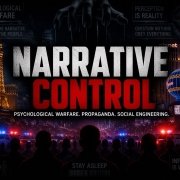
Narrative Control and the Oklahoma City Bombing
In the aftermath of the Oklahoma City bombing, a narrative formed revealing how media power, and psyops converge to shape perception, limit dissent, and stabilise public belief.
Six years before 9/11, the Oklahoma City bombing was the first mass casualty terrorist attack on American soil. From now on nothing would be the same again. “Murder in the Heartland: The Oklahoma City Bombing Coverup” is a gripping documentary that delves into the shocking events surrounding the 1995 Oklahoma City bombing and uncovers the layers of conspiracy, corruption, and unanswered questions that still linger to this day. Through powerful interviews, never-before-seen footage, and meticulous investigative work, the film challenges the official narrative and explores the possibility of a coverup at the highest levels of government.
The documentary takes viewers on a deep dive into the bombing’s aftermath, the investigation, and the legal proceedings, questioning key aspects of the case, such as the involvement of multiple perpetrators, the role of federal agencies, and the controversial handling of evidence. With expert analysis and compelling testimony from whistleblowers, the film seeks to shed light on the darker side of this tragic event and its lasting impact on the victims, survivors, and the American public.

Narrative Anchoring
In the immediate aftermath of the Oklahoma City bombing on 19 April 1995, the machinery of narrative formation moved with remarkable speed. Within 48 hours, a coherent story had taken shape across television networks, newspapers, and official briefings. A suspect had been identified, a motive outlined, and a broader ideological framework established. For the public, the tragedy was not only devastating—it was swiftly explained.
The Oklahoma City bombing became a defining example of how media ecosystems and state institutions align to create a dominant interpretation. The portrayal of “domestic extremism” as the central threat was not merely descriptive; it shaped public perception and policy direction for years to come. Within a short time, legislative responses expanded surveillance capabilities and redefined the balance between security and civil liberties.
From a psychological warfare perspective, the key issue is not whether information was true or false in absolute terms, but how it was prioritised, framed, and repeated. Human cognition is highly susceptible to early framing effects. The first widely accepted version of events tends to anchor all subsequent understanding, even when later complexities or contradictions emerge. This is known as narrative anchoring.
Media repetition further reinforces this effect. When audiences encounter the same interpretation across multiple platforms, it creates an illusion of consensus. Over time, alternative viewpoints—whether credible or speculative—are marginalised, not necessarily through suppression, but through omission and lack of amplification. Silence, in this context, is as powerful as censorship.
The term “patsy” often appears in discussions surrounding high-profile criminal cases, reflecting a deeper public mistrust of institutional transparency. The persistence of such claims reveals a growing awareness that information ecosystems are not neutral. They are curated, filtered, and influenced by political, economic, and cultural forces.
Social engineering operates most effectively when it is invisible. It does not demand blind obedience; rather, it guides perception subtly, shaping what people consider reasonable, plausible, or even thinkable. In the case of Oklahoma City, the dominant narrative not only explained a tragedy but also contributed to a broader redefinition of internal threat landscapes within the United States.
This highlights a complex dynamic: institutions responding to crisis in ways that preserve authority, maintain order, and reinforce existing power structures. The result is seamless, regardless of whether it emerged from coordination or convergence of interests.
For those examining psychological operations and propaganda, the lesson is clear. The most effective influence does not rely on fabricating reality outright, but on selecting which parts of reality are emphasised, which are ignored, and how they are emotionally framed. The story machine thrives not on deception alone, but on narrative discipline.
The Oklahoma City bombing remains a tragic and deeply painful chapter in modern history. Yet beyond the event itself lies another layer of analysis—one concerned with how societies are guided to interpret such moments. Understanding that process is not about rejecting official accounts outright, nor embracing alternative narratives uncritically. It is about recognising that perception is shaped, and that in times of crisis, the battle for meaning begins almost immediately.
In that sense, the true arena is not only the physical world, but the psychological one—where narratives are constructed, contested, and ultimately accepted.
Source: Murder In The Heartland – The Oklahoma City Bombing Coverup





Leave a Comment
Want to join the discussion?Feel free to contribute!