
Las Vegas Mass Shooting; The Anatomy of a Conspiracy Theory | The Underclass
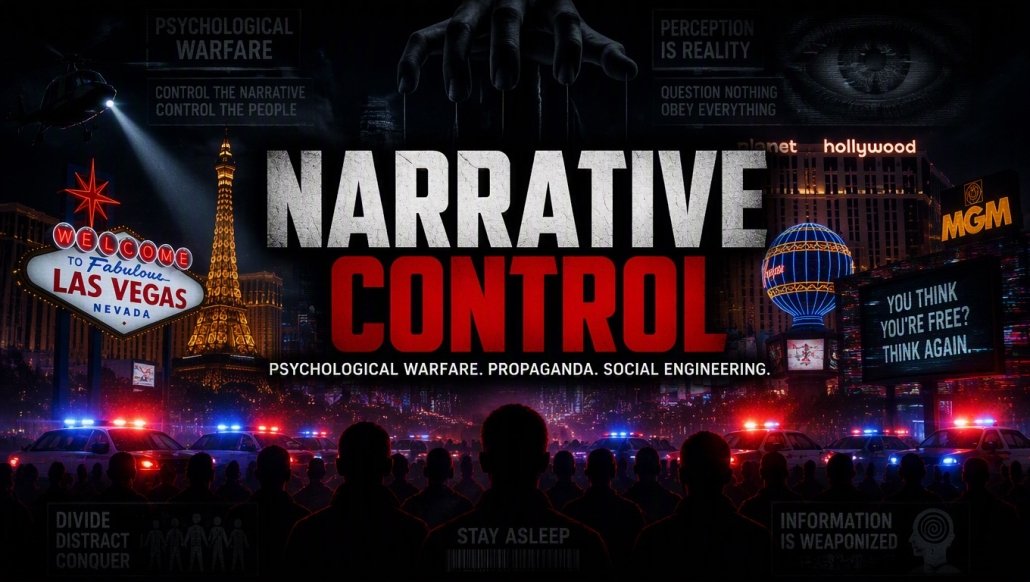
Narrative Control
Las Vegas, Mass Trauma, and The Story Machine
2017 Las Vegas Mass Shooting – 17 July 2024 | The Underclass
A mass shooting becomes psychological weaponry when grief is rapidly channelled into fear, narrative control, and consent to disarm sceptical, law‑abiding citizens.
The massacre in Las Vegas was presented as another tragic milestone in a long-running saga: an epidemic of discontent, random violence, and the supposed inevitability of ever tighter controls on ordinary citizens. The event itself was horrifying, but what followed was just as revealing. Not simply in what we were told, but in how we were told it, how quickly dissenting questions were dismissed, and how efficiently a particular script came to dominate the public mind.
For readers already familiar with the hidden hand behind political puppetry, the case is instructive. It shows how modern psychological warfare no longer relies solely on crude censorship or overt state propaganda. Instead, it operates through a sophisticated story machine whose primary objective is to preserve the illusion system: a managed perception of reality in which certain causes, culprits, and cures are always deemed acceptable, and others are quietly erased.

The Anatomy of a Modern Narrative
To understand the anatomy of a conspiracy theory, we first have to understand the anatomy of an official narrative. Every high-profile atrocity now follows a recognisable sequence:
- An immediate emotional framing: images of victims, panicked crowds, distraught relatives.
- A rapid consensus about motive and method, often before investigations are complete.
- A sidelining or ridicule of alternative accounts or anomalies.
- A policy conversation that appears pre-scripted; the “solution” emerges almost instantly.
In the case of Las Vegas, the story settled quickly: a lone, inexplicably deranged shooter; an arsenal of weapons; the familiar conclusion that firearms in private hands constitute an intolerable risk. This sequence is not accidental. It is a psychological operation built on repetition, emotional overload, and the deliberate narrowing of what the public is allowed to consider.
Conspiracy theories arise in the gaps: the unanswered questions, the contradicting witness reports, the inconsistencies in timelines, the opaque behaviour of officials. But instead of these questions being investigated in good faith, they are now used as justification to pathologise scepticism itself. To doubt the script is to be labelled unhinged, dangerous, or morally suspect. In other words, the narrative protects itself.
Preconditioning The Public Mind
For decades, citizens have been preconditioned through media, entertainment, and education to respond to crisis in very specific ways. The over-socialised and under-educated are taught that:
- Authority is generally benevolent and ultimately trustworthy.
- Complex events have simple causes and simple villains.
- Emotional reaction is a valid substitute for careful analysis.
- To question the overarching story is to “take the side” of evil.
This conditioning is a form of social engineering. It trains people to seek psychological comfort rather than truth. When a shocking event occurs, they are led to crave narrative closure as quickly as possible. The story machine obliges, offering tidy explanations and moral clarity, while quietly setting the stage for policy changes that would have been unacceptable under normal circumstances.
One example: each highly publicised act of violence is framed not as an isolated crime, but as part of an “epidemic” of discontent that can only be cured by increased control over law-abiding citizens. Responsibility is shifted from individuals and institutions to abstract forces like “hate”, “extremism”, or “radicalisation”, which conveniently justify ever-more intrusive surveillance and regulation. The very people who pose no threat are recast as the problem to be managed.
Emotional Shock as a Weapon
Mass trauma events like Las Vegas function as emotional shock weapons. They achieve several strategic effects at once:
- They create a state of fear and helplessness.
- They trigger tribal responses: for or against a specific policy agenda.
- They drown out sober discussion under a flood of outrage and grief.
- They generate consent for measures that would otherwise meet resistance.
Psychological warfare operates by exploiting the natural human tendency to seek safety and meaning. When people are emotionally overwhelmed, they become highly suggestible. The period immediately following a major atrocity is prime time for narrative injection: pundits, officials, “experts”, and celebrities converge on the same talking points, reinforcing them until they feel like common sense.
In this environment, conspiracy theories serve an odd dual function. On the one hand, they offer an alternative story for those who instinctively distrust the official version. On the other, they are used by the establishment as scarecrows—examples of irrationality and “dangerous misinformation” that must be contained. Thus the system can simultaneously produce the narrative, produce its critics, and then present itself as the arbiter who must save the public from both.
Pathologising Scepticism
The crucial move in modern propaganda is not simply telling a story; it is redefining which questions are permitted. If you ask why investigations are sealed, why contradictory evidence disappears, or why witnesses are silenced or discredited, you are no longer a concerned citizen—you are a “conspiracy theorist”. This label is designed to shut down conversation rather than encourage it.
In psychological terms, this is a classic reframing tactic.
- The focus shifts from the content of the doubt to the character of the doubter.
- Reasonable suspicion becomes proof of mental instability or moral failing.
- Institutions are protected from scrutiny by turning their critics into outcasts.
The Las Vegas case illustrated how swiftly this reframing can occur. Within days, legitimate questions about logistics, motive, and security failures were dismissed as fringe obsessions. Mainstream outlets either ignored them or lumped them together with genuinely absurd claims, thereby contaminating all dissent with the same brush. Once that contamination is complete, most people retreat from enquiry for fear of social stigma.
Disarming The Law-Abiding
At the heart of many such narratives lies a recurring objective: to restrict the capacity of ordinary people to defend themselves, both physically and intellectually. Physical disarmament is obvious enough—policies aiming to reduce or eliminate access to weapons among those who have never committed a crime. Intellectual disarmament is subtler but equally corrosive.
Intellectual disarmament involves:
- Eroding critical thinking through low-quality education.
- Rewarding emotional display over logical argument.
- Flooding the information space with superficial commentary.
- Training the public to defer to experts rather than investigate.
When law-abiding citizens are disarmed in both senses, they become passive spectators in their own societies. Their role is reduced to voting, consuming content, and reacting on cue to major events. They are discouraged from understanding the machinery of power, from mapping the links between political puppetry, corporate interests, and the security apparatus. Instead, they are taught to believe that freedom and safety are gifts bestowed from above, not rights defended from below.
The epidemic of discontent is thus framed in a way that obscures its true sources: economic precarity, cultural fragmentation, institutional corruption, and the erosion of meaning. Rather than addressing these roots, the story machine presents a series of symbolic villains—“dangerous individuals” whose actions justify deeper intrusion into everyday life.
The Conspiracy Theory as Mirror
Paradoxically, studying conspiracy theories can help us understand how the official illusion system works. A theory is often dismissed not because it is false, but because it threatens the emotional equilibrium that the system carefully maintains. Sceptics are sensitive to patterns: repeated failures, conveniently timed events, and the revolving door between government agencies and media organisations.
When you strip away the wilder claims, many conspiracy narratives are attempts to restore causality and accountability to a world where these have been systematically erased. People sense that the surface story is incomplete, that the declared motives do not match the resulting policies, and that certain actors always seem to benefit from crisis. The theory becomes a way to explain what the authorised narrative refuses to name.
From the standpoint of psychological warfare, this is dangerous. A population that sees through the illusion system becomes harder to steer. It no longer accepts that every atrocity requires an expansion of state power, that every scandal is an isolated incident, or that every deviation from the official line is a mental health issue. It begins to demand evidence, transparency, and genuine debate.
Towards a Culture of Sceptical Reflection
Imagine a society in which the intended reaction to mass trauma events fails to materialise on cue. Instead of rushing to the emotional barricades, people pause. They grieve, certainly, but they also reflect. They examine the details, compare conflicting accounts, and trace the policy proposals that ride in on the back of tragedy.
In such a society:
- Media spin would be scrutinised rather than swallowed.
- Rapid-fire legislation in the shadow of disaster would be questioned.
- The timing and beneficiaries of events would be analysed.
- Scepticism would be treated as civic duty, not pathology.
This is precisely the kind of culture that psychological warfare seeks to prevent. The illusion system relies on predictability: predictable fear, predictable outrage, predictable calls for “action now”. Break that pattern, and the story machine starts to misfire.
The Las Vegas shooting, like many events before and since, should be studied not only for what happened on the ground, but for what happened in the collective mind. Who framed the narrative? Who set its boundaries? Who censored its critics? And who gained from the policies, technologies, and norms that followed?
Until citizens consistently ask these questions, the dark magicians will continue its work from the shadows, steering perception as much as politics. And the over-socialised, under-educated, emotionally reactive public will remain its most valuable asset: not because they are weak, but because they have been taught not to see the strings.
Source: 2017 Las Vegas Mass Shooting; The Anatomy of a Conspiracy Theory – YouTube












Leave a Comment
Want to join the discussion?Feel free to contribute!