

The Occult Philosophy | Michael A. Hoffman
The Cryptocracy
The Occult Philosophy – 1987 | Michael A. Hoffman
Michael A. Hoffman‘s speech from 1987 is often referenced for its critical insights into the mechanisms of control exercised by the ruling elite over societies.
In his address delivered at the Occult Philosophy Conference held in Anaheim, California, Hoffman argues that the power regime utilise various methods, including media manipulation, symbolism, and psychological tactics, to maintain their power and influence.
“It is always the inclination of man to deny reality, to tidy things up, to wrap perception in the pretty party ribbon of partisanship and prejudice. It is the fate of the revisionist historian to forever wander the frontiers beyond party and dogma, cognisant of the original sin of his own subjectivity, but always struggling to see more, and give an account of what he sees with an utter disregard for the consequences of so fugitive a vocation.”
“Even at this juncture, information is not enough. For the key to getting as close to the truth as we can depends not on obtaining the most information, but rather, in honing our ability to detect fraud. Information is power, but it is not wisdom. Revisionist history consists in the art of discerning fraud and the courage to publicly strip illusion, even when the whole world is clamouring violently for it.”
Key Themes from Hoffman’s Speech
Media Manipulation
Hoffman emphasises the role of media as a tool for shaping public perception and opinion. He suggests that the media does not merely report news but actively constructs narratives that align with the interests of those in power. This construction of reality leads to a significant distortion of truth, influencing political discourse and public sentiment. He warns that this manipulation undermines democratic processes by creating a populace that is misinformed or easily swayed by propaganda.

Symbolism
Another critical aspect of Hoffman’s argument is the use of symbolism in controlling societal beliefs and behaviours. He posits that symbols—whether in advertising, politics, or culture—serve to reinforce the status quo and distract individuals from questioning authority. The strategic deployment of symbols can evoke emotional responses that align with the elite’s agenda, effectively guiding public thought and action without overt coercion.
Psychological Control
Hoffman also addresses the psychological dimensions of control, highlighting how fear and social conditioning are employed to maintain compliance among the masses. By promoting a sense of dependency on media narratives and societal norms, the ruling class perpetuate their influence. This psychological manipulation is often subtle but pervasive, leading individuals to internalise beliefs that serve the interests of those in power rather than their own.
Hoffman’s speech provides a profound critique of how media, symbolism, and psychological tactics are wielded by the ruling elite to control societies. His insights remain relevant in contemporary discussions about media influence and democratic integrity, serving as a cautionary tale about manipulation in modern governance and societal structures.
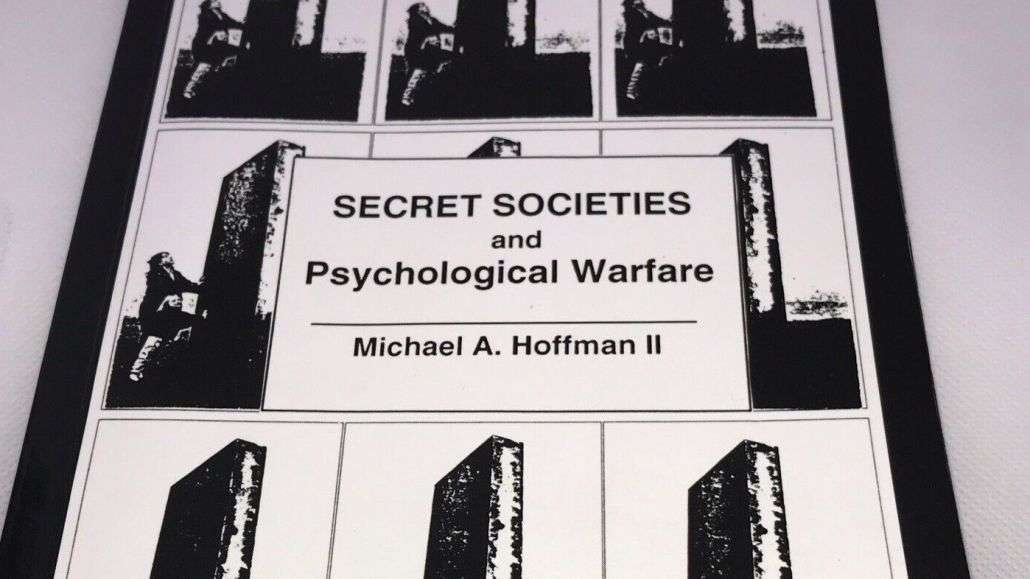
Secret Societies and Psychological Warfare
Michael Hoffman is an American author known for his exploration of elite control, occult symbolism, and the influence of secret societies on society.
His notable work, “Secret Societies and Psychological Warfare,” delves into the covert operations of clandestine organisations and their manipulation of public perception through psychological tactics.
From 007 to 2001, from Dealey Plaza to the Apollo Moon Flight, from the barrel of a Bulldog .44 to the corridors of the pyramids of Sirius; from the secret symbolism of Jack the Ripper to the public symbolism of the first atomic bomb blast, this work illuminates the crimes and command ideology of the masonic Cryptocracy, where ground zero meets the zero hour in a bestial crucible of ritual murder, human alchemy and demonic invasion.
Secret Societies and Psychological Warfare takes the reader to the core of a cosmic cryptogram, a dark Oz where the ancient fables become modern memes for the psychological contagion and devastation of humanity, and where the stratagem the author terms ‘Revelation of the Method’; becomes the key to the finale of the mysteries of the ages.
“The population has become so brutalised and desensitised that the secrecy is no longer necessary, and simply by virtue of being a percipient in-front of your network news, your electronic video games, or going to the movies, you are ingesting and imbibing this processing.”
Michael Hoffman
An Overview
Secret Societies and Psychological Warfare
In his groundbreaking book, Hoffman argues that secret societies, particularly masonic groups, engage in psychological warfare to control and influence the masses. He introduces the concept of “twilight language,” a form of coded communication that reveals hidden meanings behind historical events and societal changes. Hoffman posits that these societies thrive on the apathy and ignorance of the public, which he describes as suffering from amnesia, abulia, and apathy. This condition allows shadow governments to operate with minimal resistance, as people are often unaware of the manipulations at play.
Hoffman examines various historical events, including the JFK assassination, the atomic bomb detonation, and modern mass shootings, suggesting that they are not merely random occurrences but rather orchestrated actions with occult significance. He posits that these events serve as rituals that reinforce the power of the cryptocracy, which he describes as a hidden government operating through psychological manipulation and fear.
Key Concepts
Revelation of the Method: Hoffman discusses this principle as a psychological tactic where the perpetrators of a conspiracy reveal their actions in a way that demoralises the public, making them feel powerless to resist. This technique reinforces the idea that the secretive nature of these societies gives them an omnipotent status, further disempowering the masses.
Occult Symbolism: The book is rich in analyses of occult symbols and their meanings, suggesting that these symbols are embedded in cultural narratives and media to influence public thought subconsciously. Hoffman argues that understanding these symbols is crucial to recognising the underlying motives of secret societies.
Psychological Manipulation: Hoffman asserts that modern media and entertainment serve as tools for psychological warfare, embedding subliminal messages that shape societal beliefs and perceptions. He provides examples of how films and other media can subtly alter public consciousness through hidden agendas orchestrated by powerful groups.
Conclusion
Hoffman’s “Secret Societies and Psychological Warfare” is a controversial yet thought-provoking examination of the intersection between secretive organisations and psychological manipulation. His work invites readers to question conventional narratives and consider the deeper implications of societal events, urging a more critical approach to understanding history and current affairs. While his theories are often viewed as fringe, they contribute to ongoing discussions about the influence of power structures in shaping human behaviour and societal norms.
Secret Societies and Psychological Warfare | Michael Hoffman
Source: Secret Societies And Psychological Warfare Michael Hoffman 1987























Leave a Comment
Want to join the discussion?Feel free to contribute!