
Flat Earth Theory | My Frequencies
Flat Earth Theory – 31 Dec 2017 | My Frequencies
Narrative Control
The Psychology of an Unthinkable Question
When questioning becomes taboo, consensus replaces evidence. The real battle is not only over Earth’s shape, but who controls reality’s story and punishes dissent.
How can the shape of the earth be a serious point of debate in the 21st century?
The Forbidden Starting Point
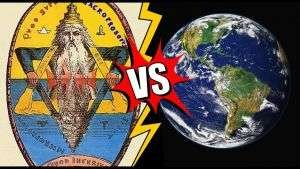
Few propositions appear more settled than the shape of the Earth. In modern life, the “globe” is treated not merely as a scientific conclusion, but as a foundational assumption—woven into education, cartography, aerospace, navigation, media and everyday speech. To question it is therefore presented as an eccentricity, a sign of ignorance or a refusal to accept reality.

Yet this reaction raises a more interesting question: why should the subject provoke such intensity?
The flat-Earth position begins with a deliberately disruptive premise: that the Earth is flat, motionless and situated at the centre of the known and knowable universe. Its advocates argue that this account is self-evident from ordinary observation, while the globe model depends upon layers of institutional explanation, technical authority and trust in distant systems that most people cannot personally inspect.
Whether one accepts that conclusion or not, the controversy offers a revealing case study in how belief is formed, defended and policed.
Belief Disguised as Common Sense
The dominant account is rarely experienced as a belief. It is experienced as reality itself. The distinction matters.
A belief becomes difficult to see when it is absorbed through repetition, authority and social expectation. From childhood, people encounter a consistent picture of the Earth through classrooms, diagrams, broadcasts, computer-generated imagery, satellite communications and official institutions. These sources are treated as separate confirmations, even when they may ultimately depend upon overlapping systems of authority.
This is how an interpretive framework becomes an illusion system: not necessarily through one spectacular deception, but through thousands of mutually reinforcing signals. The story is repeated until questioning it feels less like investigation and more like a breach of etiquette.
The phrase “everyone knows” can then perform the work of an argument. It discourages examination while creating the impression that examination has already taken place.
The Social Enforcement of Consensus
Psychological manipulation does not always require fabricated evidence. It can operate through ridicule, exclusion and the management of acceptable opinion.
A person who challenges a foundational assumption may be labelled a crank, a “conspiracy theorist” or a danger to public understanding. These labels are efficient because they shift attention away from the proposition itself and towards the supposed character of the person raising it. Instead of asking,
“What evidence supports this model?”, the audience is encouraged to ask, “What sort of person would question it?”
This is a classic form of social conditioning. The threat of humiliation becomes a substitute for scrutiny. Individuals learn to censor their own curiosity before an authority figure needs to intervene.
The story machine depends upon this reflex. Its objective is not necessarily to persuade every person of a particular alternative, but to establish the boundaries of respectable thought. Within those boundaries, debate is permitted. Beyond them, the questioner is discredited.
The Monstrous Fallacy of Disbelief
The true horror lies not only in blind acceptance, but in its inverse: disbelief without examination.
Automatic disbelief often presents itself as critical thought. In reality, it can become a refusal to investigate. An unfamiliar claim is dismissed before its premises, evidence and implications have been considered. The rejection may feel rational because it aligns with the prevailing consensus, but emotional certainty is not the same as logical evaluation.
This is the monstrous fallacy of disbelief: the assumption that an idea is unworthy of examination because it conflicts with an established narrative.
Such disbelief can produce several distortions:
- It rejects evidence before determining what would count as evidence.
- It transfers the burden of proof entirely onto the dissenter.
- It treats institutional status as a substitute for demonstration.
- It encourages rage and mockery in place of analysis.
- It converts social conformity into a measure of truth.
The result is an inversion of the scientific spirit. Inquiry is supposed to begin with questions, observations and attempts at falsification. But when a conclusion is protected from challenge by ridicule or taboo, the process becomes ideological rather than investigative.
The Hidden Hand of Narrative Control
In a society shaped by political puppetry, public relations and competing centres of power, information rarely reaches the public in an untouched form. Events are selected, framed, repeated and emotionally coded. Some subjects are amplified; others are buried. Certain explanations are granted legitimacy, while rival interpretations are placed beyond the limits of serious discussion.
This does not mean that every alternative claim is true. It means that truth cannot be established simply by observing which ideas receive institutional approval.
A propaganda system can function through omission as effectively as through falsehood. It can overwhelm people with approved information while denying them the time, tools or social permission to investigate first principles. The audience is then left with the impression of choice, while the available interpretations have already been curated.
The Earth question becomes valuable in this context because it exposes the architecture of belief. It asks whether people have arrived at their conclusions through direct observation, reproducible tests and independent reasoning—or whether they have inherited a picture from authorities whose operations remain remote and largely inaccessible.
Beyond Reflexive Certainty
The purpose of questioning the globe model need not be to demand instant conversion. A serious investigation should not replace one unquestioned orthodoxy with another.
The more important challenge is methodological. What can be observed directly? Which claims depend upon authority? What predictions does each model make? Can those predictions be tested? Are objections answered with evidence, or neutralised through insults and appeals to consensus?
These questions apply far beyond the shape of the Earth. They can be directed towards official accounts of wars, economic crises, technological systems, public emergencies and political change. In each case, the central issue is the same: who controls the frame through which events are understood?
A population trained to dismiss inconvenient questions is easier to manage than one trained to investigate them. The most effective social engineering may therefore be the creation of citizens who believe they are thinking independently while remaining inside a carefully maintained narrative enclosure.
An Invitation to Investigate
The flat-Earth debate is not merely an argument about geometry. It is a confrontation between direct experience and mediated authority, between personal inquiry and inherited certainty, between the freedom to question and the social penalties attached to questioning.
My Frequencies documents an evolving attempt to examine these assumptions without accepting ridicule as evidence or consensus as proof. The aim is not to offer comfort, but to disturb the surface of a reality that may have been presented as self-evident precisely so that its foundations would never be inspected.
The first act of resistance is simple: refuse to confuse disbelief with understanding.
The question is not only whether the Earth is flat, curved or something else. The deeper question is who taught us what to believe, how that belief is defended, and what remains invisible when the story machine controls the frame.
Sources and links
The film A Funny Thing Happened On The Way To The Moon
Source: Flat Earth Theory | My Frequencies











Leave a Comment
Want to join the discussion?Feel free to contribute!