
The American Baalroom | The Duke Report
Bots React to the Mellon Auditorium Pediment
A Temple Dedicated to Kidnapping, Rape, and Pederasty
NATO, The Draft & 9/11: All Signed Under A Child Abduction Carving |
Synthesis in Stone
A Temple to State Abduction, Rape and Child Sacrifice
Peter Duke deciphers the Mellon Auditorium pediment as a Phœnician-coded throne room: abduction, rape and child sacrifice rituals, encoded in stone, openly declaring the sovereign’s right to seize and sacrifice.
On Constitution Avenue in Washington, D.C., a limestone pediment eighty-six feet wide crowns the entrance to the Andrew W. Mellon Auditorium — a building the state has repeatedly chosen for ceremonies that commit the nation’s young to war and alliance. Researcher Peter Duke argues that the sculpture’s forms are not neutral allegory but a deliberate visual language drawn from the Olympian throne room of Zeus, complete with an abduction-credentialed eagle, a naked boy in the position of Ganymede, and flank scenes echoing the rape of Europa. In Duke’s reading, the pediment functions as an open declaration: the sovereign’s right to seize, the ritualisation of that seizure, and the public committal of sons beneath a stone tableau that encodes those very acts.
This is not merely an art-historical curiosity. For students of psychological warfare, the Mellon Auditorium pediment is a case study in how power communicates through architecture, symbolism and silence — and how the story machine maintains the illusion system by insisting that such things “mean nothing” or “are just allegory”.

The Pediment: Forms That Speak
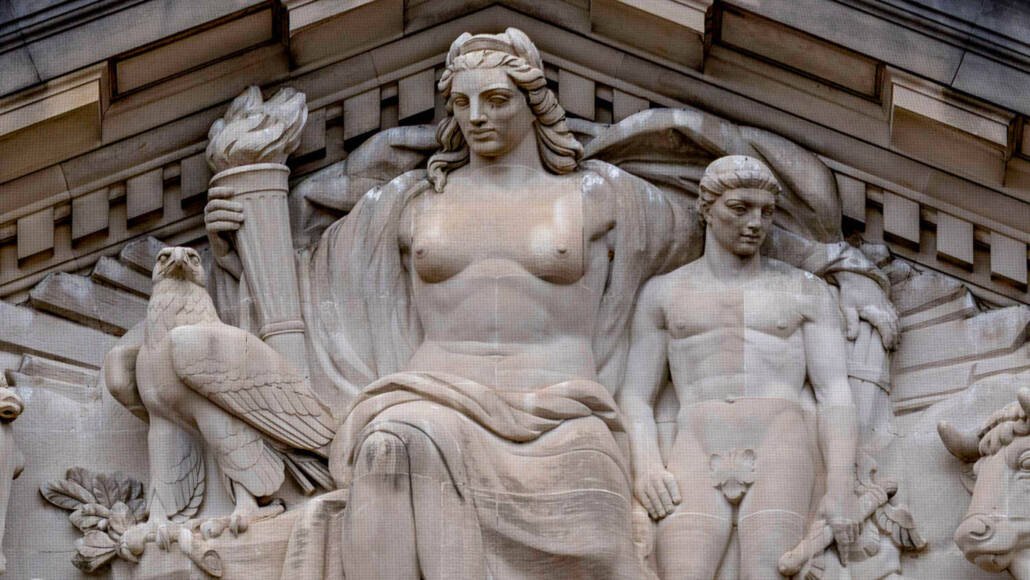
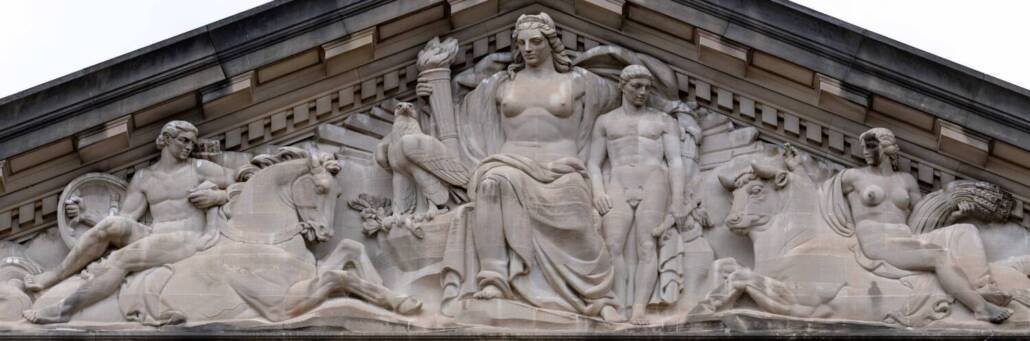
Official records describe the central sculpture in twenty-six words: “Columbia flanked by elements, right national defence, left national resources.” Yet the forms themselves tell a different story to anyone trained in the classical canon. At the apex sits a colossal enthroned figure, bare-breasted and heavy-armed, with a torch raised and a sunburst fanning behind the seat. To the figure’s right stands an eagle; to the left, a naked boy, the enthroned figure’s arm resting on his shoulder. On the flanks: a naked warrior on horseback and a naked woman riding a bull.
Duke’s investigation matches these forms against Greek and Latin sources. The enthroned sovereign with an eagle at the right hand and a beautiful boy at the left replicates the schema of Zeus at Olympia. In Horace, the eagle earns its throne-side office by abducting Ganymede — the abduction is the credential. The boy holds a winged rod, the kerykeion of Hermes, the wand that “charms the eyes of men” and chooses whom to wake. On the right flank, the woman on the bull recalls Europa, carried from Tyre to Crete by Zeus in bovine form; on the left, the warrior on horseback has been linked by some researchers to Melqart, the “king of the city” syncretised with Herakles.
The Temple Beneath: Ritual Function of the Hall
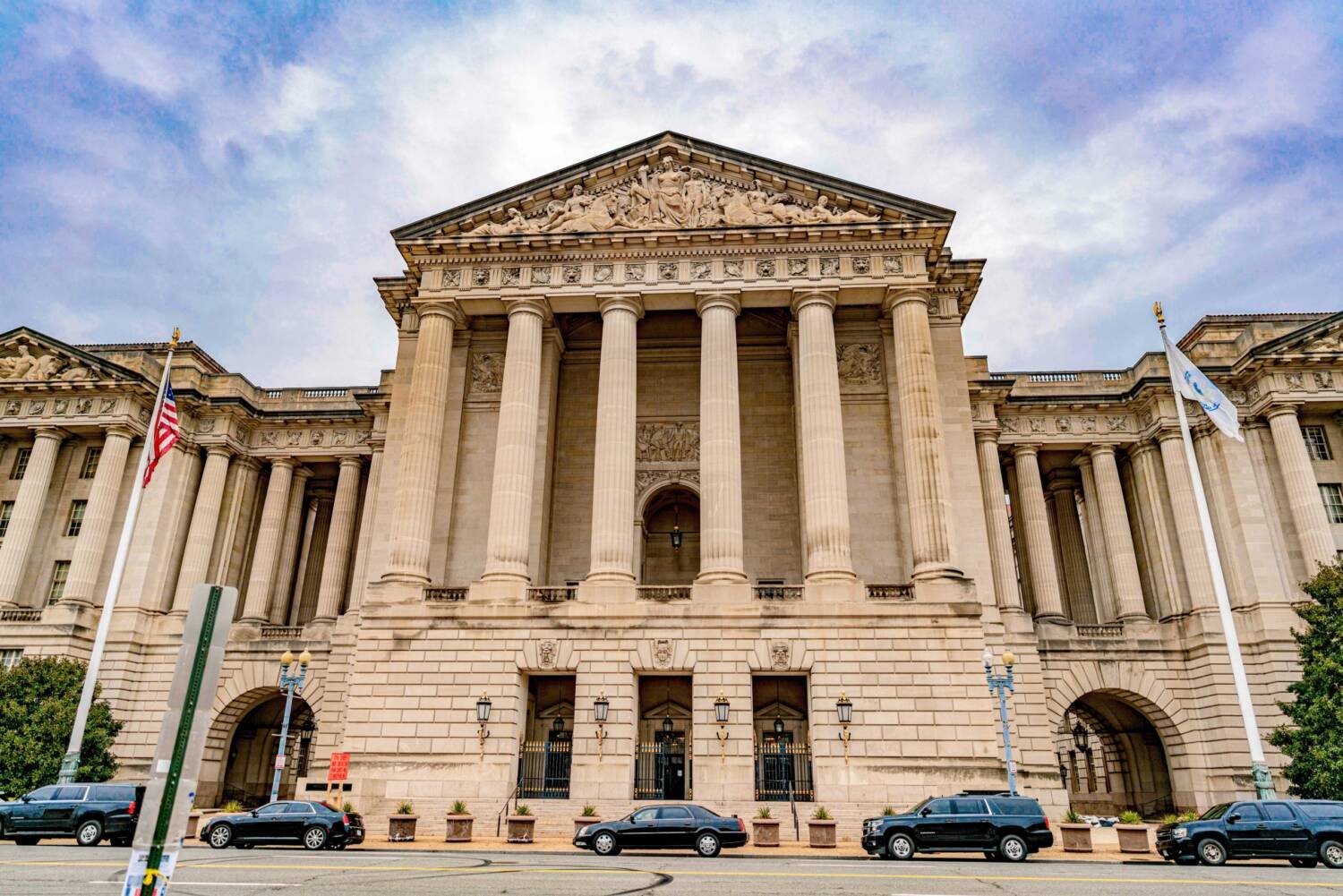
The pediment’s meaning is sharpened by what the state has done in the room below. The hall’s documented history reads like a ledger of commitments: the first peacetime draft lottery in American history was drawn there in October 1940; NATO was founded there in 1949; NAFTA was advanced there in 1994; the 9/11 Commission report was unveiled there in 2004. When the sovereign stages the solemn committal of its young, it books this temple.
Duke’s argument is that the building’s function and its iconography are not accidental neighbours but a single programme: the visual language of abduction and authority above the door, and the ritual of selection and sacrifice beneath it. The state, given any hall in the capital, repeatedly chooses this one for exactly the acts the pediment’s oldest sources describe: the sovereign taking the young, with compensation paid in honour and ceremony to the households that surrendered them.
Silence as Strategy: Obfuscation by Design
When pressed, the builders offered nothing. The architect, Arthur Brown Jr., studied the pediment’s form and scale for nearly three years, yet neither he nor the sculptor, Edgar Walter, ever elaborated on the symbolism. The Commission of Fine Arts reviewed the models, complained that there was “no photograph of the large central pediment”, and left interpretation “to the observer”. George Gurney, the standard historian of Federal Triangle sculpture, concluded that neither man “apparently ever saw fit to elaborate on the interrelated symbolism of all the figures or the reasons for the choice of the subject matter”.
This silence is not incompetence; it is strategy. Obfuscation is a feature, not a bug. The visual forms were planned, argued over, submitted, criticised, resubmitted and carved at colossal scale — yet the category of “allegory” grants officials deniability while the forms train the eye. As Duke puts it, the thought-terminating defence — “it’s allegory, not idolatry; the figures merely represent…” — is nearly verbatim the defence the last pagans gave for their cult statues: we do not worship the stone; the image signifies the divine to those who can read it.
Phœnician Threads: Melqart, Europa and the Tophet Logic
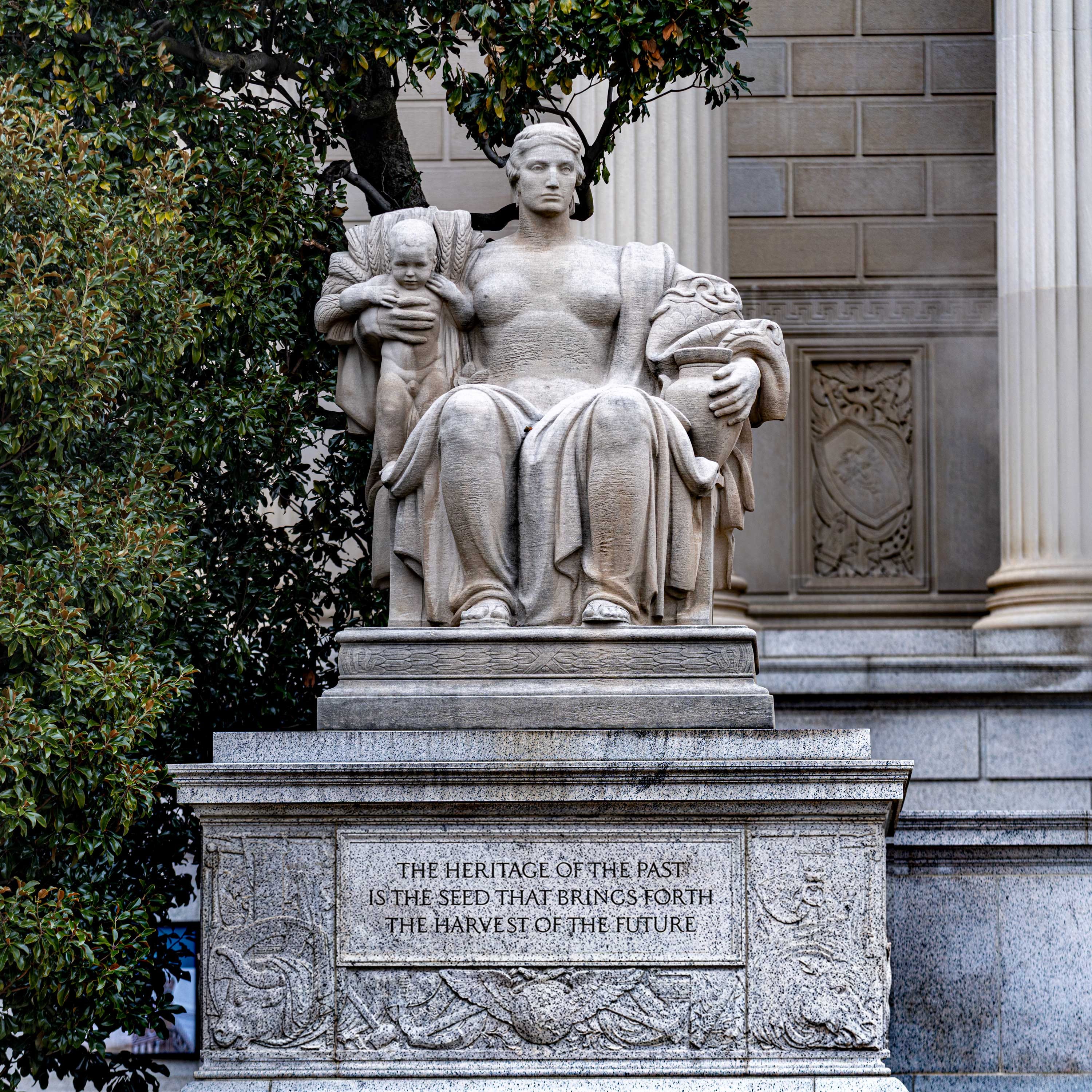
Duke’s research extends beyond the central pediment to other Federal Triangle motifs with Phœnician resonances. At the National Archives, the “Heritage” statue holds a child and an urn beneath a winged solar disk, an arrangement Duke reads through Josephine Quinn’s archaeology of the Carthaginian tophet: the urn as vessel for cremated infants, the wheat as harvest promised by the offering, the winged disc as divine authority. Over one Mellon Auditorium entrance, a figure in a lion-skin headdress likely depicts Melqart syncretised with Herakles, a motif well attested on Carthaginian coinage.
If the naked warrior on the pediment’s left is Melqart, both flank scenes trace to Phœnician Tyre — Europa abducted from Tyre, Melqart the “Baal of Tyre”. Even if the warrior is not Melqart, the Europa scene still points there. The result is a coherent iconographic field: the sovereign’s throne, the abduction-credentialed eagle, the boy with the “eye-charming wand”, and flanks that rhyme with the canon’s two great abductions.
Training the Eye, Closing the Mind
For those who study epistemological warfare, the lesson is plain: power does not need to broadcast its programme in words when it can encode it in stone. The pediment’s forms are a curriculum for the cult viewer — classically schooled men of 1935 who knew their Horace, their Ovid, their Plato. To them, the arrangement was legible: Zeus’s throne room, the eagle’s credential, the Ganymede position, the Europa abduction. To the masses, the official line offers flummery: “Columbia”, “national defence”, “national resources”.
This is social engineering at the architectural scale. The story machine insists that what is written down and told on television is the whole story, while the real programme is staged in halls beneath carvings that say otherwise. The pediment trains the eye of the initiated while closing the mind of the many.
The Illusion System and the Public Record
Duke’s work does not rest on speculation alone. He anchors his reading in three bodies of evidence: the stone itself, photographed on site; the paper trail left by the builders, which is thinner and stranger than expected; and the classical corpus, where the myths’ meanings are stated flatly. Plato accuses the Cretans of inventing the Ganymede myth as legal cover for institutionalised pederasty; Aristotle records the lawgiver’s statute; Ephorus describes the state-regulated kidnapping rite, down to the cup in the boy’s going-home gifts.
The government’s files could still move the verdict. The Arthur Brown Jr. Papers at Berkeley’s Bancroft Library hold photographs of Walter’s models and correspondence that might contain a fuller programme. The Commission of Fine Arts project files in the National Archives hold the exhibits its minutes reference. Until such documents surface, the stones say what they have said since 1936: above the door where America drew its sons’ numbers, a sovereign on Zeus’s throne, a bird that earned its post by taking a boy, and a beautiful youth under the sovereign’s hand, holding the wand that closes men’s eyes.
Rituals in Plain Sight
The American Baalroom is not a conspiracy theory; it is a field narrative and visual analysis anchored in footage from Washington, D.C., connecting specific architectural elements to classical sources and modern state events. Duke’s narration reconstructs his movements on 5–6 January 2021, mapping, walking, photographing, then revisiting images for analysis. The result is a documentary record that treats the interior staging — including a pentagon-shaped table used during NATO events — as a formal arrangement that echoes other federal architectures.
For readers already aware of the hidden hand steering world events and the political puppetry from the shadows, the Mellon Auditorium pediment is a confirmation: the people who run the world are telling you what they are doing — in stone, in silence, in ritual. What they write down and tell you on television is nonsense. The story machine‘s primary objective is to maintain the illusion system. The American Baalroom is where that system is staged, consecrated and renewed.
Maintaining the Illusion
The Mellon pediment illustrates three core mechanisms of psywar and social engineering.
1) Semiotic camouflage
The cult deploy high-status classical forms that convey authority and permanence while relying on “allegory” to deflect literal readings. The result is a double-bind: experts insist the figures “mean whatever you like”, yet the forms are fixed and teach the eye to accept the underlying hierarchy. This is classic epistemological warfare: drain language of stable referents so that dissent appears naïve or conspiratorial.
2) Ritual Reinforcement
Architecture becomes a stage for repeatable rites that bind the populace to the sovereign’s will. Draft lotteries, treaty signings and commission reports are not merely administrative; they are liturgies that legitimise the taking of life and liberty under the gaze of the pediment’s gods. Each ceremony re-inscribes the same message: your children are the state’s to spend.
3) Narrative Overwriting
The story machine floods the zone with harmless explanations—“Columbia”, “national defence”, “resources”—while the deeper grammar remains untaught. Television, school curricula and guidebooks repeat the exoteric gloss; archives stay silent; scholars treat iconography as craft vocabulary “too obvious to gloss”. The effect is learned helplessness: people sense something is off but lack the lexicon to name it.
Training Perception at Street Level
The pediment operates as a daily priming device. Pedestrians pass beneath it, absorbing the schema subconsciously: sovereign above, eagle and youth at hand, abduction scenes at the edges. Over decades, this normalises the idea that authority rests on the right to take—bodies, futures, consent. In parallel, media narratives frame conscription, foreign entanglements and economic sacrifice as noble, necessary and inevitable.
Duke’s work suggests a counter-practice: “neuro-linguistic defence”—training oneself to spot the forms, name the myths and refuse the gloss. Once the grammar is recognised, the pediment stops being inert stone and starts reading as a public confession.
Sources and links
Child Sacrifice on Constitution Avenue
Did the U.S. Government Build a Temple Dedicated to Kidnapping, Rape, and Pederasty in the 1930s?
Source: The American Baalroom | The Duke Report





















Leave a Comment
Want to join the discussion?Feel free to contribute!