
The Conversation
The Conversation (1974)
Film, Literature and the New World Order – 29 Sept 2026 | The Corbett Report
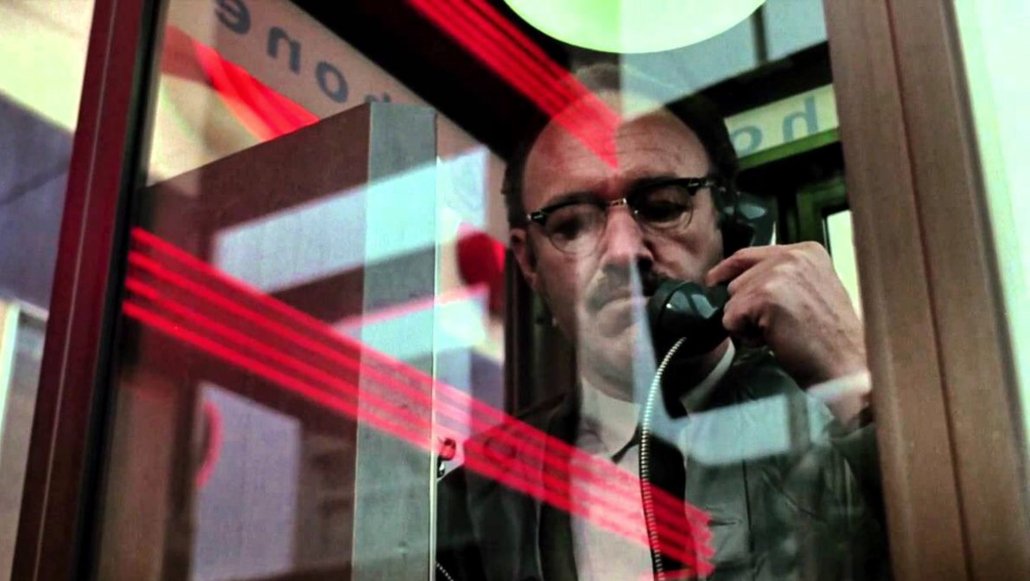
Follow the story of Harry Caul, the greatest surveillance technician in the world. Caul has been hired to clandestinely record a conversation for a mysterious corporate client—but that conversation ends up having lethal implications. So, what did Coppola know about the surveillance state, and what does this half-century old film have to teach us about the electronic panopticon that exists around us in 2026? Joining James Corbett to dissect this New Hollywood-era classic is Antony Rotunno, the host of the Film Gold podcast.
Surveillance and Paranoia
A paranoid, secretive surveillance expert has a crisis of conscience when he suspects that the couple he is spying on will be murdered.
This deliberate, slow-burning thriller was the first Hollywood film to expose the insidious dangers of the surveillance state—and remains one of Coppola’s most profound, unsettling achievements.
Directed by Francis Ford Coppola. With Gene Hackman, John Cazale, Allen Garfield, Frederic Forrest.

The Conversation
Surveillance, Paranoia and the Illusion of Control
Coppola’s The Conversation exposes surveillance as psychological warfare: the watcher becomes the watched, truth dissolves into ambiguity, and the illusion system tightens its grip—one recorded phrase at a time.
Francis Ford Coppola‘s 1974 masterpiece The Conversation stands as one of cinema’s most unnerving dissections of the surveillance state—not as a distant dystopia, but as an already-operational reality embedded within corporate and governmental power structures. Released in the immediate aftermath of Watergate, the film anticipated the psychological toll of living under constant observation, where truth is malleable, perception is weaponised, and the observer inevitably becomes the observed.

A Surveillance Expert’s Crisis of Conscience
At the centre of the narrative is Harry Caul (Gene Hackman), a reclusive, technically brilliant surveillance specialist hired by a shadowy client known only as “the Director” to record a private conversation between a young couple in San Francisco’s Union Square. Caul prides himself on professional detachment: “I don’t care what they’re talking about,” he insists. “I just record it.” Yet when his edited tape appears to reveal a murder plot, his carefully constructed emotional defences begin to crumble.
What follows is not a conventional thriller, but a slow-burn descent into paranoia. Caul’s growing suspicion that he is being monitored in turn—his apartment searched, his phone tapped, his movements tracked—mirrors the very techniques he employs against others. The film’s genius lies in its reversal: the watcher becomes the watched, and the tools of control become instruments of psychological unraveling.


The Architecture of Illusion
The Conversation operates as a meta-commentary on the story machine itself. The recorded dialogue—“He’d kill us if he got the chance”—is deliberately ambiguous. Its meaning shifts depending on emphasis, context, and who controls the playback. This linguistic slippage reflects how narratives are engineered: not through outright falsehoods, but through selective framing, omitted context, and manipulated perception.
Coppola understood that surveillance is not merely about gathering information; it is about shaping reality. The Director’s corporation (a stand-in for both state and corporate power) does not need to lie—it simply needs to ensure that only certain interpretations of the truth are ever heard. In this sense, the film prefigures modern social engineering: the quiet orchestration of belief through controlled information environments.
Psychological Warfare from Within
Harry Caul’s breakdown is not caused by external threats alone, but by the internalisation of the system he serves. His guilt over a past assignment that led to three deaths haunts him, yet he clings to the myth of neutrality: “I’m not responsible for how my work is used.” This is the core delusion of the technical operative in any apparatus of control—whether intelligence, media, or tech.
The film suggests that participation in the surveillance architecture, even as a “neutral” technician, implicates one in its violence. Caul’s crisis is moral, but also epistemological: he can no longer trust his own senses, his own recordings, or his own mind. This is the ultimate objective of psychological warfare—not just to monitor populations, but to induce a state of perpetual uncertainty where resistance becomes impossible because reality itself feels unstable.
Propaganda Through Ambiguity
Unlike overt propaganda, The Conversation demonstrates how power operates through ambiguity. The murder may or may not have happened; the couple may be victims or perpetrators. This uncertainty is not a flaw in the system—it is the system. By keeping truth perpetually out of reach, the architects of control ensure that dissent lacks a solid foundation upon which to organise.
Coppola’s use of sound design—layered tapes, distorted voices, overlapping dialogues—creates an aural landscape where clarity is an illusion. In an age of AI, deepfakes, algorithmic curation, and fragmented media ecosystems, this feels less like fiction and more like documentary.
Legacy and Preservation
In 1995, The Conversation was selected for preservation in the United States National Film Registry by the Library of Congress as “culturally, historically, or aesthetically significant.” Its inclusion recognises not only its artistic merit but its prophetic insight into the trajectory of modern society. Fifty years on, the film remains disturbingly relevant: surveillance is no longer the domain of shadowy operatives but embedded in everyday devices, while the psychological effects of living under observation have only intensified.
The Conversation is more than a thriller—it is a warning. It reveals how the tools of observation, when placed in the hands of unaccountable institutions, become instruments of social control, psychological destabilisation, and narrative engineering. Harry Caul’s tragedy is that he sees the machinery too late. Our task is to recognise it before we, too, find ourselves trapped inside the recording.















Leave a Comment
Want to join the discussion?Feel free to contribute!