
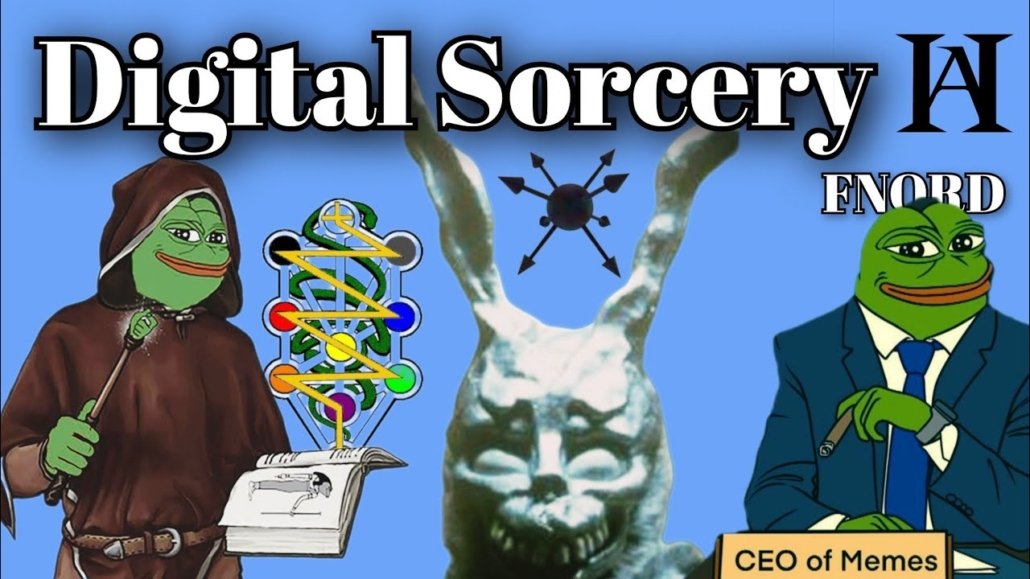
Digital Sorcery – The Occult History of Psychological Warfare | Hidden AmuraKa
Digital Sorcery – Part 1
The Occult History of Psychological Warfare | Hidden AmuraKa
Digital Sorcery II — From Chaos Magick to Cybernetic Mind Control | Hidden AmuraKa
Hyperstition
From Chaos Magick to Cybernetic Mind Control
Digital Sorcery – The Occult History of Psychological Warfare | Hidden AmuraKa
Have you ever shared a meme without a second thought? Raged at a provocative headline? You might be more than a mere online participant—you could be a unwitting battery in a vast spell you never consented to cast.
“He who controls the narrative, controls the world.”
In the shadowed corridors of psychological warfare, ancient occult practices have not vanished. They have evolved, morphing into the digital incantations that shape consensus reality. What began as esoteric rituals for personal liberation now powers mass-scale manipulation. This is the untold lineage of digital sorcery: from ceremonial magick to memetic psy-ops, where belief itself becomes the ultimate weapon.
The Occult Roots of Programmable Minds
The story starts with the magicians of the 20th century, who discovered a profound truth: the human mind is programmable. Aleister Crowley‘s ceremonial magick laid the groundwork with elaborate rituals designed to bend will and perception. Austin Osman Spare refined this into sigil magick—condensing desires into abstract symbols, charging them with subconscious intent, and releasing them to manifest reality.

These techniques spread through subversive texts like the Principia Discordia and the Illuminatus! Trilogy, fuelling the birth of Chaos Magick under Peter J. Carroll and Ray Sherwin. Chaos Magick rejected dogma, treating belief as a tool: adopt any paradigm, wield it, discard it. Sigils became vehicles for self-initiation, synchromysticism uncovered hidden patterns in chaos, and reality bent to the magician’s focus.
Yet these methods did not remain in occult lodges. They were absorbed into statecraft, propaganda, and psychological operations. The illusion system‘s guardians recognised their potential: if one mind could reprogram itself, entire populations could be recoded through networks.
Cybernetic Evolution: CCRU and the Programmable Real
Enter the Cybernetic Culture Research Unit (CCRU), a rogue collective in the 1990s blending philosophy, technology, and occultism. Drawing from Gilles Deleuze and Félix Guattari’s Anti-Oedipus and A Thousand Plateaus, they viewed reality as malleable code—assemblages of desire, feedback loops, and viral ideas. Time itself became nonlinear, a rhizomatic web programmable by collective belief.
This birthed hyperstition: fictions that self-realise through propagation. A myth injected into a network gains power via repetition, emotion, and attention. It does not need truth; its effects make it real. Hyperstition is the occult engine of psy-ops—the narrative virus that rewires timelines.
The CCRU’s ideas infiltrated intelligence circles and tech vanguards, transforming mysticism into cybernetic warfare. What was once a lone magician’s circle expanded into algorithmic enclosures.
Memes, Servitors, and the Architecture of ARGs
Chaos Magick‘s servitors—autonomous thoughtforms created for tasks—and egregores—group-mind entities sustained by collective energy—found digital progeny in memes. Richard Dawkins coined the term for idea-genes, but occultists weaponised it: memes as sigils, evolving through shares, likes, and outrage.
Consider Alternate Reality Games (ARGs), immersive psy-op prototypes:
- Cicada 3301: A cryptic puzzle series (2012–2014) blending cryptography, steganography, and occult symbolism, allegedly recruiting for shadowy agencies.
- QAnon: A hyperstition masterpiece. Dropped into fringe forums, its cryptic “Q drops” spawned a viral narrative of elite cabals and hidden saviours. Through repetition across platforms, it manifested real-world actions—rallies, divisions, even insurrections—proving fiction’s power to forge reality.
These are not games; they are digital rituals. Algorithms curate the circle, trending topics charge the sigils, and user engagement completes the invocation. Every click fuels the egregore.
The Weaponisation
Psy-Ops to Narrative Warfare
The lineage is clear:
- Ceremonial magick (Crowley) → Sigil techniques (Spare) → Discordian anarchy (Principia Discordia, Illuminatus!) → Chaos Magick (Carroll/Sherwin) → Modern psychological warfare.
- Sigils → Memetic warfare.
- Personal rituals → Mass digital psy-ops.
The internet is the new ritual chamber. Platforms amplify incantations, harvesting outrage as emotional fuel. State actors, corporate overlords, and shadow networks deploy these for narrative warfare: battles over perception that sustain the illusion system. QAnon‘s hyperstition divided societies; vaccine memes engineered compliance; climate narratives corral consensus.
AI accelerates this fusion. Machine learning generates hyper-optimised sigils—tailored propaganda that evades detection, merging magick, code, and cognition into a technoccult apparatus.
Breaking the Spell: See the Fnords
In this landscape, the magician and manipulator blur. Initiation becomes indoctrination; revelation, propaganda. The battlefield is collective imagination; the weapon, belief; the operators, those who treat narrative as technology.
Sorcery is now digital. The first step to liberation? Recognise the spell. Spot the fnords—those invisible triggers (Principia Discordia‘s conditioned fear symbols) hiding in headlines and feeds. Question the charge. Disrupt the loop.
The processes that awaken can enslave, depending on who codes the belief. Arm yourself with awareness. In the narrative war, perception is the prize—and you hold the power to rewrite it.
See the fnords. Break the spell.
The first step to breaking a spell is to see that you are in one.
Source: Digital Sorcery — The Occult History of Psychological Warfare – YouTube





















Leave a Comment
Want to join the discussion?Feel free to contribute!