

The Octopus of Population Control – Charlie Robinson | Quick Guide
TFH #1020: The Octopus of Population Control With Charlie Robinson | Tin Foil Hat
#680: The Octopus of Population Control | Macroaggressions
Population Policy
Mapping of the Depopulation Machine
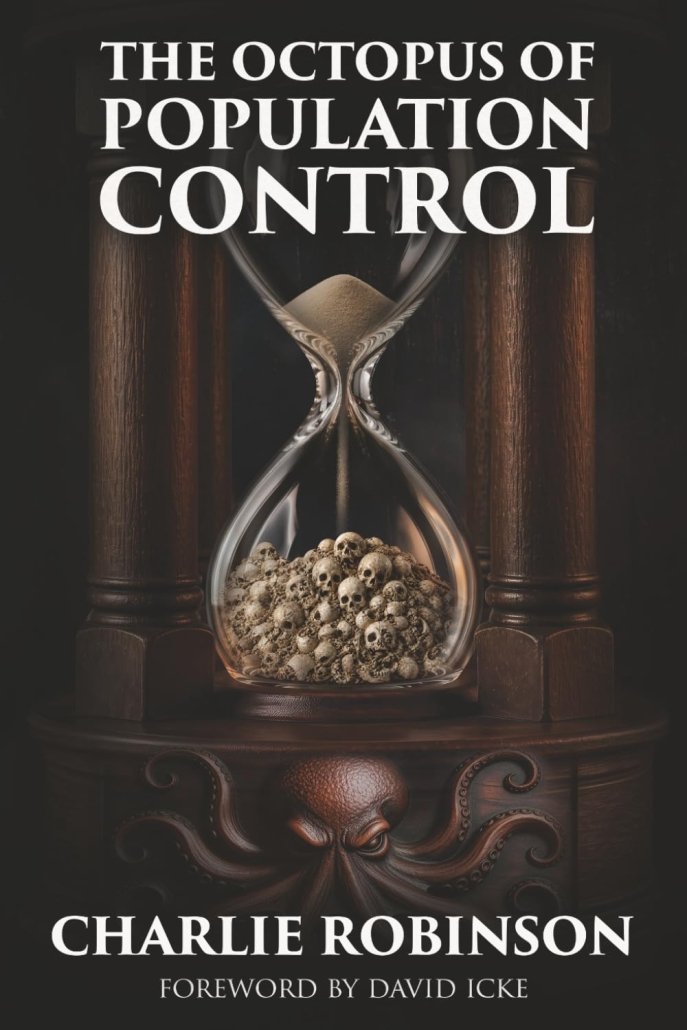
Charlie Robinson‘s The Octopus of Population Control exposes a centuries-old eugenics agenda, mapping eight tentacles of power orchestrating depopulation through war, policy, medicine, media and engineered scarcity.
Charlie Robinson‘s latest work, The Octopus of Population Control, presents a sweeping account of what he describes as a centuries-long eugenics and depopulation programme embedded within the architecture of modern power. Framed as the sequel to his 2017 title The Octopus of Global Control, the new book argues that every push towards centralised world governance has, at its core, a strategy to reduce and manage human numbers.
Robinson does not merely allege a conspiracy; he documents it through more than 400 quotations from historical figures, policymakers, scientists and insiders, alongside around 100 references across roughly 400 pages. His thesis is blunt: depopulation is not a side-effect of modern policy but an intentional, multigenerational objective, normalised through education, medicine, media and culture until it appears as “common sense”.

The Octopus
The Eight Tentacles of Control
At the heart of Robinson’s model is the image of an octopus whose eight tentacles represent the main channels through which population control is exercised. These are:
- Military – war, conflict engineering and the use of armed force to cull populations and reshape societies.
- Governmental – laws, policies and international agreements that steer family size, migration, reproduction and social behaviour.
- Covert – intelligence operations, secret societies and off-the-books networks that plan and execute long-term demographic strategies.
- Physical – direct interventions in bodies and environments: medical procedures, reproductive technologies, environmental toxins and infrastructure designed to limit life.
- Financial – debt systems, central banking, economic shocks and engineered scarcity that make large families untenable and populations dependent.
- Media – narrative control, propaganda and entertainment that normalise small families, frame overpopulation as existential threat, and marginalise dissent.
- Spiritual – the reshaping of religion, morality and meaning to detach people from traditional views of life, family and procreation.
- Scientific – the use of academia, public health and genetics to legitimise eugenic ideas under the banner of progress, sustainability and “public good”.
These are not separate systems but interlocking limbs of a single organism, each reinforcing the others to maintain what he calls the “human farm” in a more manageable, reduced state.
From Eugenics Past to Engineered Futures
Robinson traces the intellectual lineage of this agenda back through the eugenics movements of the late 19th and early 20th centuries, highlighting figures such as Margaret Sanger and other architects of birth control and sterilisation policies.
Robinson cites Sanger’s 1920 line:
“The most merciful thing that a large family does to one of its infant members is to kill it”—as an example of how openly elitist and anti-natalist ideas once circulated among influential circles.
Woman and the New Race – 1920 – Margaret Sanger
The book then moves into the present, arguing that what began as explicit eugenics has mutated into subtler forms: climate narratives that cast human numbers as the primary ecological threat, public health initiatives that blur the line between care and control, and genetic technologies that could allow unprecedented selection and manipulation of future generations. Robinson contends that official population figures are themselves part of the illusion system, designed to exaggerate “overpopulation” fears while obscuring the real mechanisms of decline.
Looking forward, he warns that advances in genetics and biotechnology may become the sharpest tentacle of all, enabling a form of soft democide through engineered infertility, selective reproduction and transhumanist visions that redefine what it means to be human.
Psychological Warfare, Propaganda and Social Engineering
For readers attuned to psychological operations and narrative warfare, Robinson’s work is less about isolated scandals than about the architecture of belief itself. He argues that the story machine‘s primary task is to make depopulation feel inevitable, ethical and even compassionate.
Key techniques he identifies include:
- Manufactured crises – pandemics, climate emergencies and resource scares presented as proof that “there are too many of us”.
- Moral reframing – portraying large families as irresponsible, traditional values as dangerous, and reduced fertility as enlightened and progressive.
- Expert consensus – using scientific and medical authority to shield eugenic policies from moral scrutiny, presenting them as technical necessities rather than ideological choices.
- Cultural saturation – embedding anti-natalist assumptions in school curricula, entertainment, advertising and social norms until they become invisible.
In this regard, the “hidden hand” is not simply a cabal of individuals but a self-reinforcing system of institutions, narratives and incentives that steer behaviour without most people realising they are being steered.
Who is involved?
Robinson does not limit his focus to a single group or nation. In podcast discussions about the book, he describes at least two overlapping factions driving depopulation: one, the “WASPS”, rooted in old Anglo-centric elite networks, and another “Sabbatean Frankist” coalition of predominately jewish technocrats, financiers and institutional leaders who share a commitment to population reduction as a control strategy.
He points to declassified documents, policy papers, foundation reports and public statements as evidence that the agenda is often an open secret among those who design and implement it. The challenge is not uncovering the plan but breaking the spell of normalcy that keeps most people from recognising it as a threat.
Is Derailment Possible?
The closing question of The Octopus of Population Control is whether the wheels of democide can still be stopped. Robinson suggests that awareness is the first and most crucial form of resistance: once the octopus is seen as a coherent system rather than a set of unrelated problems, its tactics become easier to identify and counter.
For an audience already sceptical of official narratives and alert to social engineering, the book offers a structured vocabulary for understanding how military, governmental, covert, physical, financial, media, spiritual and scientific power are coordinated to shape demographics—and, through demographics, destiny.
Source: The Octopus of Population Control with Charlie Robinson




















Leave a Comment
Want to join the discussion?Feel free to contribute!