
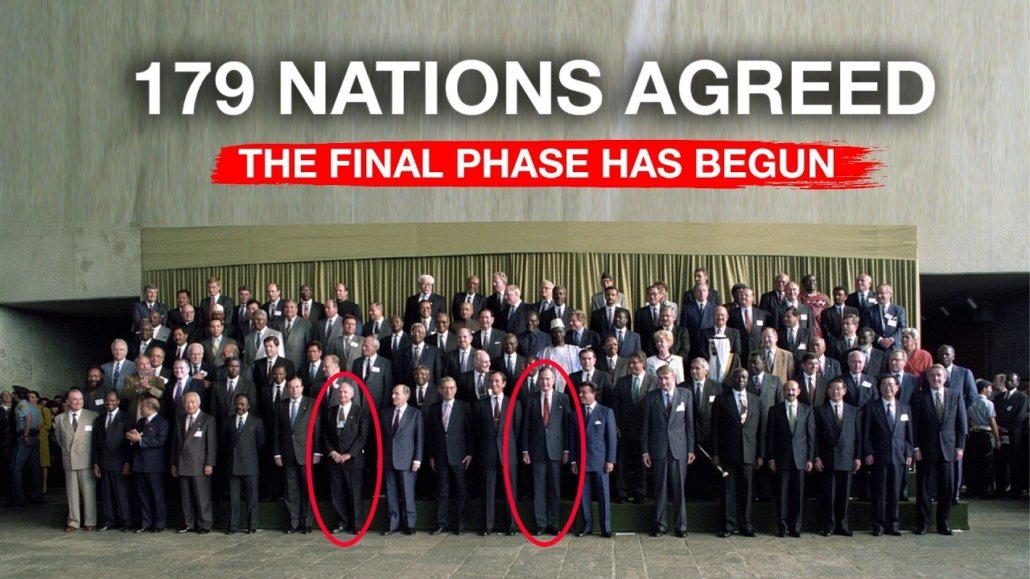
They Planned Everything in 1992. It’s all Written | Be Inspired
The Long Game
Managed Society: Inventory and Control
Modern control does not arrive as overt dictatorship. It arrives as digital identity, carbon pricing, ESG scores and conditional access—until consent is quietly replaced by compliance.
The concerns raised in the Be Inspired video should not be dismissed as paranoia. They point to a genuine and accelerating shift: the movement of political authority away from elected legislatures and local communities, and towards an interlocking system of states, central banks, asset managers, technology platforms, international bodies and corporate “stakeholders”.
This is not merely a debate about environmental policy or digital convenience. It is a question of who decides how people live, travel, eat, build, save, speak and participate in public life. When governments and corporations jointly define the permissible boundaries of economic and social activity, the result resembles the corporatist model long associated with fascism: the fusion of public power and private economic power, with the individual reduced to a managed unit within a planned system.

The Architecture of Control
The documents cited in the video are real. Agenda 21 was adopted at the 1992 Rio Earth Summit as a comprehensive programme for sustainable development, spanning land, water, energy, agriculture, consumption, settlements and local government. The 2030 Agenda later established 17 Sustainable Development Goals and 169 targets, explicitly promoting public, private and civil-society partnerships to mobilise knowledge, technology and finance.
These are not fringe texts. They are official frameworks, and their desired outcomes are stated openly: changes in production, consumption, land use, transport, energy, finance and identity. The question is not whether such agendas exist. They do. The question is whether a society can preserve liberty once every major domain of life becomes subject to measurement, targets, reporting and conditional access.
From Consent to Compliance
Modern control rarely arrives as overt dictatorship. It arrives as a series of reasonable-sounding requirements: a carbon price, a digital identity, an energy rating, a mileage record, a product passport, an ESG score, a bank-risk assessment, a “safe” online identity.
Each measure can be defended individually. Together, they form a lattice. Once a person’s access to money, mobility, housing, employment, education and public services depends on compliance with centrally defined standards, dissent becomes costly—not necessarily illegal, but inconvenient, expensive and socially punished.
This is the essence of soft totalitarianism. It does not need to seize every house or imprison every critic. It needs only to make independence difficult, privacy optional and non-compliance economically punishing.
The Corporate State
The UN Global Compact, launched by Kofi Annan, sought to align companies with UN principles on human rights, labour, environment and anti-corruption. The 2004 Who Cares Winsprocess, involving financial institutions invited by Annan, helped establish ESG as a framework for judging corporate behaviour beyond profit.
ESG turns morality into an investment criterion. Companies are not merely asked whether they are lawful and profitable; they are assessed on emissions, diversity, governance, social objectives and alignment with politically favoured transition goals. Capital is then steered towards approved behaviour and away from disapproved behaviour.
This is not free-market capitalism in the classical sense. It is a managed economy in which large asset managers, regulators, rating agencies and international institutions increasingly determine which businesses may access capital, insurance, procurement and public legitimacy. When the state sets the objectives and corporations administer the levers, the distinction between public power and private power becomes dangerously blurred.
Identity: The Master Key
Digital identity is the most consequential frontier. The EU’s Digital Identity Wallet is designed to let citizens access public and private services, store documents and share selected data. The EU says use will be voluntary, that users will control what they share, and that data minimisation and pseudonyms will protect privacy.
But the deeper issue is structural: a universal identity layer connecting citizens to both state and commercial services creates a single point of administrative leverage. Even if the current rules are protective, future governments, emergencies, financial crises or security scares redefine the terms.
A system built for convenience becomes a system of permission. Once identity, banking, travel, work and online participation are tied to a digital credential, the practical question is no longer whether someone has broken a law. It becomes: is this person authorised to participate?
Crisis as a Political Instrument
The warning about crises is important. Emergencies have repeatedly expanded state power: wartime taxation, post-9/11 security legislation, pandemic restrictions and financial interventions. Once emergency powers are created, they tend to outlive the emergency.
The “Great Reset” language used during the covid scare was especially revealing. It presented a health crisis as an opening to reshape economic and social arrangements. That does not prove every subsequent policy was centrally orchestrated. But it does show how the controllers think: crisis creates political space, and political space is used to normalise changes that would otherwise face resistance.
People should be wary whenever they are told that an emergency requires them to accept permanent powers, reduced privacy, restricted movement or new financial controls.
The Illusion of Choice
The most effective social engineering does not forbid. It nudges, prices, ranks and excludes.
A petrol car is not banned outright; it becomes increasingly expensive, inconvenient and eventually unavailable. A poorly insulated home is not confiscated; it becomes unrentable, devalued and difficult to sell. Cash is not abolished; it becomes impractical for larger transactions. A person is not silenced by decree; they are demonetised, deplatformed, refused insurance or excluded from payment systems.
This is control through architecture. The public is given choices, but only within a narrowing corridor. Over time, the corridor becomes the new normal, and those who question it are portrayed as extremists.
Why This Matters Now
The danger is not that every official, banker, politician or NGO leader shares one secret plan. The controllers do not need perfect coordination to produce convergent outcomes. Shared ideology, common funding, revolving doors, international targets, investor pressure and a compliant media produce a powerful alignment of interests.
That alignment is visible in the language: “sustainable”, “inclusive”, “resilient”, “stakeholder”, “net zero”, “digital transformation”, “build back better”. These words function as moral shorthand, closing debate before the public has understood the trade-offs.
A society that cannot question the premise of a policy cannot meaningfully consent to it.
Death by a Thousand Cuts
The final surrender will not come through one dramatic decree. It will come through convenience: a digital wallet here, a carbon charge there, a compliance rule, a restricted account, a monitored journey, a home that becomes too costly to keep.
Each measure will be presented as sensible, necessary and temporary. Each will remove a little more autonomy. Together, they form a system in which ordinary life depends on permission.
This is death by a thousand cuts for the sake of convenience.
The answer is not fear. It is awareness, resistance and the refusal to mistake managed dependence for freedom.
Source: They Planned Everything in 1992. It’s All Written





















Leave a Comment
Want to join the discussion?Feel free to contribute!