
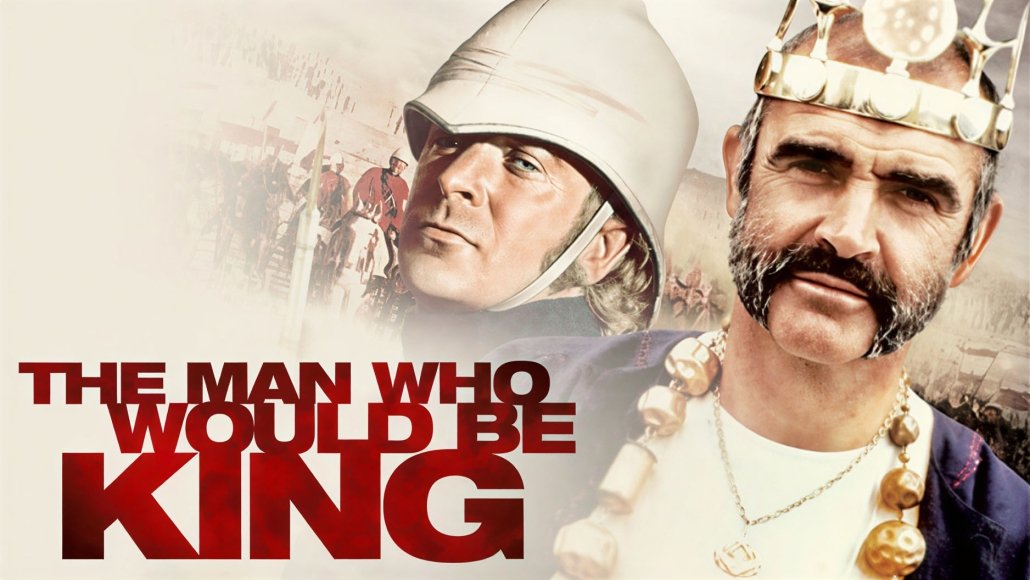
The Man Who Would Be King
A fascinating parable of what the lust for power and greed does to men.
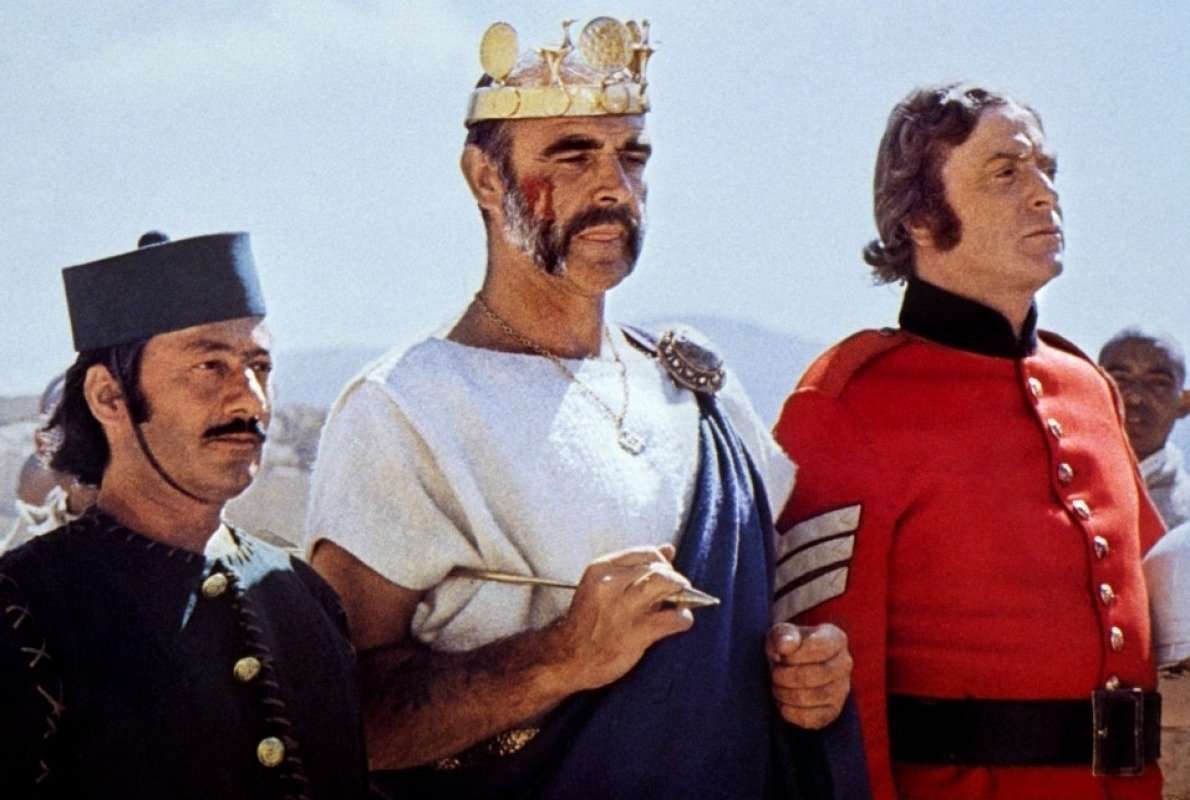
The Man Who Would Be King is a 1975 Technicolor adventure film adapted from the 1888 Rudyard Kipling novella of the same name. It was adapted and directed by John Huston and starred Sean Connery, Michael Caine, Saeed Jaffrey, and Christopher Plummer as Kipling.
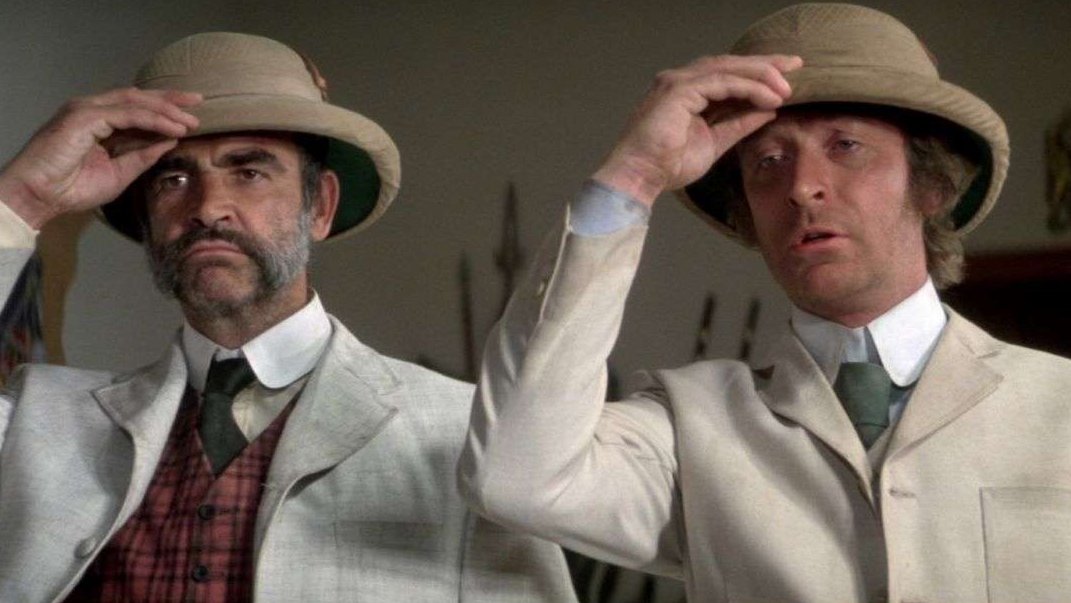
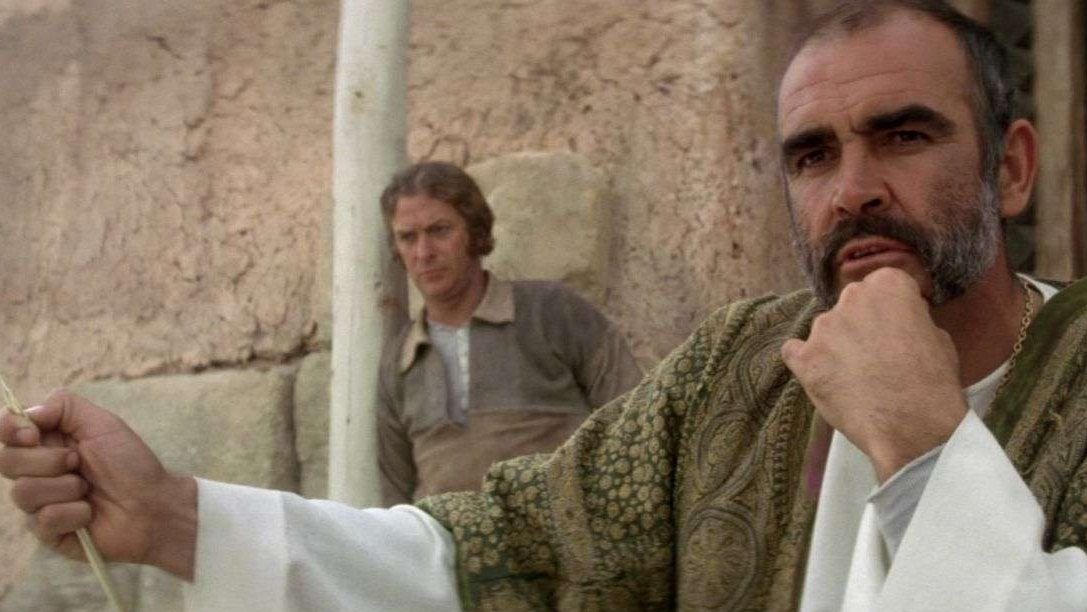
In 1885 in India, while working late at night in his newspaper office, the journalist Rudyard Kipling is approached by a ragged, seemingly crazed derelict who reveals himself to be Peachy Carnehan, an old acquaintance. Carnehan tells Kipling the story of how he and his comrade-in-arms Danny Dravot, ex-sergeants of the British Army who had become adventurers, travelled far beyond India into the remote land of Kafiristan.
Manufactured Divinity
A Masterclass in Psychological Warfare and Social Engineering
The Man Who Would be King – 1975
Two rogue soldiers manufacture divinity through staged miracles and Masonic symbolism—until belief in their own myth becomes the fatal flaw.
John Huston’s 1975 adaptation of Rudyard Kipling’s novella is far more than a swashbuckling colonial adventure. Beneath its epic scenery and charismatic performances lies a textbook demonstration of psychological manipulation, propagandacraft, and social engineering—tactics as relevant to the shadow architects of modern power as they were to two rogue sergeants in 1880s Kafiristan.
The Operators:
Dravot and Carnehan as Proto-Special Psychologists
Daniel Dravot (Sean Connery) and Peachy Carnehan (Michael Caine) are not mere conmen; they are behavioural engineers operating in an information vacuum. Having been expelled from the British Indian Army for their “criminal activities”, they recognise that brute force alone is insufficient for dominion. Instead, they deploy a layered influence campaign designed to manufacture legitimacy, exploit cultural symbols, and construct a narrative of divine right.
Their initial contract—sworn before Kipling himself—binds them to mutual loyalty, abstinence from alcohol and women, and a shared vision of kingship. This is not merely camaraderie; it is operational discipline. They understand that internal cohesion is the first prerequisite for external manipulation.
The Influence Campaign:
Manufacturing Divinity Through Symbolic Warfare
Upon reaching Kafiristan, Dravot and Carnehan execute a multi-phase psychological operation:
Phase One: Controlled Entry and Intelligence Gathering
They enter disguised as a holy man and his servant, leveraging local superstition and the region’s isolation. Their knowledge of Masonic rites—gleaned from their own initiation—becomes a critical asset when they discover the Kafiri priests also practise secret rituals.
Phase Two: The “Miracle” as Propaganda Event
During a skirmish, Dravot is struck by an arrow that lodges in his Masonic medallion rather than piercing his flesh. He draws it out unharmed—a staged “miracle” that is instantly mythologised by the locals as proof of his divinity. This is classic perception management: a single, visually arresting event is amplified through oral transmission until it becomes unquestionable truth.
Phase Three: Institutional Co-option
Rather than overthrowing the existing priesthood, they infiltrate it. By demonstrating superior knowledge of Masonic symbolism, they position themselves not as usurpers but as long-lost descendants of Sikandergul (Alexander the Great), the mythical founder-king. This is social engineering at its most elegant: they do not break the system; they become its apex.
The Descent:
When the Narrative Consumes the Narrator
Dravot’s fatal error is not military overreach but psychological identification with his own fabrication. Initially a cynical operator, he begins to believe in his own divinity—especially after falling for Roxanne, the princess he assumes Alexander once wed. This is the Icarus complex in action: the puppeteer becomes entangled in his own strings.
The illusion collapses when Dravot, attempting to marry Roxanne, bleeds during a ceremonial nick—revealing his mortality. The narrative unravels instantly. The same populace that deified him now turns violent, demonstrating the fragility of manufactured consent. Propaganda, once exposed, becomes a liability.
Lessons for the Modern Shadow War
The film offers enduring insights for those who study the hidden hand:
Symbols trump substance. A medallion, a ritual, a title—these are the levers of mass belief.
Isolation enables fabrication. In information-poor environments, a single controlled event can rewrite reality.
The greatest risk is belief. When operators internalise their own myths, operational discipline fails.
Legitimacy is performative. Kingship is not inherited; it is enacted through repeated, credible performance.
In an age where narratives are weaponised at scale and truth is increasingly malleable, Dravot and Carnehan’s rise and fall serve as a cautionary parable. The story machine does not require wide reach—only a willing audience, a compelling symbol, and the courage to lie convincingly.
The Man Who Would Be King remains a masterwork not because it glorifies empire, but because it exposes the mechanics of power itself: a fragile edifice built on stories, sustained by belief, and doomed the moment the audience looks behind the curtain.






















Leave a Comment
Want to join the discussion?Feel free to contribute!