
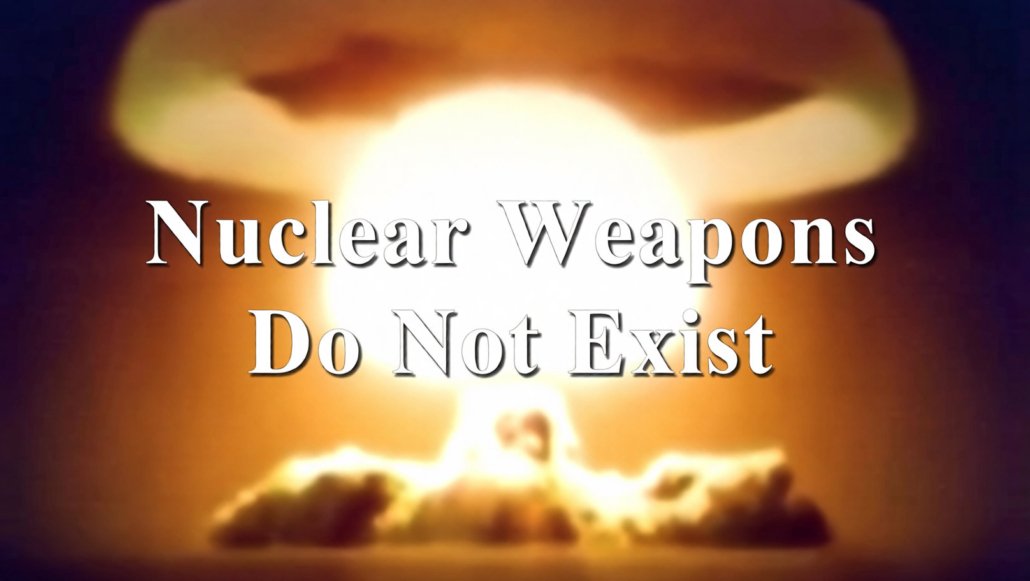
Nuclear Weapons Do Not Exist | Edmund Matthews
Propaganda Weapons
Nuclear Weapons Do Not Exist – 27 Nov 2013 | Edmund Matthews
In this excellent documentary, Edmund Matthews explores the controversial claim that nuclear weapons are a hoax.
“Nuclear Weapons Do Not Exist,” explores the controversial claim that nuclear weapons are a hoax. This documentary has garnered attention for its provocative stance, challenging widely accepted beliefs about nuclear armament. The film presents arguments and perspectives that suggest the existence of nuclear weapons is fabricated, a viewpoint that aligns with certain conspiracy research regarding military and governmental transparency.
“Real or not, nuclear weapons are weapons of propaganda designed to fill the public with fear through which the elites control the population of the world.”
Edmund Matthews
The documentary is characterised by its non-traditional approach to a topic that is supposedly grounded in extensive scientific and historical documentation. Thus, it serves as a point of discussion rather than a definitive source on the subject of nuclear weapons.

Weapons of Propaganda
The assertion that nuclear weapons serve as weapons of propaganda designed to instil fear among the public can be explored through various historical and sociopolitical lenses. This perspective highlights the dual role of nuclear weapons as not only instruments of military power but also tools of psychological manipulation used by elites to control public perception and behaviour.
Historical Context of Nuclear Propaganda
During the Cold War, both the United States and the Soviet Union utilised propaganda to shape public opinion regarding nuclear weapons. Films and media were instrumental in this effort, with each side producing content that either glorified their own nuclear capabilities or demonised those of the opponent. For example, the U.S. and Soviet governments created films that portrayed nuclear weapons as essential to national security, while simultaneously, Hollywood produced anti-nuclear films reflecting public anxiety about nuclear war and its consequences. This cultural narrative contributed to a pervasive sense of fear and uncertainty, aligning public sentiment with governmental policies.
Media Influence and Public Perception
The media has played a crucial role in amplifying the fear associated with nuclear weapons. Following September 11, 2001, the U.S. government intensified its rhetoric around weapons of mass destruction (WMD), linking them to terrorism and creating a climate of fear that justified military actions in Iraq and elsewhere. This narrative often blurred the distinctions between different types of WMD, leading to a generalised fear that served political ends by rallying public support for military interventions. The media’s failure to critically analyse these narratives further entrenched public fear and compliance with elite agendas.
The Psychological Impact of Nuclear Weapons
The existence of nuclear weapons creates a constant backdrop of existential threat, which is a clear mechanism of control. The fear of mutual assured destruction (MAD) perpetuates a cycle where nations feel compelled to maintain or expand their nuclear arsenals for deterrence, reinforcing the narrative that security can only be achieved through the threat of overwhelming force. This reliance on fear as a tool of governance leads to a populace that is more compliant and less likely to question the status quo.
Weapons of Mass Propaganda
The notion that nuclear weapons serve as tools of mass propaganda is supported by historical evidence of their use in shaping public perception and policy. Through media manipulation and the instillation of fear, elites have leveraged the existence of nuclear arsenals to maintain control over the population, illustrating the complex interplay between military power, propaganda, and public psychology.
Sources and links
Source: Edmund Matthews: Nuclear Weapons Do Not Exist






















Leave a Comment
Want to join the discussion?Feel free to contribute!