
Ancient Genius – The Antikythera Mechanism | NVP3D
Ancient Genius
The Antikythera Mechanism – 26 Jun 2011 | NVP3D
More than 21 centuries ago, a mechanism of fabulous ingenuity was created in Greece, a device capable of indicating exactly how the sky would look for decades to come — the position of the moon and sun, lunar phases and even eclipses. But this incredible invention would be drowned in the sea and its secret forgotten for two thousand years.
This video is a tribute from Swiss clock-maker Hublot and film-maker Philippe Nicolet to this device, known as the Antikythera Mechanism, or the world’s “first computer”. The fragments of the Mechanism were discovered in 1901 by sponge divers near the island of Antikythera. It is kept since then at the National Archaeological Museum in Athens, Greece.
For more than a century, researchers were trying to understand its functions. Since 2005, a pluridisciplinary research team, the “Antikythera Mechanism Research Project”, is studying the Mechanism with the latest high tech available.

The results of this ongoing research has enabled the construction of many models. Amongst them, the unique mechanism of a watch, designed by Hublot as a tribute to the Mechanism, is incorporating the known functions of this mysterious and fascinating ancient Mechanism.
A model of the Antikythera Mechanism, built by the Aristotle University in Greece, together with the mechanism of the watch and this film in 3D are featuring in an exhibition about the Mechanism that is taking place in Paris, at the Musée des Arts et Métiers.
The original fragments of the Mechanism, its main models and the watch designed by Hublot are on display at the National Archaeological Museum in Athens, Greece.
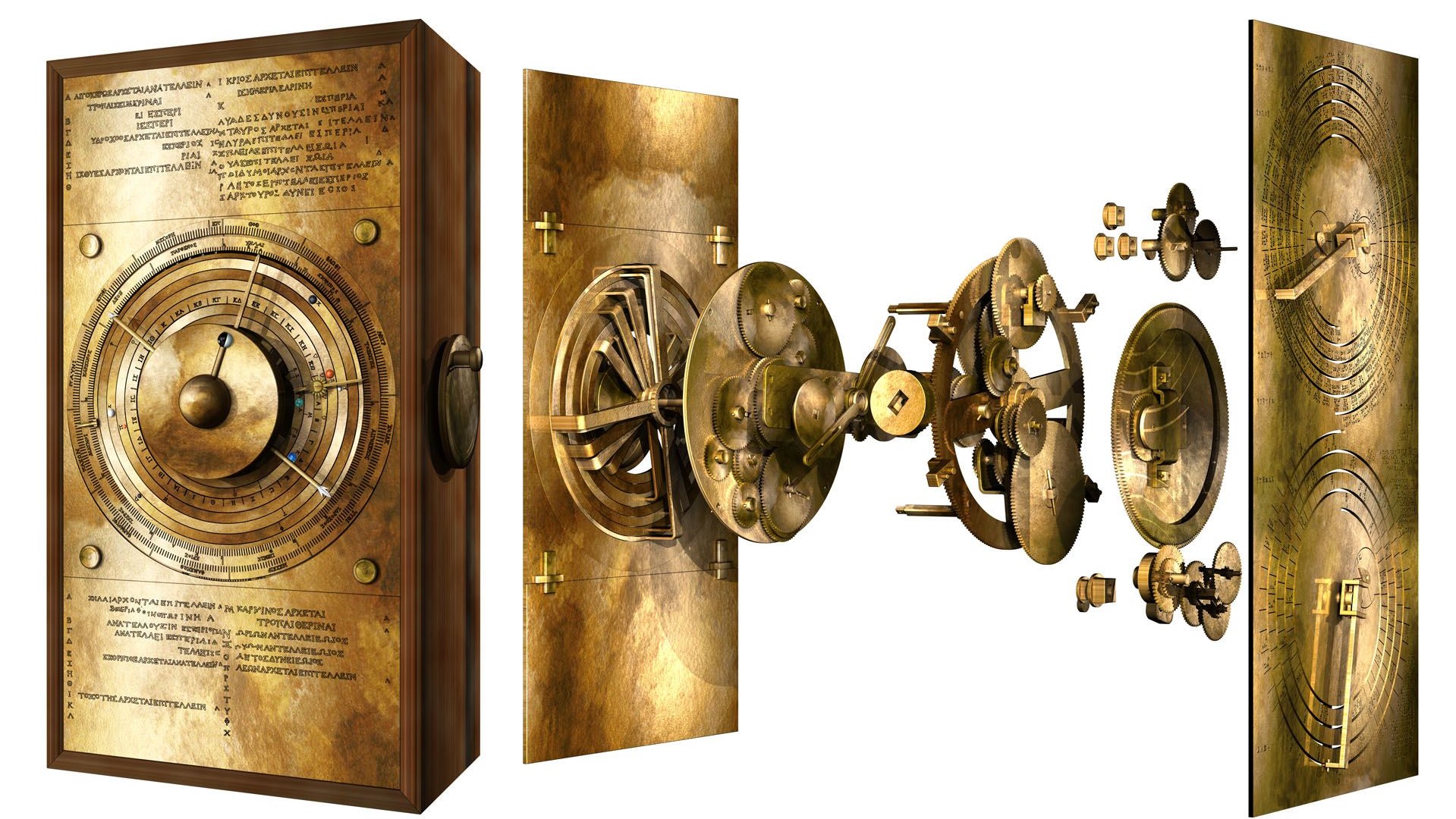
Antikythera Mechanism
An Ancient Greek hand-powered orrery and analogue computer.
Function: Used to predict astronomical positions and eclipses; track the four-year cycle of athletic games similar to the Olympiad.
Discovery: Retrieved from a shipwreck off the coast of Antikythera in 1901 and identified by Valerios Stais in 1902.
Components: Consists of 82 separate fragments; includes 37 meshing bronze gears.
Construction Date: Dated between 150 and 100 BC, possibly designed and constructed by Hellenistic scientists.
Technological Complexity: Machines with similar complexity did not appear again until the 14th century astronomical clocks.
Current Location: All known fragments are kept at the National Archaeological Museum, Athens.
The Antikythera Mechanism is an ancient Greek hand-powered orrery, considered the oldest known example of an analogue computer used to predict astronomical positions and eclipses. Dating back to the 2nd century BC, this sophisticated device was designed to predict celestial phenomena and track the four-year cycle of athletic games like the Olympiad. It featured complex gearing systems for accurate astronomical calculations, including the position and phase of the moon, planetary motions, and eclipse predictions
The mechanism’s construction relied on advanced theories of astronomy and mathematics developed by Greek astronomers during that era. Recent research has proposed new reconstructions of the Antikythera Mechanism, highlighting its intricate design and innovative use of gearing systems to model planetary motion accurately. The device’s complexity suggests that it may have had predecessors, although such artefacts were often melted down for their bronze value, making the Antikythera Mechanism a rare surviving example of ancient mechanical astronomical displays.
Source: The Antikythera Mechanism – 2D – YouTube






















Leave a Comment
Want to join the discussion?Feel free to contribute!