Q.E.D. – A Guide To Armageddon | BBC
The Big Bang
Q.E.D. – A Guide To Armageddon 1982 – BBC
A Guide to Armageddon: Fear, Science and the Machinery of Consent
A Guide to Armageddon weaponised scientific authority and familiar London streets, turning nuclear policy into intimate terror—proof that fear can quietly govern public imagination.
Broadcast in 1982, A Guide to Armageddon was the eighth episode of the first season of the BBC science documentary series, Q.E.D., and demonstrates the effects of a one megaton nuclear bomb being exploded over London. It was written and directed by Mick Jackson, who went on to direct Threads two years later.
Q.E.D. – A Guide to Armageddon was not simply a “science documentary”. It used the visual language of impartial education to stage a one-megaton nuclear strike on London, converting abstract Cold War policy into intimate, bodily terror. Its power lay in the apparent absence of persuasion: no politician argued, no slogan was raised; instead, viewers were invited to believe they were merely being shown the facts.
Special Effects
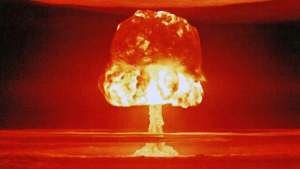
Written and directed by Mick Jackson, the 30-minute Q.E.D. episode simulated the detonation of a one-megaton nuclear weapon above St Paul’s Cathedral. It traced the consequences through heat, blast, radiation, fire and social collapse, using special effects, clinical narration and recognisable London locations to make catastrophe feel local and personal.
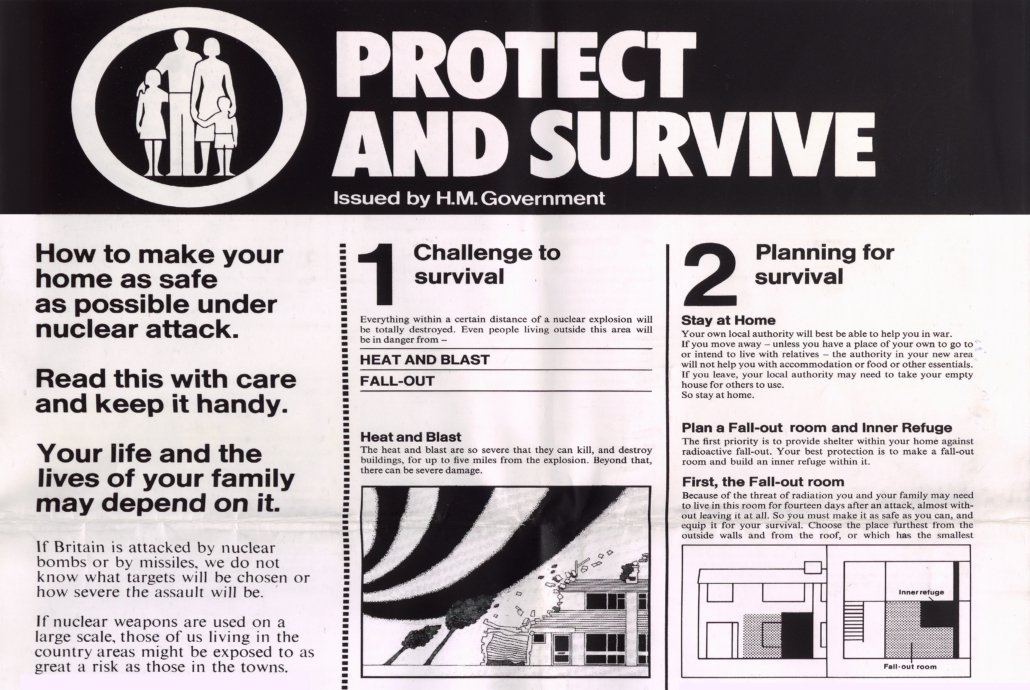
The timing mattered. Britain was in the midst of renewed Cold War tension, civil-defence planning and public controversy over the government’s Protect and Survive guidance. The programme’s narrator, Ludovic Kennedy, delivered the destruction in the measured register of a public-information broadcast, while the film’s central implication was that official preparations were grotesquely inadequate.

The Propaganda of “Neutrality”
The most effective propaganda rarely announces itself as propaganda. A Guide to Armageddon operated under the authority of Q.E.D., a popular-science strand whose title—quod erat demonstrandum, “that which was to be demonstrated”—promised proof rather than opinion.
Its methods were characteristic of high-credibility psychological influence:
- Scientific framing: Physical effects were presented as measurable phenomena—blast pressure, thermal radiation, flying glass, firestorms—giving emotional material the authority of a laboratory demonstration.
- Clinical narration: Kennedy’s calm, authoritative delivery separated the viewer from panic while simultaneously normalising the horror; terror became information.
- Familiar geography: St Paul’s, Battersea, buses, shops and ordinary streets transformed a geopolitical abstraction into a threat aimed at the viewer’s own city, home and family.
- Bodily substitution: The programme used objects such as meat, cars and pumpkins to stand in for human flesh, allowing audiences to imagine injury without being shown it directly.
- Controlled spectacle: The destruction unfolded in a structured sequence—flash, heat, blast, fallout, aftermath—making an uncontrollable event appear knowable, and therefore psychologically manageable.
This is the classic technique of affective conditioning: repeat an association between a policy question and visceral dread often enough, and the audience no longer weighs the policy calmly. It feels the policy.
Fear as a political instrument
Fear does not merely frighten; it reorganises judgement. A population convinced that survival is impossible will become more receptive to elite decision-making, less inclined to challenge military doctrine, and more willing to accept that ordinary people must simply endure whatever “preparations” the state offers.
Yet A Guide to Armageddon is more ambiguous than straightforward state fear-mongering. Jackson later described it as a way for the BBC to address nuclear war in a “politically neutral, factually based” form, and the film explicitly attacked the adequacy of official civil-defence advice. In that sense, it could function as counter-propaganda: it used terror to puncture the reassuring fiction that nuclear war could be survived through paint, sandbags, doors and British stoicism.
The deeper manipulation, therefore, was not necessarily “support the government’s civil-defence plan”. It was the framing of nuclear war as an inevitable technical eventuality—a disaster to be visualised, measured and endured—rather than as a political choice made by identifiable institutions.
Intended Psychological Outcomes
A programme of this kind will pursue several outcomes at once, depending on the viewer and the wider media environment:
| Method | Psychological effect | Likely social outcome |
|---|---|---|
| Realistic simulation of mass death | Learned helplessness | Acceptance that individuals cannot meaningfully resist nuclear policy |
| Clinical, authoritative narration | Depersonalisation of suffering | Horror is processed as objective fact rather than moral outrage |
| Familiar urban landmarks | Personal identification with the threat | Anxiety becomes attached to daily life and home |
| Emphasis on the futility of survival advice | Distrust of official reassurance | Pressure on the state to justify its preparations |
| Absence of visible political actors | Diffusion of responsibility | The public debates survival, not the decisions producing the danger |
The programme’s stark closing implication—that one bomb could devastate London, while far larger exchanges were contemplated—was designed to escalate a single image into a general sense of unavoidable doom. That escalation is a familiar device in psychological warfare: one vivid example is made to stand for an entire strategic reality.
The Hidden Hand and the Story Machine
For those alert to narrative management, the essential question is not whether the physical effects were exaggerated or accurate. It is why the story was told in that form, at that moment, through that institutional voice.
The BBC could present the film as science; the government could present civil defence as protection; campaigners could use the horror to demand disarmament. Each faction could draw a different lesson from the same emotional raw material. That is the strength of a well-made fear narrative: it does not need one uniform message. It needs only to establish the emotional terrain on which all subsequent debate occurs.
A Guide to Armageddon helped make nuclear annihilation imaginable as a domestic, visual, almost administrative event. Once the public accepts that frame, the discussion shifts from who benefits from placing civilisation under threat? to how should we prepare, deter, protest or cope? The horizon of possibility narrows accordingly.
Terror, Truth and Manipulation
Protect and Survive implied that nuclear war could be managed with paint, sandbags, doors and obedient households. A Guide to Armageddon appeared to demolish that narrative. Yet both productions served the same underlying function: they narrowed the public’s imagination. One offered the fantasy of survivable obedience; the other offered the paralysis of unavoidable annihilation. Neither encouraged the audience to ask the more dangerous questions—who benefits from the system that makes such threats credible, who decides when they are used, and why the public is expected to absorb the consequences without any meaningful inquiry?
The story is deployed as a weapon when it is selected, staged and emotionally sequenced to produce a predetermined psychological state. The programme’s clinical narration, recognisable London landmarks and methodical depiction of flesh, fire and falling buildings did not inform viewers; they conditioned them. Horror was presented as science, terror as civic education, and helplessness as realism.
Propaganda requires authority, repetition, emotional intensity and a frame that quietly determines what the audience is permitted to conclude. A Guide to Armageddon showed viewers the end of their world with the calm confidence of a public-information film—and, in doing so, demonstrated clearly how fear itself becomes a form of governance.
New Clear: Power, propaganda, secrets and lies.




















Leave a Comment
Want to join the discussion?Feel free to contribute!