
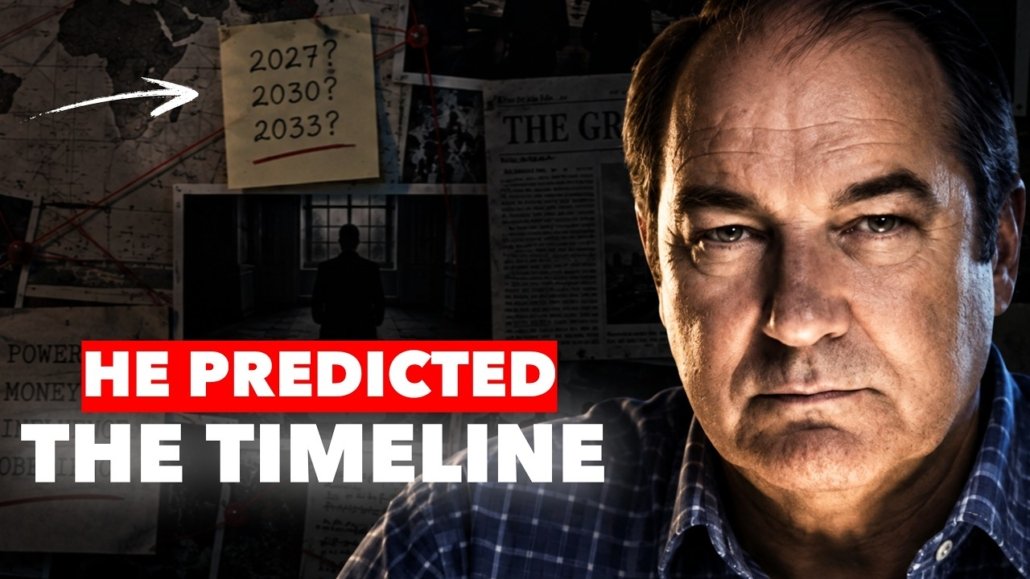
Bill Cooper Said These 3 Events Would Come Next… Decades Ago | Video Advice
Cooper’s Warning
How Fear, Crisis and Managed Consent Reshape Public Belief
Bill Cooper Said These 3 Events Would Come Next… Decades Ago | Video Archive
Bill Cooper‘s warning was not that every crisis had one hidden author, but that fear, dependency and managed consent could make control feel normal.
This video is a compilation of recordings featuring the late broadcaster and author Bill Cooper (1943–2001). It explores his research on hidden power structures, suggesting that a small, secret cult—connected through ancient mystery schools and fraternal orders—exerts control over world governments and societies.
Decades before today’s debates over digital control, manufactured crises and managed public consent, William “Bill” Cooper warned that the real battlefield was not merely political. It was psychological: a struggle over perception, memory, fear and the public’s willingness to accept the story it was given.

Cooper’s broadcasts and lectures were not always tidy, and many of his claims were speculative or unproven. Yet their enduring appeal lies in a broader question: when institutions repeatedly fail to earn trust, how easily can fear, secrecy and spectacle be used to reshape what people believe is real?
The Man Behind the Warnings
Cooper was an American radio broadcaster, author and researcher, best known for his 1991 book Behold a Pale Horse and his shortwave programme The Hour of the Time. His work blended warnings about secret government, militarism, surveillance, propaganda and the erosion of national sovereignty.
He was not a conventional political commentator. Cooper operated in the tradition of the outsider broadcaster: part researcher, part provocateur, part prophet of collapse. His influence was substantial enough that later writers have described him as a forerunner of modern conspiracy culture, with his ideas echoing through subsequent movements and online networks.
Cooper discussed extraterrestrials, secret societies, disease and political violence. But the reason his material still circulates is that he spoke into a growing public suspicion that official narratives are curated, crises are exploited, and democratic consent is engineered rather than freely formed.
Pattern Recognition
Cooper’s central premise was not that every event had one hidden cause. It was that powerful interests could use recurring methods—crisis, fear, division, dependency and narrative control—to move populations towards outcomes they would not otherwise accept.
In that sense, his broadcasts belong to a wider tradition of psychological warfare: the effort to influence an adversary’s beliefs, emotions and behaviour without necessarily firing a shot. The modern version does not always look like wartime propaganda. It can appear as emergency messaging, moral panic, entertainment, expert consensus, bureaucratic language or an endless stream of outrage designed to keep attention fragmented.
The public is not asked to believe one lie forever. It is asked to accept a sequence of manageable stories: that a crisis is unavoidable, that exceptional powers are temporary, that dissent is dangerous, and that questioning the official account is somehow antisocial.
Three Events, One Direction
Video Advice presents Cooper as having identified three coming developments. Whatever one makes of the specific predictions, the deeper warning is structural: a society can be prepared for control not through one dramatic event, but through a series of conditions that make control feel normal.
| Condition | Psychological Effect | Political Result |
|---|---|---|
| Permanent Emergency | Fear becomes the default lens through which events are understood | Extraordinary powers become ordinary |
| Information Dependency | People outsource judgement to approved authorities | Dissent is framed as ignorance or extremism |
| Social Fragmentation | Citizens see one another as enemies rather than fellow members of a polity | Collective resistance becomes harder to organise |
This is the core of social engineering. It does not require a single hidden hand issuing commands from a darkened room. It operates through incentives, institutional habits, media influence, security doctrine and the quiet normalisation of surveillance. The result is a public trained to wait for permission, defer to expertise and treat suspicion itself as a character flaw.
Crisis as a Political Technology
Cooper understood that fear is one of the most efficient instruments of governance. A frightened population will trade liberties for protection, accept opaque decision-making and forgive failures that would be intolerable in calmer times.
The formula is familiar: identify a threat, amplify its emotional force, present a narrow set of authorised responses, then treat criticism of those responses as indifference to human suffering. The crisis may be real, exaggerated, manufactured or strategically framed; the political effect is often the same. Power expands in the name of safety.
This is why Cooper’s material continues to find an audience. People are not necessarily accepting every claim he made. Many are recognising a pattern: emergencies arrive, institutions demand obedience, boundaries of acceptable speech tighten, and afterwards the emergency powers rarely disappear.
The Illusion of Consent
A functioning illusion system does not need to convince everyone of everything. It only needs to make enough people feel isolated, confused and uncertain that they stop trusting their own judgement.
Modern propaganda is therefore less about crude slogans than about atmosphere. It is the sense that everyone else already agrees; that the official explanation is settled; that alternative interpretations are socially costly; and that silence is safer than scrutiny. The aim is not merely to persuade. It is to make independent thought feel eccentric, dangerous or futile.
Cooper’s broadcasts appeals to listeners who feel that the official world has become a performance: politicians reading scripts, experts delivering authorised certainty, media outlets amplifying the same framing, and citizens being managed rather than represented. Whether or not one accepts his conclusions, that feeling of estrangement is real—and it is politically exploitable.
Why Cooper Still Matters
Cooper’s importance is not that he was invariably right. It is that he understood the emotional architecture of control: fear first, dependency second, obedience third.
The answer is not blind belief in official accounts, nor automatic belief in every counter-narrative. It is disciplined scepticism: demand sources, distinguish fact from inference, resist fear-based urgency, and judge institutions by their conduct rather than their branding.
The question raised by Cooper’s old recordings is not whether he foresaw every event. It is whether the methods he described—crisis management, psychological pressure, narrative conformity and the gradual normalisation of control—have become more sophisticated since his death.
For those already alert to political puppetry and the hidden machinery of influence, the useful lesson is simple: do not surrender your judgement to either the official story or the oppositional story. The story machine thrives when people stop asking who benefits, who decides, and what evidence would change their minds.
Bill Cooper in The_Void:
The Story of Ruby Ridge | Bill Cooper
Bilderberg Group – CFR – Trilateral Commission – Freemasonry | ARTIKEL 7
The Georgia Guidestones | Bill Cooper
The Scariest Movie Ever Made | KJ Ozborne
Behold A Pale Horse | Bill Cooper
The Porterville Presentation | Bill Cooper
Skull And Bones | Bill Cooper
Source: Bill Cooper Said These 3 Events Would Come Next… Decades Ago – YouTube
























Leave a Comment
Want to join the discussion?Feel free to contribute!